
Reviewed · JAPANESE CALLIGRAPHY CLASSES
Calligraphy Culture SHODO Experience in Tokyo
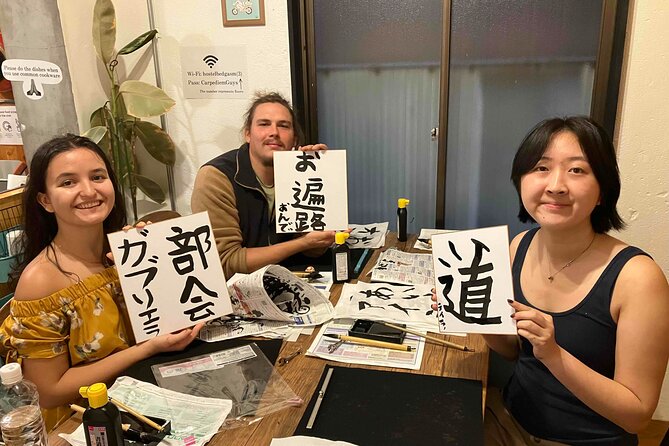
Japanese calligraphy here is more than copying a character onto paper. You learn how a brush is held, how your posture affects the stroke, and why a simple line can look graceful or clumsy. Then you write your name in Japanese or choose a favorite word in kanji. Your finished piece becomes a useful souvenir, not another mass-produced trinket.
I like the small maximum group of five, which gives the teacher time to correct your hand and brush angle. I also like the location: only a five-minute walk from Iriya Station, with Asakusa and Ueno nearby for a fuller afternoon. The main consideration is the setting. The class takes place in a hostel or shared lodging space, and one account describes interruptions from people using the kitchen and laundry area.
In This Review
- Key points to know before booking
- What the 90-minute shodo class actually gives you
- Starting with brush, posture, and basic lines
- Choosing between hiragana, katakana, and kanji
- Teachers Sachie and Zuisen shape the experience
- The hostel setting: useful, informal, and not perfectly quiet
- Why the location works well with a day in Taito
- The value of a $33.03 cultural activity
- Who will enjoy this activity most
- Practical details that affect your visit
- How this compares with other Tokyo souvenirs
- Should you book the Tokyo Iriya Shodo Club?
- FAQ
- How long does the calligraphy experience last?
- How much does the experience cost?
- Where does the calligraphy class meet?
- How far is the meeting point from public transportation?
- Does the activity finish at the meeting point?
- How many people can join the class?
- Are calligraphy supplies included?
- Can I write my name in Japanese?
- Who teaches the class?
- Can I cancel for a full refund?
Key points to know before booking
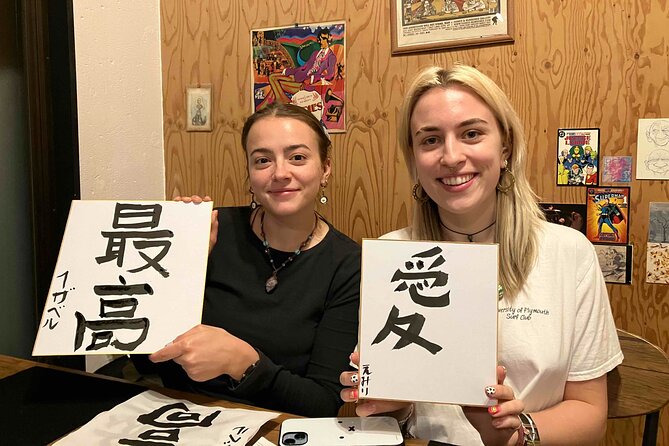
- Write your own name or favorite word: You choose the final subject instead of receiving a fixed classroom assignment.
- Teachers include Sachie and Zuisen: Both are described as patient, friendly, and able to explain the art in English.
- Practice comes before the souvenir: The lesson covers brush grip, posture, basic shapes, hiragana, katakana, and kanji.
- Very small class size: No more than five people can join, and some sessions may be nearly private.
- Convenient Taito location: The club is a five-minute walk from Iriya Station, near both Asakusa and Ueno.
- Supplies and take-home artwork included: You do not need to bring calligraphy tools, and your finished work goes home with you.
What the 90-minute shodo class actually gives you
Shodo means Japanese calligraphy, but this class is not designed to turn you into a professional calligrapher in an hour and a half. It gives you a clear introduction to the discipline and lets you produce one personal piece under guidance.
That distinction matters. You will not simply sit down, copy a symbol once, and leave. The session begins with the physical basics. You learn how to hold the brush, how to sit or stand with suitable posture, and how to draw the first lines. These small details are the foundation of the art, and they also make the activity accessible if you have never handled a calligraphy brush.
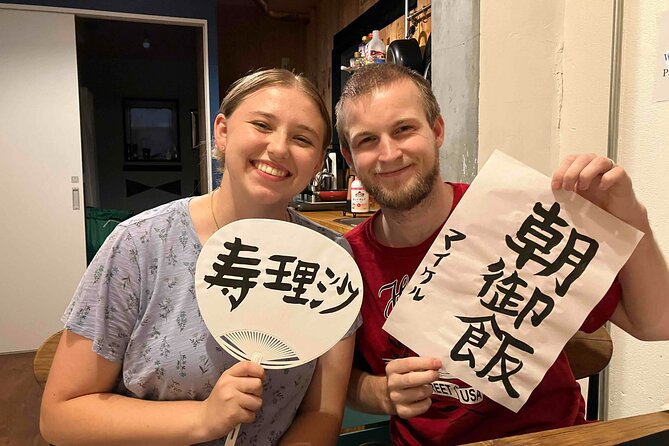
The lesson then moves toward Japanese writing. You may work with hiragana, katakana, and kanji, depending on your interests and the direction of the teacher. If you want to write your name, katakana is often the relevant choice for foreign names. You can also select a favorite word in kanji, though a more complicated word may require extra help and practice.
At the end, you write your chosen name or word on a nice cardboard autograph board to take home. The final piece may not look like professional Japanese calligraphy, and that is part of its charm. It records your hand, your choice of word, and the small lessons you picked up along the way.
More calligraphy tables:
- Tokyo: Calligraphy on Kanji Fan & Scroll with Drink
★ 5.0 · 210 reviews - Let’s experience calligraphy in YANAKA, Taito-ku, TOKYO !!
★ 5.0 · 127 reviews - Tokyo: Calligraphy Workshop & Original T-Shirt Creation
★ 4.9 · 105 reviews
Starting with brush, posture, and basic lines
The early part of the class may seem simple, but it is where the real value lies. A brush behaves differently from a ballpoint pen. Pressure, speed, angle, and the amount of ink all affect the result.
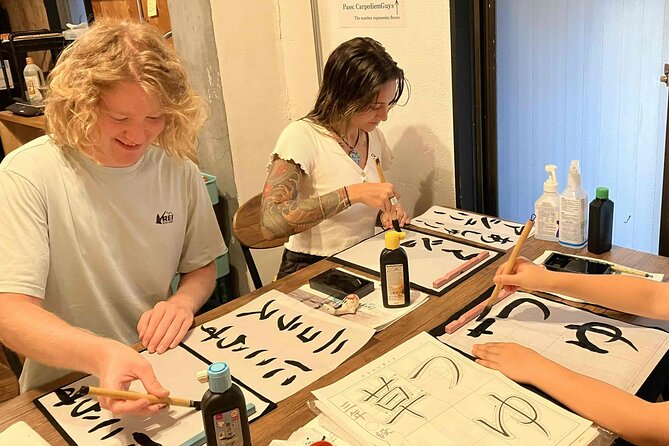
You begin by learning the correct grip. The teacher can watch your hand and offer corrections that are hard to make by reading a guidebook. You also practice posture, which helps you control the brush instead of letting your wrist do all the work.
Basic lines follow. You practice shapes and strokes before attempting a full word. This gives you room to make mistakes without sacrificing your final artwork. It also helps you see why Japanese characters are built from carefully ordered marks rather than loose decorative squiggles.
I like this gradual approach for first-time visitors. It gives you something to do with your hands from the start, while the teacher explains the cultural side in practical terms. You are not expected to arrive knowing Japanese.
Choosing between hiragana, katakana, and kanji
Japanese uses several writing systems, and the class offers a friendly introduction to the differences. Hiragana and katakana are phonetic scripts. Kanji characters carry meaning and can look especially striking on a finished board.
For a foreign name, katakana is likely to be the most useful route. One participant wrote a name in katakana and found that Google Translate recognized it, a small but satisfying test of whether the characters had been formed clearly enough.
A favorite word in kanji can make a more artistic souvenir. Keep in mind that some words are much more complicated than others. One person chose knitting, which involves difficult characters, and found the challenge worthwhile. If you want an easier session, ask the teacher to help you select a word with a manageable number of strokes.
The important point is that you have a personal choice. You are not all producing the same character, so the finished work has a connection to your own trip.
Teachers Sachie and Zuisen shape the experience
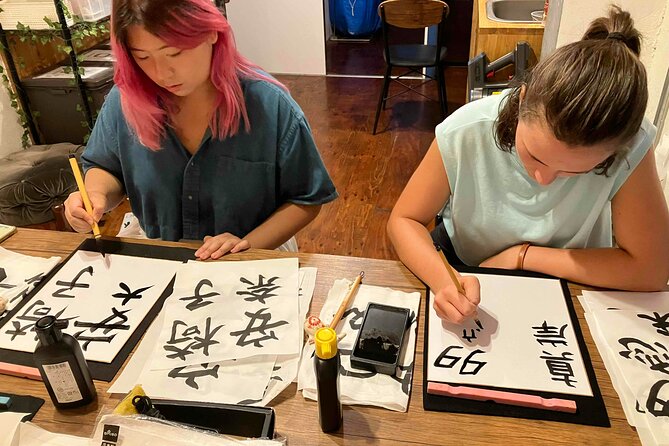
The teacher is central to this activity. Sachie is described as kind, patient, and engaging, with a strong desire to share the art. That combination matters when the class includes complete beginners, including people who do not consider themselves artistic.
Zuisen is also described as patient, clear in English, and skilled at explaining the practice. You should expect an instructor who works directly with you rather than giving a long speech and leaving you alone with the brush.
The small class limit helps. With a maximum of five people, the teacher can watch individual strokes and give corrections. One session had only one student, creating a personal lesson. Another had four people in a cozy classroom setting.
I would choose this activity for the quality of instruction rather than for a grand venue. The appeal is the close attention, the chance to ask questions, and the relaxed pace. If your group includes children or adults who are nervous about art, a patient teacher can make the difference between frustration and fun.
A few more Tokyo bookings worth comparing
- Mt Fuji and Hakone 1-Day Bus Tour Return by Bullet Train
★ 5.0 · 26,383 reviews - 1-Day Tokyo Bus Tour
★ 5.0 · 14,250 reviews - Tokyo: TOKYO SKYTREE® Admission ticket
★ 4.5 · 11,192 reviews - Tokyo: teamLab Planets TOKYO Digital Art Museum Entry Ticket
★ 4.6 · 9,779 reviews
The hostel setting: useful, informal, and not perfectly quiet
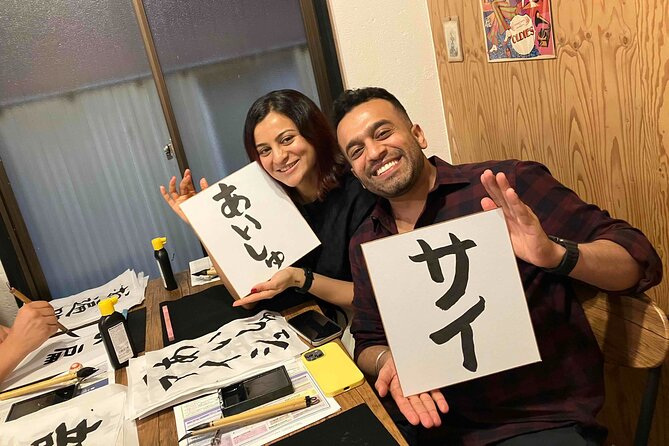
The meeting point is Tokyo Iriya Shodo Club, at 2-chome 29-2, second floor, in Iriya, Taito City. The club is close to public transportation and about a five-minute walk from Iriya Station.
The setting has an informal feel. The class may take place in a hostel kitchen or shared lodging area, and this can make the experience feel more like a local introduction than a formal tourist attraction. One account described a cozy classroom in an old-style lodging setting, with the atmosphere of an actual Japanese language school.
There is also a clear drawback. Shared spaces are shared spaces. Someone may be cooking, washing clothes, or moving through the area while the class is under way. One participant found these interruptions distracting and felt they reduced the sense of occasion.
I would set your expectations accordingly. Book this for the instruction and the hands-on work, not for a silent studio or polished cultural center. If a quiet, carefully staged environment is essential to you, this may not be the best match.
Why the location works well with a day in Taito
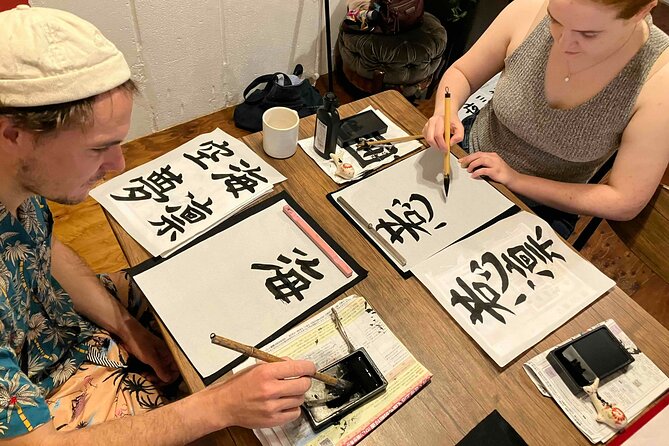
Iriya is a practical base for combining calligraphy with sightseeing. The club is near Asakusa and Ueno, so you can build the class into a day in Taito rather than making a separate trip across Tokyo.
A 90-minute activity is long enough to learn the basics but short enough to fit around other plans. You might schedule the lesson before exploring the nearby area, or use it as a slower break after sightseeing. The activity ends back at the meeting point, so you know where you will finish.
The location is especially useful if you want a cultural activity away from the biggest tourist crowds. The supplied information does not promise a tour of Iriya, Asakusa, or Ueno, so plan to explore those areas independently. Save extra time if you want to pair the lesson with local streets, shops, or major sights nearby.
The mobile ticket is convenient, and confirmation arrives when you book. You should still allow enough time to find the second-floor meeting point, especially if the class is held within a hostel. The activity description notes that you may need to ask inside the hostel.
The value of a $33.03 cultural activity
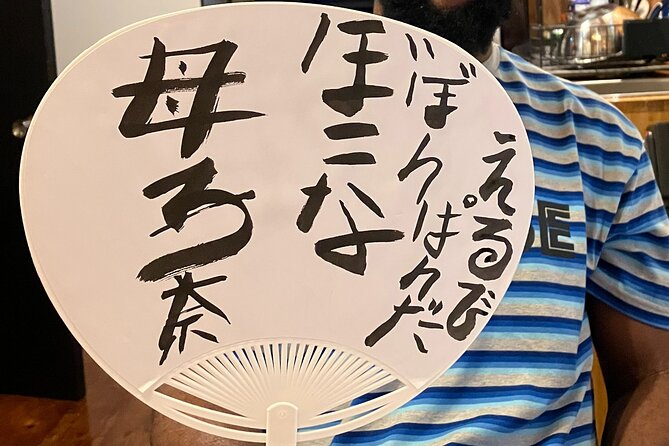
At $33.03 per person, this is priced as an affordable hands-on introduction rather than a premium private workshop. Your supplies are included, so you are not paying extra for brushes, ink, paper, or the board used for your final work.
The strongest value comes from the combination of teaching and a personal souvenir. A quick photo stop costs less, but it does not give you a new skill or an artwork made by your own hand. A longer specialist class might offer more technical training, but it would also demand more time and probably more patience.
The small group size improves the value. If five people attend, you still have a better chance of receiving personal guidance than in a large classroom. If fewer people attend, the instruction may feel close to private without the cost of a private booking.
I would not book this expecting a finished piece worthy of a gallery wall. Book it for the story behind the piece. The slightly uneven stroke may be exactly what reminds you of your time in Tokyo.
Who will enjoy this activity most
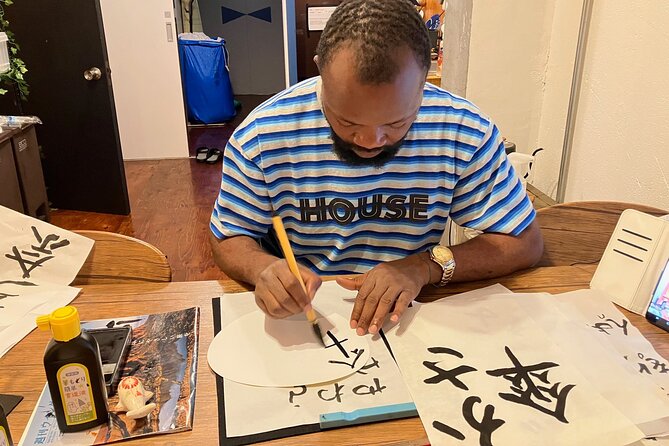
This class suits first-time visitors who want an activity with a clear local connection. You do not need prior Japanese language or art experience. The lesson starts with the basics, and most people can participate.
Families can also find it appealing. The session gives everyone a task, and each person can choose a name or word. The reported experience of a family with Sachie points to an engaging lesson that works well for different ages, though the supplied information does not specify a minimum age.
Solo visitors should not dismiss it. A one-person booking may turn into a personal lesson, giving you plenty of time to ask about the writing systems and refine your final piece.
It may be less suitable if you want a silent, highly formal ceremony, a long historical lecture, or a broad tour of Japanese arts. This is a focused workshop. You learn the mechanics of the brush, practice characters, and make one take-home item.
Practical details that affect your visit
The activity lasts about one hour and 30 minutes. That is enough time for instruction and practice, but you should not expect mastery. The session is best approached with curiosity and a willingness to repeat the same stroke several times.
Calligraphy supplies are included. You only need to arrive ready to work carefully and accept that the first attempts may look rough. Wear nothing special based on the information provided, but remember that calligraphy uses ink and a brush, so sensible travel clothing is always a good idea.
The meeting point is near public transportation. The exact address is Tokyo Iriya Shodo Club, Japan, 110-0013, Tokyo, Taito City, Iriya, 2-chome 29-2, second floor. The activity returns to this same point.
The maximum group size is five. Confirmation is provided at booking, and free cancellation is available if you cancel at least 24 hours before the local start time. Changes or cancellations within 24 hours are not accepted for a refund.
How this compares with other Tokyo souvenirs
Tokyo offers endless ready-made souvenirs. Calligraphy gives you something different: a souvenir that includes a lesson, a little effort, and your own handwriting.
The final board is light and easy to carry. That is useful near the end of a trip, when you may not want another bulky purchase. You also get a chance to choose the meaning, rather than accepting a generic Tokyo design.
The cultural value is modest but real. In 90 minutes, you learn that Japanese writing is not one single alphabet and that the appearance of a character depends on controlled brush movement. You will leave with an introductory understanding, not expert command, but that is plenty for a short holiday activity.
I especially like the way the class connects language and physical movement. Writing your name in katakana makes Japanese script personal. Choosing kanji turns a favorite word into a visual object. That connection is harder to get from a museum display or a souvenir shop.
Should you book the Tokyo Iriya Shodo Club?
Book it if you want a short, personal, hands-on cultural activity near Asakusa and Ueno. The $33.03 price includes materials, instruction, and a take-home board, while the five-person limit gives the lesson a friendly scale.
The strongest reasons to go are the patient teachers, the choice of your own name or word, and the chance of receiving close guidance in English. Sachie and Zuisen are both associated with calm, encouraging instruction, which is valuable for beginners.
Think twice if you need a quiet, purpose-built studio. The hostel or shared-space setting can bring interruptions, and that is the one notable weakness. For most people, though, the relaxed setting is a fair trade for the accessible price and personal teaching.
I would book this as a memorable break from sightseeing, then leave time to explore Taito on your own. You may not become a calligrapher in one session, but you will understand the brush a little better and carry home something only you could have made.
FAQ
How long does the calligraphy experience last?
The activity lasts approximately one hour and 30 minutes.
How much does the experience cost?
The listed price is $33.03 per person.
Where does the calligraphy class meet?
It meets at Tokyo Iriya Shodo Club, Japan, 110-0013, Tokyo, Taito City, Iriya, 2-chome 29-2, second floor.
How far is the meeting point from public transportation?
The club is about a five-minute walk from Iriya Station.
Does the activity finish at the meeting point?
Yes. The activity ends back at Tokyo Iriya Shodo Club.
How many people can join the class?
The activity has a maximum of five participants.
Are calligraphy supplies included?
Yes. Calligraphy supplies are included in the experience.
Can I write my name in Japanese?
Yes. You can write your name in Japanese, including using katakana, or choose a favorite word in kanji.
Who teaches the class?
Teachers include Sachie and Zuisen. The experience information describes them as patient, friendly, and able to provide instruction in English.
Can I cancel for a full refund?
Yes, if you cancel at least 24 hours before the experience start time. Cancellations or changes made less than 24 hours before the local start time are not eligible for a refund.
New on our Tokyo list
- From Tokyo: Mount Fuji & Hakone Full Day Private Tour★ 4.9 · 25 reviews
- Tokyo Spectacular View Day-Cruise in 90 Minutes★ 5.0 · 25 reviews
- Real Tokyo Runner Club : Daikoku Car Meet Night Tour with JDM Car★ 5.0 · 25 reviews
- 2.5 Hour-Guided Cycle Tour in the Central Tokyo★ 5.0 · 25 reviews
- Ramen Making from Scratch +Akihabara Tour –Cooking Class★ 5.0 · 25 reviews
- [Self-Drive] Tokyo & Daikoku Custom Car Driving Tour★ 4.9 · 25 reviews
- Tokyo: 2-Hour Night Bike Tour of the City’s Hidden Gems★ 4.9 · 25 reviews
- Samurai themed Entertainment show in Shinjuku★ 4.5 · 25 reviews
Japanese Calligraphy Classes, compared.
Let’s experience calligraphy in YANAKA, Taito-ku, TOKYO !!
Read our review →
Calligraphy Workshop & Original T-Shirt Creation
Read our review →
Calligraphy Workshop & Original T-Shirt Creation
Read our review →
Calligraphy &Make your original folding fan in Asakusa
Read our review →
Tokyo Asakusa:Calligraphy & Make T-shirt Activity
Read our review →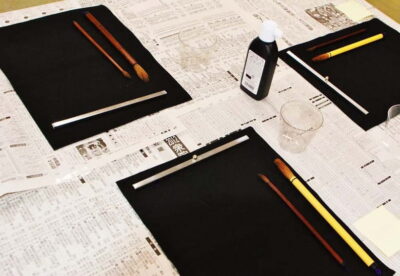
Calligraphy Workshop Craft Your Own Art in Asakusa
Read our review →Browse the lists this tour appears in