
Reviewed · JAPANESE CALLIGRAPHY CLASSES
Tokyo:Calligraphy &Make your original folding fan in Asakusa
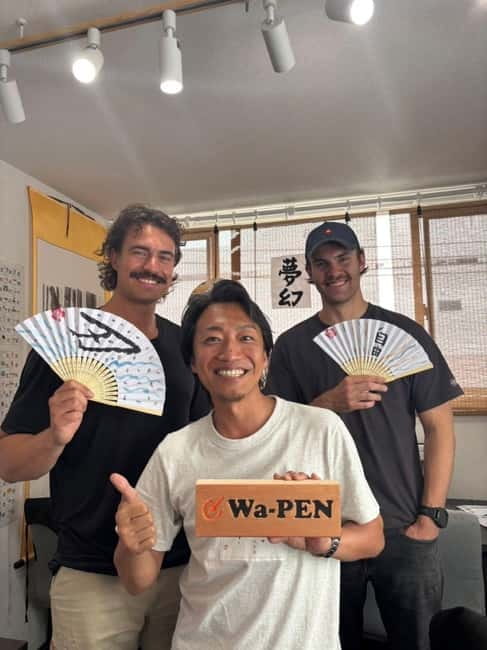
Japanese calligraphy becomes much more personal when your final work goes onto a folding fan. In this Asakusa workshop, you learn the basics from Mana, practice on thin paper, then create a souvenir that carries a word, name, or idea you chose yourself.
I like the calm pace and the chance to practice until your writing feels right. I also like the small postcard ritual: you write about your experience, then receive a reminder of Tokyo after you return home. The main thing to consider is ink. Wear clothes that can handle a splash, even though aprons are provided.
In This Review
- Key points to know before booking
- Why this Asakusa calligraphy class feels different
- From solid ink to the first brush stroke
- Choosing a word, name, or design
- Creating the original folding fan
- Green tea and a postcard to your future self
- The instructor and the pace of the lesson
- Who will enjoy this experience most
- Location, timing, and practical value
- What to bring and what to expect
- Should you book the Asakusa calligraphy workshop?
- FAQ
- How long does the calligraphy and fan activity last?
- How much does the experience cost?
- Is the activity taught in English?
- What will I learn during the session?
- Is the folding fan included?
- Can I print my calligraphy on a T-shirt?
- What should I wear?
Key points to know before booking
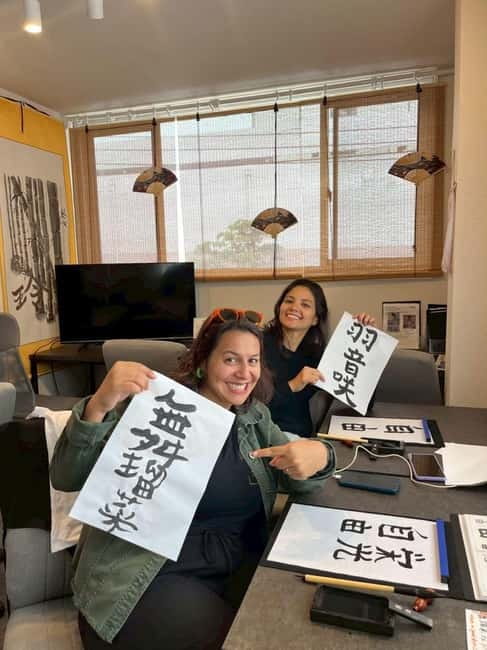
- Make a fan you actually design: Choose a favorite sample or ask Mana for help with a custom idea.
- Start with the basics: Learn posture, brush handling, ink control, and about eight fundamental techniques.
- Use traditional ink: You melt a solid ink stick with water instead of simply reaching for a ready-made bottle.
- Take your time: The formal session lasts from 30 to 90 minutes, with practice before the final piece.
- Add a quiet memory: Green tea and a postcard to yourself give the activity a thoughtful finish.
- Expect English instruction: Mana teaches in English and explains both calligraphy and Japanese writing culture.
Why this Asakusa calligraphy class feels different
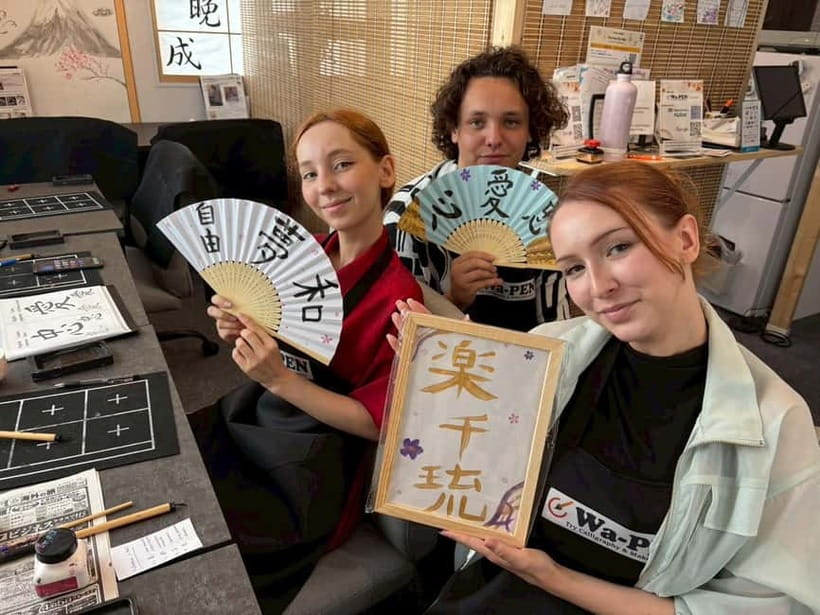
Many souvenir activities give you something to buy. This one asks you to make something slowly. That difference matters.
You begin by learning what Japanese calligraphy is trying to express. The session introduces the history of the art, the role of hiragana, and the way Japanese writing connects with daily life. This is not a full academic lesson, but it gives your brushwork some context. You are not simply copying an attractive character without knowing why it matters.
The workshop also covers posture and attitude. That may sound formal, but it is useful. A relaxed grip, steady position, and proper brush angle help you control the ink. You quickly discover that calligraphy is less about producing a perfect first stroke and more about repeating a movement until it feels natural.
That makes the class a good break from the hard walking and visual overload of Tokyo. You sit, concentrate, and work with one small set of tools. Several people have found it especially relaxing, and I can see why. The activity gives you a clear task without rushing you through a crowded attraction.
More calligraphy tables:
- Tokyo: Calligraphy on Kanji Fan & Scroll with Drink
★ 5.0 · 210 reviews - Let’s experience calligraphy in YANAKA, Taito-ku, TOKYO !!
★ 5.0 · 127 reviews - Experience all of Japanese culture and Japanese food experience classes “origami, udon, Japanese food, green tea, calligraphy” in 4 hours
★ 5.0 · 105 reviews
From solid ink to the first brush stroke
A particularly nice touch is the traditional ink preparation. Rather than beginning with premixed ink, you use water to melt an ink stick. The process connects the finished character with the materials beneath it. It also slows the start of the class in a useful way.
Mana then shows you how to hold the fude, the Japanese brush, and how much ink to load onto it. Too little ink leaves a weak line. Too much can make the stroke spread or lose its shape. Those small adjustments are part of the lesson, and they are easier to understand when you see them demonstrated in front of you.
You practice about eight basic techniques with guide paper. The guide sheets give your brush a path to follow, so you are not expected to produce polished calligraphy from scratch. This is important for beginners, children, and anyone who has never used a Japanese brush.
The practice stage takes about 30 minutes, although the full experience may run from 30 to 90 minutes depending on the option and how long you work. That range is worth noting when planning your day. If you want only a short introduction, you may be finished quickly. If you want to repeat strokes and refine your final design, allow more time.
Choosing a word, name, or design
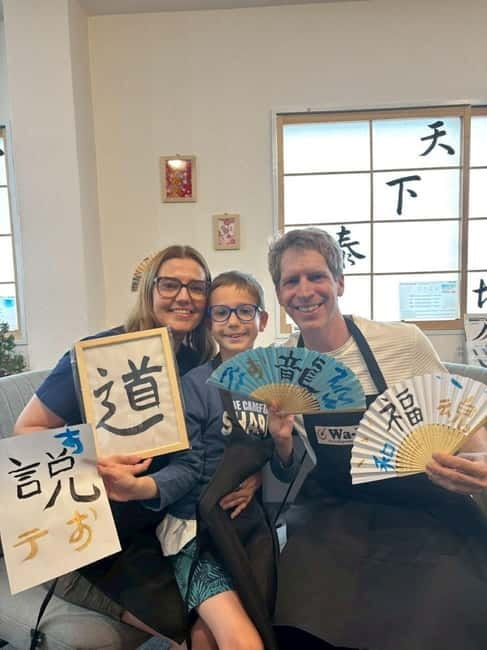
Once you understand the basic movements, you choose what to put on your final work. You can select a design from a sample book or ask the instructor to help create something suited to you.
One popular choice is a name written in kanji. You can also work with a kanji character that carries a personal meaning. The activity introduces the meaning behind Japanese writing, so this is a good moment to ask about the character you choose rather than selecting one only because it looks attractive.
Hiragana also receives attention. Hiragana is the rounded Japanese syllabary used throughout everyday writing, while kanji characters carry meanings and come from Chinese writing traditions. You do not leave as a calligraphy expert, but you gain a clearer sense of why Japanese writing has different systems and how they fit into modern life.
This personal choice is what gives the souvenir weight. A fan decorated with a word connected to your trip will mean more than a generic item picked up in a shop. You may still produce a few uneven lines. That is part of the charm. The aim is not museum-quality work. It is to make something that shows your hand.
Creating the original folding fan
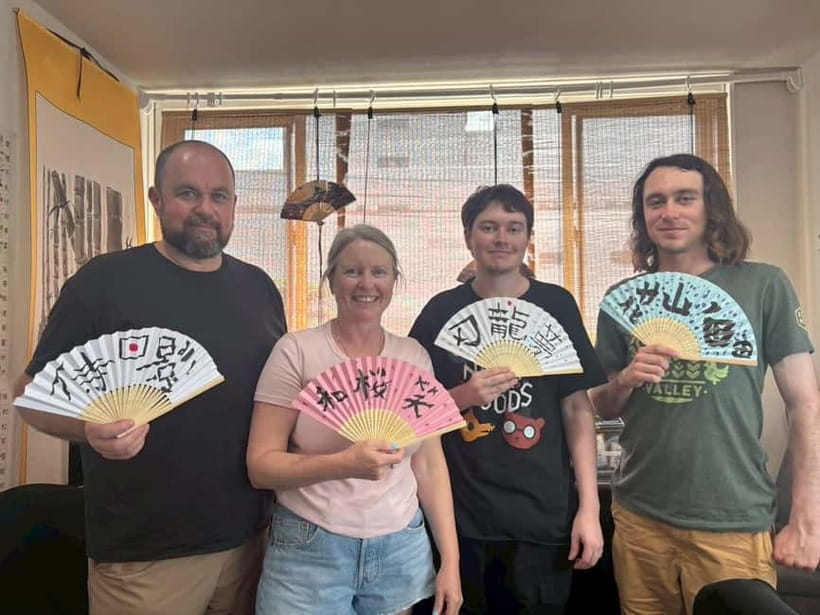
The fan is the main payoff. After practicing on thin paper, you select your preferred result and use your calligraphy for the final design. The exact appearance will depend on the character, your brushwork, and the design options available when you visit.
You are encouraged to continue practicing until you are satisfied. That makes the experience more forgiving than a one-shot craft class. You can test a character, compare strokes, and ask Mana for corrections before committing to the final version.
If you are visiting with a companion, this part can be fun to compare. One person may choose a name, while another picks a word such as peace, strength, or travel. Families can work at different levels, too. A six-year-old has enjoyed the activity with a parent, while older visitors have appreciated the patient instruction and slower pace.
The included fan is a practical souvenir. It is light, easy to pack, and connected directly to the time you spent in Asakusa. If you want to print your calligraphy on a T-shirt, that is a separate option. The T-shirt is not included, and you may buy one at the shop if you choose that add-on.
Be clear when booking: the henna tattoo option does not include the calligraphy experience. If calligraphy is your goal, select the calligraphy and fan activity rather than the henna option.
More Asakusa visits:
- Tokyo: Japanese Dance Cabaret Theater Asakusa-Kaguwa Ticket
★ 4.8 · 2,270 reviews - Tokyo: Meiji Shrine, Asakusa, Skytree Bus Tour and Cruise
★ 4.7 · 1,986 reviews - Tokyo: Roll and Authentic Sushi Making Class in Asakusa
★ 4.9 · 1,957 reviews - Tokyo: Asakusa Walking Tour with Sensoji Temple Visit
★ 4.8 · 1,583 reviews
Green tea and a postcard to your future self
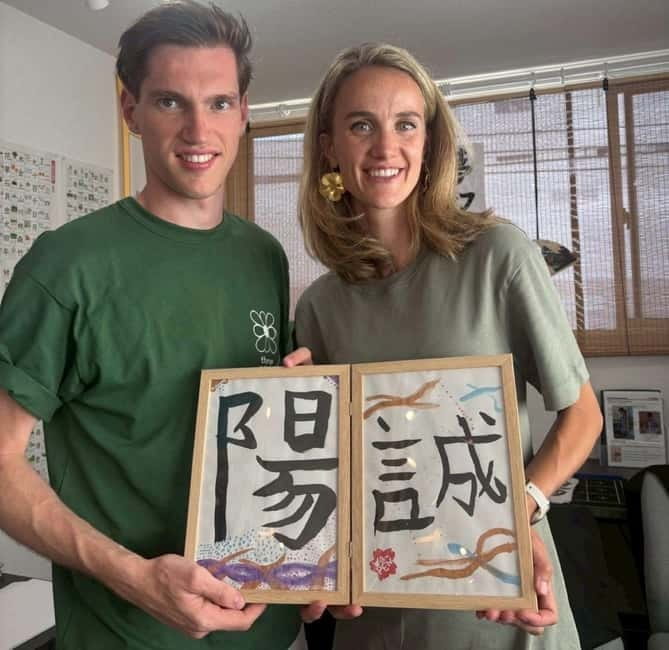
The workshop ends with green tea and a postcard. The tea gives you a gentle pause after the concentration of brushwork. Food and drinks are not allowed during the working session, so this refreshment belongs at the end rather than beside your ink tray.
The postcard is an unusually thoughtful detail. You write about how the calligraphy felt and what you want to remember from your trip. It is addressed to yourself at home, turning the experience into a delayed souvenir. When it arrives later, the postcard can bring back the small details that photographs often miss.
This part works best if you take a minute to write something specific. Mention the word you chose, the difficulty of controlling the brush, or the feeling of sitting quietly in Asakusa. You do not need a long message. A few honest lines will do the job.
Several people have also appreciated the instructor’s local suggestions. Mana has offered ideas for food and things to do in Tokyo, including advice for visitors heading toward Senso-ji. That can be useful if you schedule the class near the start or end of your Asakusa visit.
The instructor and the pace of the lesson
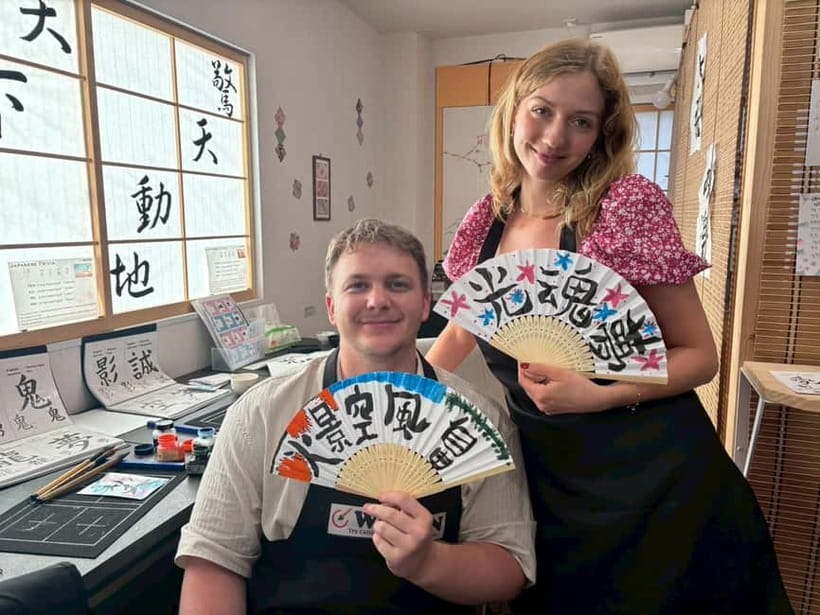
Mana is the key to the experience. She teaches in English, explains the steps clearly, and adjusts her help to your level. Beginners receive guidance on the strokes, while more confident students can spend longer refining their work.
Her patience comes up again and again in the experience feedback. That matters because calligraphy can feel awkward at first. A brush does not behave like a pencil, and your first attempts may look nothing like the sample. An instructor who lets you practice rather than rushing you makes the class much more enjoyable.
The pace is also flexible in practice. Some people have been allowed extra time to finish their calligraphy, while others have completed the activity within the shorter time frame. Do not treat the 30-minute minimum as a promise that every visit will follow the same exact schedule. Your selected option, the number of people attending, and your own practice time can affect the length.
One small practical improvement would be a towel for cleaning hands. Aprons are ready, but ink can still make your fingers messy. Bring comfortable clothing that can tolerate a mark, and wash or dry your hands before handling your phone or camera.
Who will enjoy this experience most
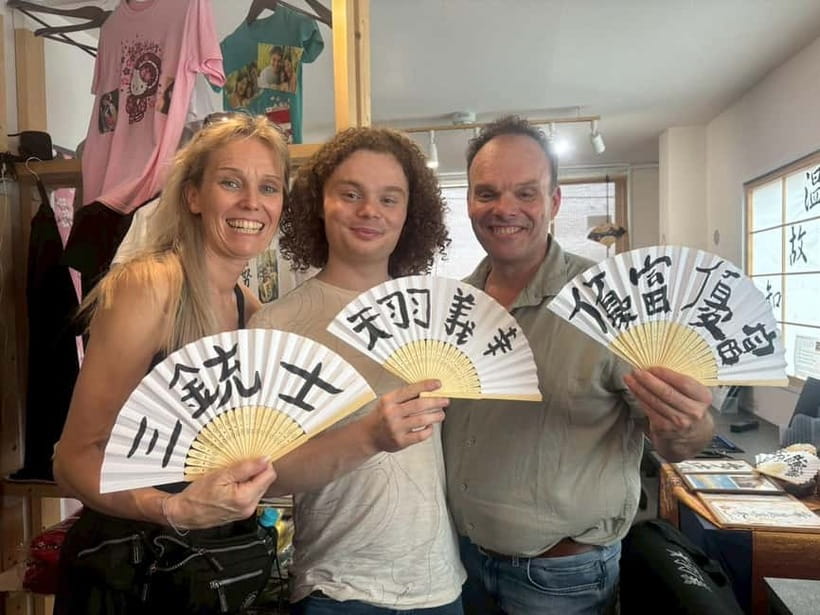
I would recommend this workshop to you if you want a hands-on Tokyo souvenir rather than another purchased object. It suits first-time calligraphy students because the guide sheets and demonstrations remove much of the pressure.
It also works well for families. Children can practice simple strokes, learn about Japanese names, and make a fan they helped create. The session requires some sitting still and attention, so a child who dislikes quiet activities may need encouragement.
Couples and friends can enjoy the shared process without needing the same design. One person can focus on kanji while the other works with hiragana or a personal name. Solo visitors may find the class especially comfortable because the instructor can give focused help.
I also see value for older adults and anyone who wants a slower afternoon. One family brought a grandmother who had always liked calligraphy but had never taken a proper class. The simple structure lets you participate without needing previous art experience.
This is not the best choice if you need wheelchair access. The activity is listed as unsuitable for wheelchair users. You should also avoid booking it if you are looking for a fast, high-energy attraction. The pleasure comes from repetition, attention, and making peace with imperfect strokes.
Location, timing, and practical value
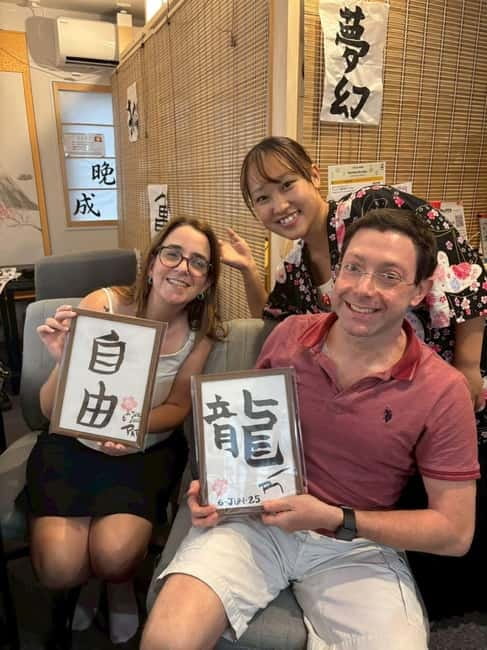
The workshop is in Asakusa, with the meeting point varying by the option you book. The supplied location coordinates are 35.7162239, 139.7922354, but check your exact meeting instructions before setting out.
Asakusa is a sensible area for this activity because you can pair it with a visit to Senso-ji and nearby sights. One useful approach is to schedule calligraphy during the hottest part of the day, then continue sightseeing afterward. The indoor class provides a welcome pause from Tokyo’s summer heat and crowded streets.
The price is $16 per person. For that amount, you receive instruction, practice materials, traditional ink preparation, the calligraphy activity, a folding fan, green tea, and the postcard. That is strong value if you want both a cultural introduction and a handmade keepsake.
The value is less clear if you only want a quick photograph or a souvenir with no personal effort. In that case, a shop purchase will be faster. Here, you are paying for time with an instructor and the chance to make several attempts before choosing your final work.
Cancellation is flexible: you can cancel up to 24 hours ahead for a full refund. You can also reserve and pay later, which helps if your Tokyo schedule is still shifting. Starting times vary, so check availability for the day you want.
What to bring and what to expect
Wear comfortable clothes and use the apron provided. Ink is the only real mess concern, but it is a sensible one. Avoid bringing pets, although assistance dogs are allowed.
You cannot eat or drink during the active session. The included green tea comes later, after the brushwork is complete.
The class is conducted in English. If you want a specific kanji for your name or a meaningful word, think about that before you arrive. You can still choose from the sample book, but having an idea ready gives you more time to discuss the design and practice it.
Do not expect every final stroke to look like the instructor’s. The value is in learning how the brush moves and in taking home something made by you. A slightly irregular character can be a better memory than a flawless printed souvenir.
Should you book the Asakusa calligraphy workshop?
Book it if you want a calm, affordable activity with a personal result. The fan, postcard, and green tea make the session feel more complete than a basic brush lesson, while Mana’s patient English instruction helps beginners feel at ease.
I would especially choose it for a hot afternoon, a family outing, a couple’s activity, or a final-day experience that gives you a physical reminder of Tokyo. The $16 price is easy to justify when you include the materials and finished fan.
Skip it if you need wheelchair access, dislike careful handwork, or want a major sightseeing attraction rather than a seated craft. For everyone else, this is a small but meaningful way to slow down in Asakusa and leave with a souvenir that cannot be exactly duplicated.
FAQ
How long does the calligraphy and fan activity last?
The experience lasts from 30 to 90 minutes. Available starting times and the exact duration depend on the option you select.
How much does the experience cost?
The listed price is $16 per person.
Is the activity taught in English?
Yes. The instructor provides English instruction.
What will I learn during the session?
You learn about Japanese calligraphy, hiragana, posture and attitude, brush handling, ink control, traditional ink preparation, and about eight basic techniques. You also practice with guide paper and create a custom design.
Is the folding fan included?
Yes. Making an original folding fan is part of the calligraphy experience.
Can I print my calligraphy on a T-shirt?
T-shirt printing is not included. You can buy a T-shirt at the shop if you want to use that separate option.
What should I wear?
Wear comfortable clothes that can get a little dirty from ink. Aprons are provided, but you should still avoid clothing you want to keep perfectly clean.
New on our Tokyo list
- Tokyo Spectacular View Day-Cruise in 90 Minutes★ 5.0 · 25 reviews
- From Tokyo: Mount Fuji & Hakone Full Day Private Tour★ 4.9 · 25 reviews
- Real Tokyo Runner Club : Daikoku Car Meet Night Tour with JDM Car★ 5.0 · 25 reviews
- 2.5 Hour-Guided Cycle Tour in the Central Tokyo★ 5.0 · 25 reviews
- Ramen Making from Scratch +Akihabara Tour –Cooking Class★ 5.0 · 25 reviews
- [Self-Drive] Tokyo & Daikoku Custom Car Driving Tour★ 4.9 · 25 reviews
- Tokyo: 2-Hour Night Bike Tour of the City’s Hidden Gems★ 4.9 · 25 reviews
- Samurai themed Entertainment show in Shinjuku★ 4.5 · 25 reviews
Japanese Calligraphy Classes, compared.
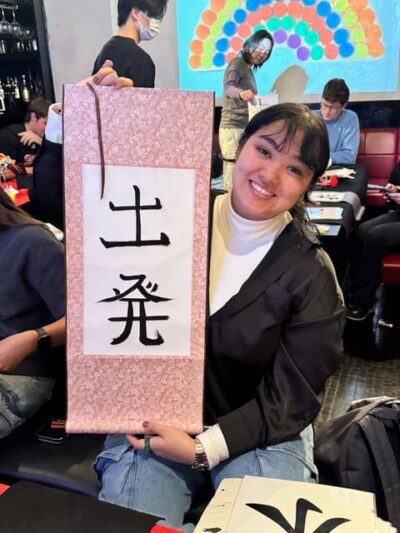
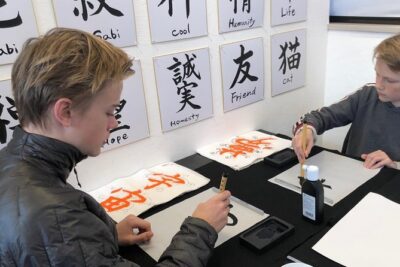
Let’s experience calligraphy in YANAKA, Taito-ku, TOKYO !!
Read our review →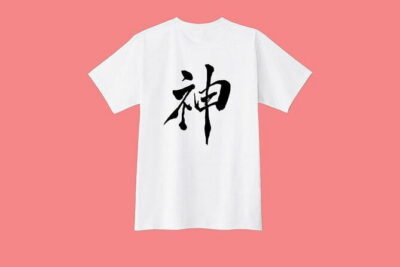
Calligraphy Workshop & Original T-Shirt Creation
Read our review →
Calligraphy Workshop & Original T-Shirt Creation
Read our review →
Tokyo Asakusa:Calligraphy & Make T-shirt Activity
Read our review →
Calligraphy Workshop Craft Your Own Art in Asakusa
Read our review →Browse the lists this tour appears in