
Reviewed · HIKING & TREKKING
Kamakura One Day Hike Tour with Government-Licensed Guide
Kamakura packs samurai history, Zen temples, shrines, wooded hills, and the sea into a compact day trip from Tokyo. The best part of this private tour is its flexibility: you choose three or four key sights, then add a hike or a special interest such as local history, old neighborhoods, or views from Enoshima.
I like the personal pace and the chance to work with a government-licensed English-speaking guide. Guide Shinji Komiyama has built particularly thoughtful days around a visitor’s interests, including Kamakura history, a good hike, and even a clear-weather view of Mount Fuji from Enoshima.
The catch is time. Six hours is enough for a well-chosen route in Kamakura, but not for every temple on the long menu. If you are coming from Tokyo, travel time can make the day feel short, and transportation, lunch, and entrance fees are not included.
In This Review
- Key points to know before booking
- What this Kamakura day is really designed to do
- The Great Buddha and Daibutsu Trail
- Tsurugaoka Hachimangu and the samurai story
- Zen temples in the northern hills
- Southern and eastern temples for a quieter route
- Hasedera, Meigetsuin, and the seasonal appeal
- Zeniarai Benten and the local side of Kamakura
- Enoshima and the Mount Fuji possibility
- How much value do you get for $153.50?
- Who will enjoy this walking tour most?
- Planning a better six-hour route
- Should you book the Kamakura One Day Hike Tour?
- FAQ
- How long does the Kamakura hiking tour last?
- How long is the Daibutsu hiking trail?
- Is this a private tour?
- How many sights can I choose?
- Is transportation included?
- Are entrance tickets included?
- Can the tour include Enoshima?
- Can I cancel for a full refund?
Key points to know before booking
- The 6-kilometer Daibutsu Trail links the Great Buddha area with Jochi-ji and passes through Kamakura’s wooded hills.
- You choose three or four sights, so the experience works best when you decide your priorities before meeting the guide.
- Shinji Komiyama is one named guide available for this experience, and he has tailored outings around history, hiking, photography, and local life.
- This is a private walking tour, not a bus tour, so only your group participates and the pace can be adjusted.
- The $153.50 price buys guiding and planning, but train fares, entrance tickets, lunch, and personal costs come separately.
- Rain can affect the trail. After wet weather, the path may be slippery, so sturdy shoes and sensible timing matter.
What this Kamakura day is really designed to do
Kamakura is not a single sight with a few nearby extras. It is a broad historic town where important temples and shrines sit among hills, narrow lanes, and coastal districts. That makes a private guide useful, but it also makes an unfocused itinerary a poor choice.
This tour gives you a meeting point at your hotel or the closest station within the designated Kamakura or Yokohama area. The pickup is on foot, and the day remains a walking experience from there. You are not being driven between sights.
The tour description offers a long menu of possible stops, but the included service is a customized route of three or four sites. That distinction matters. You should not expect to visit all 18 places in six hours. Instead, tell the guide what matters most: samurai history, Zen Buddhism, gardens, photography, a serious hike, the Great Buddha, or a quieter side of Kamakura.
I would contact the operator with your preferred start time, lodging location, and must-see places before the day begins. That gives the guide a chance to shape a route rather than spend the first part of the morning deciding what to do.
More Kamakura and Enoshima days:
- Private Car Tour to see Highlights of Kamakura, Enoshima, Yokohama from Tokyo
★ 5.0 · 48 reviews - Kamakura 6hr Private Walking Tour with Government-Licensed Guide
★ 5.0 · 42 reviews - Private Kamakura plus Yokohama Tour – English Speaking Driver
★ 4.5 · 28 reviews
The Great Buddha and Daibutsu Trail
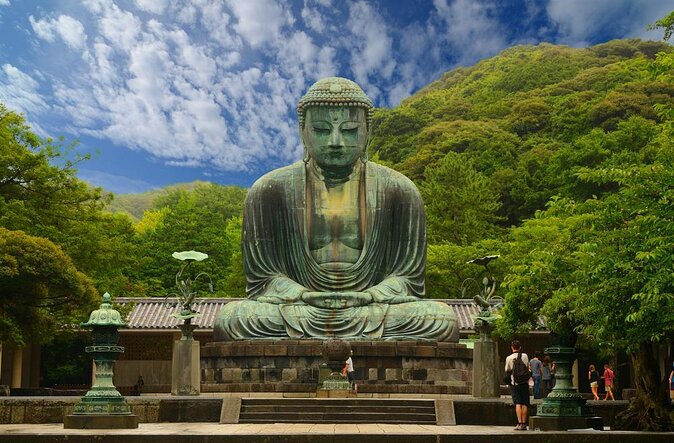
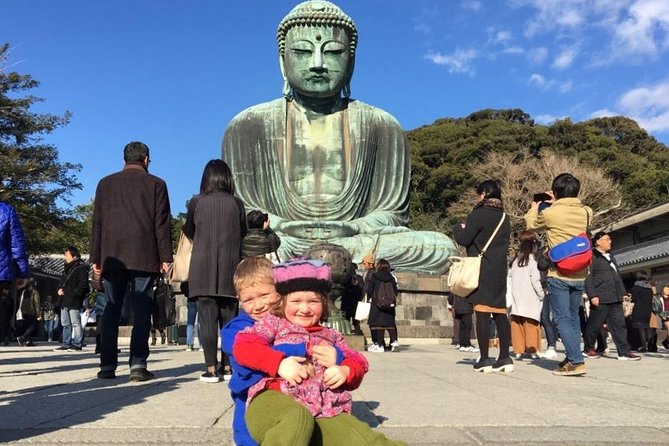
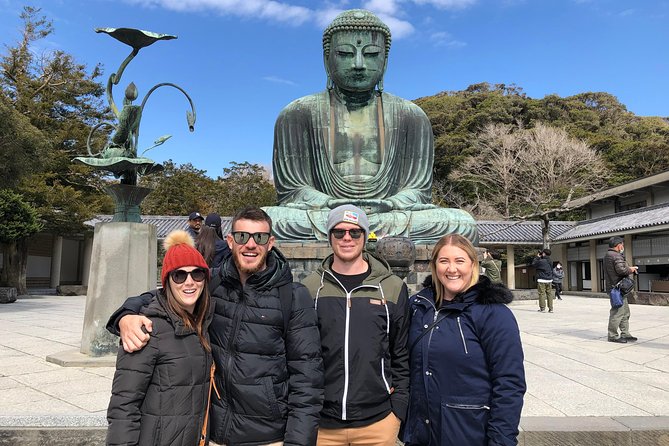
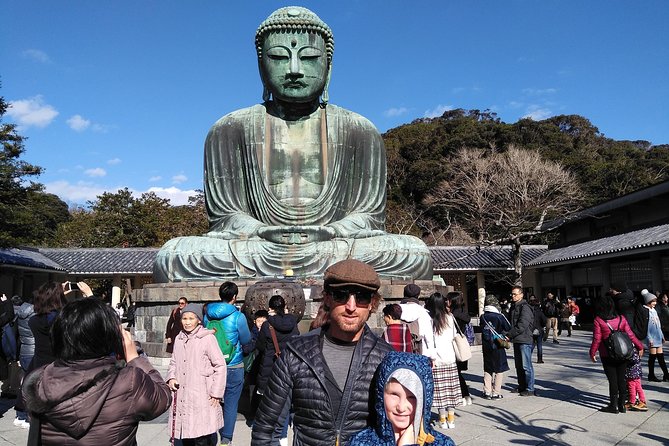
The clearest centerpiece is Kotoku-in, home of Kamakura’s bronze Great Buddha. The Amida Buddha measures 11.4 meters high and has long been Japan’s second-tallest Buddha statue. It is an impressive sight, but it is also a busy one, so a guide adds value by explaining its place in Kamakura’s religious and artistic story.
The listed stop gives only a short time at Kotoku-in, and the admission ticket is extra. That short duration should not be read as a promise that you will have a full temple visit there. Ask for more time if the Buddha is your main reason for coming.
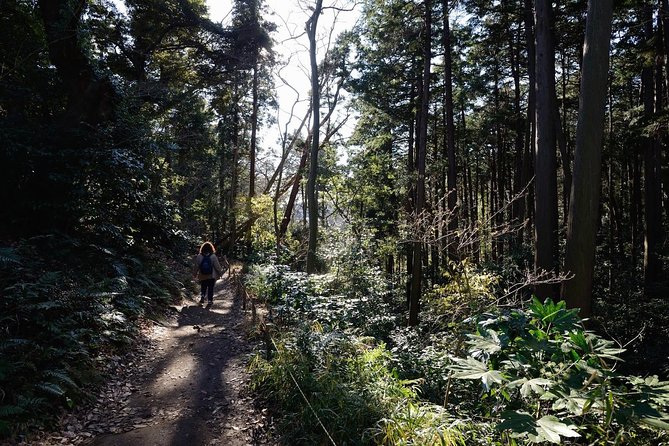
The Daibutsu Trail is the active heart of the outing. It runs about 3.7 miles, or 6 kilometers, between the Great Buddha area in the south and Jochi-ji Zen Temple toward the north. The route passes through wooded hills and links the town’s cultural sights with its natural setting.
I like this combination because the walk helps you understand Kamakura as a place surrounded by hills, not just a string of famous buildings. You move from major religious sites into quieter wooded sections, then back toward temples and neighborhoods.
The trail does require sensible preparation. A previous rainy day left the path slippery, even though the group completed the hike without trouble. Wear shoes with a firm sole, and do not treat this as a flat city stroll. If hiking is your main goal, tell the guide early so the rest of the itinerary does not crowd it out.
Tsurugaoka Hachimangu and the samurai story
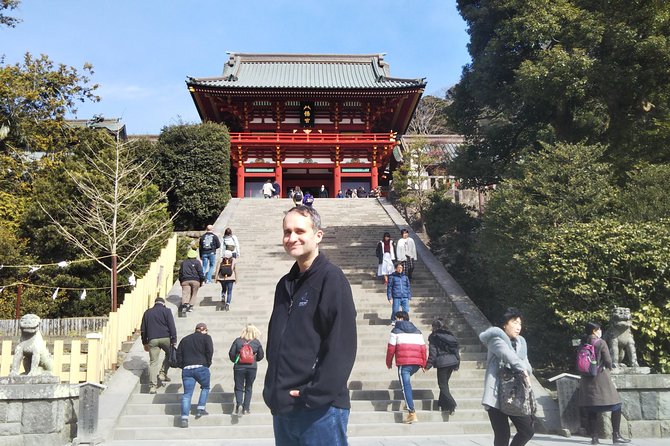
Tsurugaoka Hachimangu Shrine is a strong opening stop for visitors who want the political and military story of Kamakura. The shrine honors Hachiman, the patron deity of the Minamoto family and of the samurai more broadly. The older Emperor Ojin is identified with Hachiman, along with Hime-gami.
A half-hour visit can give you a useful introduction to the city’s connection with the Minamoto clan and the rise of the samurai government. This is not simply a pretty shrine stop. It helps explain why Kamakura became one of Japan’s key historic centers.
I would pair Tsurugaoka Hachimangu with the Great Buddha if you want a first visit that covers both power and faith. The shrine represents the warrior government and its patrons, while Kotoku-in gives you a major Buddhist monument.
The shrine has no admission fee listed here, but your overall day still includes other paid sites. Since the tour is private, you can ask the guide to spend more time on the historical connections instead of rushing through the grounds.
Zen temples in the northern hills
Kamakura’s five great Zen temples give the city much of its calm, wooded character. Several appear on the available list, but you should select carefully rather than attempt them all.
Engaku-ji is ranked number two among Kamakura’s five great Zen temples. It was founded in 1282 by Hojo Tokimune and is one of the leading Zen temples in eastern Japan. It is a sensible choice if you want a major temple with strong historical importance.
Kencho-ji ranks first among the five great Zen temples and was founded in 1253 during the Kencho Era by Hojo Tokiyori. The available schedule gives it only a short listed visit, so ask for more time if this is one of your priorities. Entrance is not included.
Jochi-ji ranks fourth and belongs to the Engaku-ji school of Rinzai Zen Buddhism. It is especially relevant if you plan to walk the Daibutsu Trail, since the trail runs toward the Jochi-ji area.
Jufuku-ji, ranked third, was established on the order of Hojo Masako, the wife of Minamoto Yoritomo. Tokei-ji is another Rinzai temple near Engaku-ji. Both can add depth to a Zen-focused day, but the short listed durations suggest that they work best as part of a route, not as major standalone visits.
Eisho-ji offers a different angle. It is the only surviving nunnery in Kamakura and was founded in the early Edo period by a woman connected with the Tokugawa family. If you want a less predictable historical stop, I would ask about including it.
More Yokohama outings:
- Authentic Sumo Experience in Tokyo: Enter the Sanctuary
★ 5.0 · 603 reviews - EVO, WRX, Skyline – JDM Night Run to Daikoku Car Meet
★ 4.9 · 478 reviews - Tokyo: Best Price Daikoku Parking Area JDM Car Meet
★ 4.9 · 192 reviews - Daikoku & Tokyo Private JDM Tour by 700HP R34 GT-R
★ 4.9 · 101 reviews
Southern and eastern temples for a quieter route
The tour can also move away from Kamakura’s best-known sights. That is where the private format earns its keep.
Ankokuron-ji is one of several Nichiren temples in the southeastern hills. Nichiren founded it around 1253 when he first came to Kamakura. Myohon-ji, also in the southeastern hills, was founded by Hiki Yoshimoto in 1260 and provides another Nichiren Buddhist stop.
Jomyo-ji is the fifth of Kamakura’s five great Zen temples. It sits in the eastern hills and was founded by the influential Ashikaga family. Zuisen-ji lies farther east, at the back of a narrow valley surrounded by wooded hills. It is a branch temple of Engaku-ji and can suit you if you want a more secluded setting.
These sites may appeal more than the headline attractions if you have already seen the Great Buddha or want a slower, less crowded day. The tradeoff is that you will not cover as many iconic sights. A guide can help you judge whether the extra travel and walking are worth it for your interests.
Hasedera, Meigetsuin, and the seasonal appeal
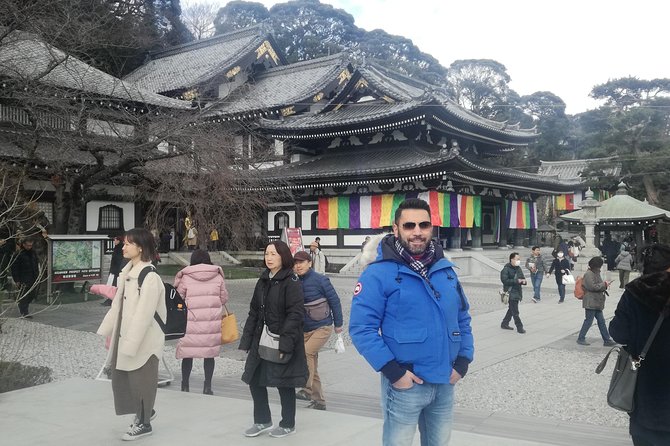
Hasedera is a Jodo temple famous for its eleven-headed Kannon, the Buddhist goddess of mercy. The gilded wooden statue is 9.18 meters tall and is one of the largest wooden sculptures of its kind. This is a good pick if you want religious art as well as temple grounds.
Meigetsuin is known as the Hydrangea Temple because hydrangeas bloom in abundance on its grounds. It was founded in 1160 and belongs to the Rinzai Zen sect. The name matters most if your visit matches the flowering season, but the temple also gives you another way to experience Kamakura’s Zen tradition.
Both temples require admission fees, and the short listed durations may not match your interests if you want time for careful photographs or a relaxed look around. Tell the guide if gardens or seasonal flowers are more important to you than a long hike.
Zeniarai Benten and the local side of Kamakura
Zeniarai Benten Shrine is one of Kamakura’s more distinctive stops. People visit to wash money in the shrine’s spring, following the belief that washed money will multiply. The practice gives the visit a playful, local character without needing a long explanation to make it memorable.
The shrine is in western Kamakura, and a half-hour visit is listed. It is a good choice for you if you want something beyond major temples and formal historical sites. It also fits nicely into a day that mixes religion, custom, and daily life.
The guide’s role here is less about rushing you through a checklist and more about explaining what you are seeing and why people come. That kind of context is especially useful at a small shrine, where the meaning may not be obvious at first glance.
Enoshima and the Mount Fuji possibility
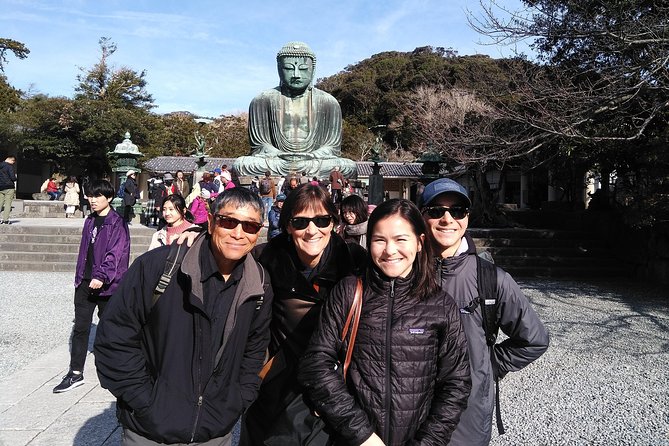
Enoshima is a short train ride west of Kamakura. The island is linked to the mainland by a bridge and offers a shrine and other attractions. Its character is more tourist-oriented than the wooded temple districts, so it creates a noticeable change of pace.
The listed time at Enoshima is very brief, which means it should be treated as an optional add-on or a quick viewpoint stop, not a full island visit. You also need to account for the train fare and the time spent reaching it.
Guide Shinji Komiyama has shaped a day around photography and a request to see Mount Fuji. Good weather allowed the group to see Fuji from Enoshima. That possibility depends entirely on visibility, so you should view it as a bonus, not a promised feature.
If your main goals are the Great Buddha and the Daibutsu Trail, I would not add Enoshima unless you have enough time. If you care most about coastal views or Mount Fuji photography, it may be worth building the day around it.
How much value do you get for $153.50?
At $153.50 per person, this is not the cheapest way to see Kamakura. You still pay for transportation, entrance tickets, lunch, and other personal expenses. Private transportation is not included, so the price does not buy a chauffeured sightseeing day.
The value comes from the guide and the planning. A private tour lets you avoid a one-size-fits-all route and focus on three or four places that suit your group. You also gain an English-speaking government-licensed guide with formal knowledge of Japanese culture and history.
That matters most when you want context rather than photographs alone. A temple can look beautiful while its connection to the Minamoto, Hojo, Ashikaga, Nichiren, or Tokugawa families remains unclear. A good guide can connect those names and dates into a usable story.
The price makes more sense for a small private group than for one person trying to see Kamakura on the lowest budget. Group discounts are offered, though the exact savings are not specified. Since you cannot combine multiple tour groups, this remains a private experience for your own party.
I would also factor in the trip from Tokyo. One direct review of the experience pointed out that reaching Kamakura from Tokyo can take about 1.5 hours each way, leaving less time on the ground during a six-hour outing. If you are making the long journey, consider arranging a longer stay in Kamakura rather than trying to see the whole town in one short visit.
Who will enjoy this walking tour most?
I would recommend it to you if you want:
- A private day with a guide who can explain Japanese history and culture in English
- A serious walk through wooded hills, combined with temples and shrines
- Help choosing among Kamakura’s many religious sites
- A route shaped around photography, samurai history, Zen Buddhism, or local life
- The freedom to slow down at a priority stop and skip places that do not interest you
It may be less suitable if you want a fixed sightseeing program with every admission included. It is also a poor fit if you dislike hills, walking, or changing trains. Most people can participate, and service animals are allowed, but the experience is still an active walking day.
Planning a better six-hour route
For a first visit, I would choose Tsurugaoka Hachimangu, the Great Buddha, one major Zen temple, and the Daibutsu Trail. That gives you samurai history, a famous Buddhist monument, Zen culture, and Kamakura’s wooded hills.
For a temple-focused day, choose Tsurugaoka Hachimangu, Engaku-ji or Kencho-ji, one of the smaller Rinzai temples, and Zuisen-ji or Hasedera. Keep the route realistic and ask the guide to protect your time at the places you care about most.
For a quieter local route, consider Zeniarai Benten, Ankokuron-ji, Myohon-ji, Jomyo-ji, or Eisho-ji. You will sacrifice some famous sights, but you may gain a better sense of Kamakura beyond its headline attractions.
If you want hiking, make that clear before the start. The trail can be slippery after rain, and a long temple list can quietly turn a walking tour into a rushed series of brief stops.
Should you book the Kamakura One Day Hike Tour?
Book it if you want a private, flexible introduction to Kamakura and value explanation, route planning, and a real walk through the hills. The strongest version of this experience is not an attempt to visit every listed temple. It is a carefully chosen day built around three or four priorities.
I would be especially interested in booking with Shinji Komiyama if history, hiking, or photography were important to me. His approach has included advance questions about interests, attention to trail conditions, and a willingness to shape the day around Mount Fuji views when weather allowed.
Skip it if you want the lowest-cost option, a fully inclusive price, or a longer stay that lets you explore Kamakura at leisure. For a six-hour visit from Tokyo, plan tightly, accept that entrance fees and transport are extra, and choose your must-see sights before you arrive.
FAQ
How long does the Kamakura hiking tour last?
The tour lasts approximately six hours.
How long is the Daibutsu hiking trail?
The Daibutsu Trail is about 3.7 miles, or 6 kilometers, running between the Great Buddha area and Jochi-ji Zen Temple.
Is this a private tour?
Yes. Only your group participates, and you cannot combine multiple tour groups.
How many sights can I choose?
The included service allows you to create a customized itinerary of three or four sites from the available list.
Is transportation included?
No. Transportation fees are not included, and private transportation is not provided. The meeting and pickup are on foot within the designated Kamakura or Yokohama area.
Are entrance tickets included?
No. Entrance fees are generally extra. Guide entry fees are covered only for sights listed under the tour’s included attractions.
Can the tour include Enoshima?
Enoshima is one of the possible stops. It is a short train ride west of Kamakura, but train fares and personal expenses are not included.
Can I cancel for a full refund?
Yes. You can cancel at least 24 hours before the experience start time for a full refund. Changes or cancellations made less than 24 hours before the start time are not accepted for a refund.
More Hiking & Trekking in Yokohama
- Yokosuka : Scenic Hidden Gem Hike and Naval Port Cruise
★ 5.0 · 13 reviews - Hiking Tour in Enoshima with a Local Guide
★ 5.0 · 4 reviews - Full Day Hiking Tour at Mt.Takao including Hot Spring
★ 5.0 · 52 reviews - Hike Hakone Hachiri
★ 5.0 · 48 reviews
More Day Trips from Yokohama
- Tokyo: Kamakura and Yokohama Private Day Trip with Guide
★ 4.6 · 27 reviews - Private Tour Kamakura Yokohama Day Trip English speaking driver
★ 5.0 · 7 reviews - Yokohama and Kamakura Private Day Trip from Tokyo
★ 5.0 · 6 reviews - Mt Fuji and Hakone 1-Day Bus Tour Return by Bullet Train
★ 5.0 · 26,383 reviews
New on our Yokohama list
- Yokohama Chinatown: Authentic Local Street Food Experience★ 4.7 · 3 reviews
- Yokohama: A City at the Corner of Tradition and Modernity★ 4.7 · 3 reviews
- 【50 mins】 City lights HelicopterTour: Tokyo and Yokohama plan★ 5.0 · 3 reviews
- Wheelchair Accessible Taxi from HND to Yokohama Port★ 5.0 · 3 reviews
- Tokyo/yokohama: Full Day Nikko Private Sightseeing Trip★ 5.0 · 3 reviews
- Eat like a local in Yokohama – with a Local Expert Guide!★ 4.7 · 3 reviews
- Tokyo JDM Daikoku PA Car Meet Private LEXUS RC Tour from Yokohama★ 5.0 · 3 reviews
- Yokohama: Soba Noodle Workshop with a Soba Master★ 5.0 · 3 reviews
Hiking & Trekking, compared.
Full Day Hiking Tour at Mt.Takao including Hot Spring
Read our review →
Hike Japan Heritage Hakone Hachiri with certified mountain guide
Read our review →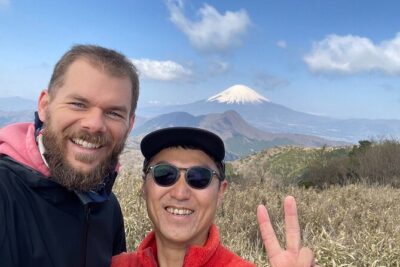
Traverse Outer Rim of Hakone Caldera and Enjoy Onsen Hiking Tour
Read our review →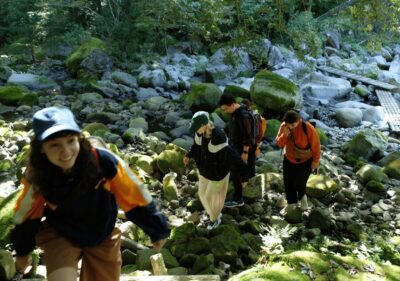
Hakone Hachiri: Old Tokaido Highway Hiking Tour
Read our review →
Private Local Hiking to enjoy the nature and culture of Mt.Fuji
Read our review →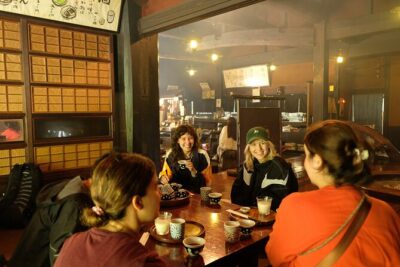
Browse the lists this tour appears in