
Reviewed · MT FUJI AREA TOURS
Tokyo: Mount Fuji One Day Trip Lake Kawaguchi & Lake Yamanaka
Mount Fuji is the star here, but the best part is how many different ways you see it in one day: reflected beside a lake, framed by flowers, rising behind a pagoda, and peeking above an ordinary Japanese street. The route gives you a strong sampler of the Fuji area without the bother of arranging several buses and trains.
I like the wide mix of sights and the price, $58.90 for roughly 10 hours with transport and fees included. I also like the practical help from guides such as Taiyo, Saki, Yuan, Lucy, and Kyo, who have been praised for clear meeting instructions, good timing, local tips, and taking photos. The catch is that this is a busy photo-stop tour, not a slow countryside outing, and the large group can make the morning meeting chaotic.
In This Review
- Key points to know before booking
- Why this Mount Fuji day trip works from Tokyo
- Lake Kawaguchi and Oishi Park: the classic Fuji view
- Lake Yamanaka, the quieter second lake
- Oshino Hakkai: springs, food, and a slower hour
- Lawson Fujikawaguchiko Town Hall: a quick modern photo stop
- Chureito Pagoda: the signature photograph
- Arakura Fuji Sengen Shrine: a short historic pause
- Hikawa Clock Shop: an ordinary street with an extraordinary backdrop
- The guide can shape the whole day
- Group size, transport, and the morning meeting
- How to judge the $58.90 price
- Who should book this Fuji tour?
- Should you book it?
- FAQ
- How long is the Mount Fuji tour?
- Where does the tour start?
- What time does the tour begin?
- Where does the tour end?
- Is lunch included?
- Is transportation included?
- Can I cancel for a full refund?
Key points to know before booking
- Eight stops in one long day: Lakes, flowers, springs, shrines, a pagoda, a clock shop, and a famous convenience store all fit into the route.
- Mount Fuji views depend on the weather: The mountain can be hidden by clouds, so the finest photographs are never guaranteed.
- Chureito Pagoda takes effort: Plan on about an hour here, including time for the approach and the view.
- Oshino Hakkai is your best culture-and-food pause: You get clear spring ponds, a traditional village setting, and time to find lunch.
- Expect a large coach group: The maximum is 45 people, and several buses may gather at the same Tokyo meeting point.
- Bring cash for lunch and small purchases: Lunch is not included, and personal expenses are your responsibility.
Why this Mount Fuji day trip works from Tokyo
A day around Mount Fuji can be awkward to plan independently. The famous viewpoints sit around the Fuji Five Lakes, and the places on this route are spread out. This tour solves the main problem by putting you in an air-conditioned vehicle with an English-speaking guide and returning you to the same Tokyo meeting point.
The trade-off is time. Ten hours sounds generous, but the route includes eight stops and the drive between Tokyo and the Fuji area. You are moving often, and each visit has a fixed departure time. If you need quiet walks, long meals, or time to browse every shop, this is not the right format.
If you want a big first look at Mount Fuji, though, the value is good. Transport and all listed fees are included, while lunch and personal purchases are not. At $58.90, you are paying mainly for transport, route planning, and a guide who keeps a complicated day moving.
More Mt Fuji days from Tokyo:
- Mt Fuji and Hakone 1-Day Bus Tour Return by Bullet Train
★ 5.0 · 26,383 reviews - Mt Fuji & Hakone Cruise, Drum Show Bullet Train 1 Day from Tokyo
★ 4.0 · 7,413 reviews - Tokyo Mt Fuji 5th St & Hakone Cruise Bus Tour w/Bullet Train
★ 4.4 · 5,024 reviews
Lake Kawaguchi and Oishi Park: the classic Fuji view
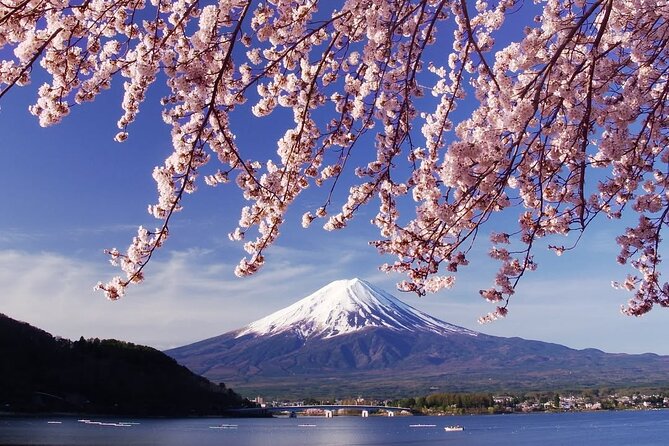
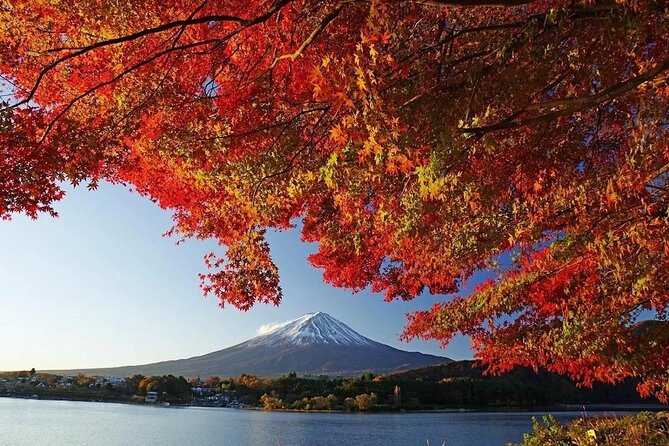
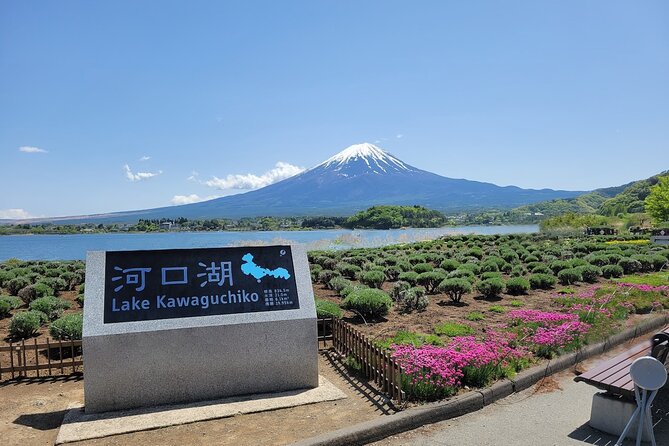
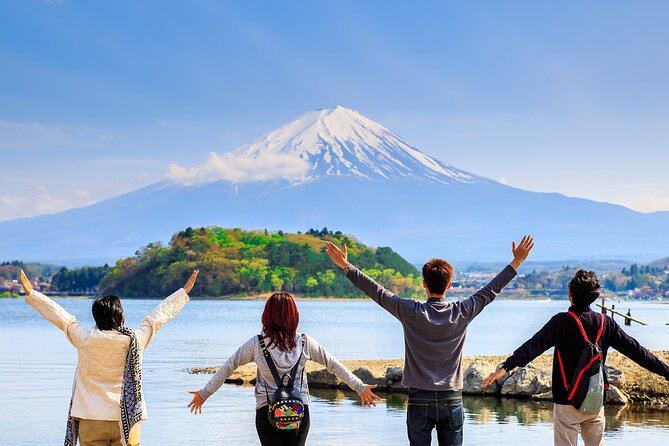
Lake Kawaguchi is the most popular of the Fuji Five Lakes and has the longest shoreline of the group. Its broad water views make it one of the most reliable places on this route for a classic Mount Fuji photograph, provided the clouds cooperate.
The scheduled stop here is about 25 minutes. That is enough to step out, look across the lake, and take photographs, but not enough for a proper lakeside walk. Keep your camera ready and listen closely for the return time. In a large group, a late return can delay everyone.
Oishi Park adds flowers to the lake-and-mountain view. Its promenade changes with the flowering seasons, so the exact colors depend on when you visit. You can frame flowers in the foreground, Lake Kawaguchi in the middle, and Mount Fuji behind it, which explains why this stop is a favorite for photographs.
Again, you have about 25 minutes. I would treat Oishi Park as a focused viewpoint rather than a park visit in the usual sense. Take a few photos, enjoy the setting, and do not expect time to wander far along the promenade.
Lake Yamanaka, the quieter second lake
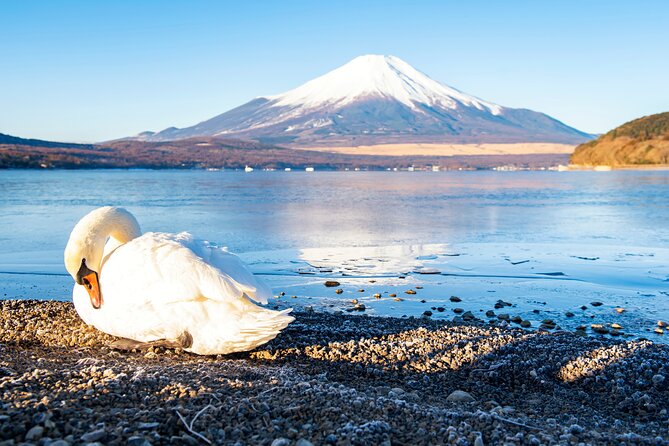
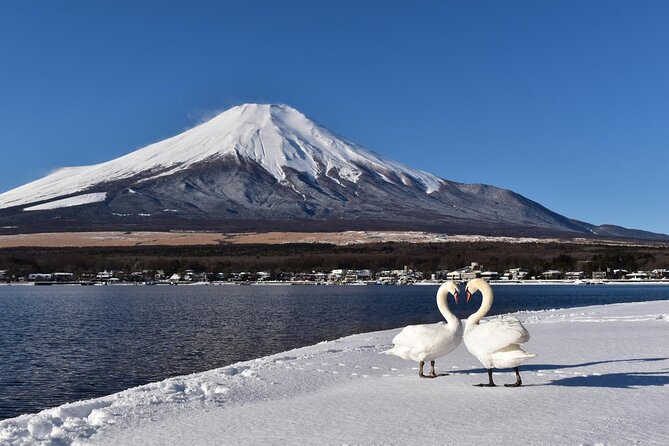
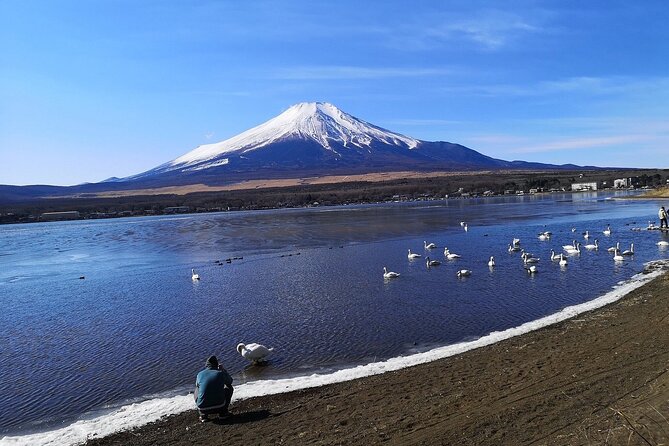
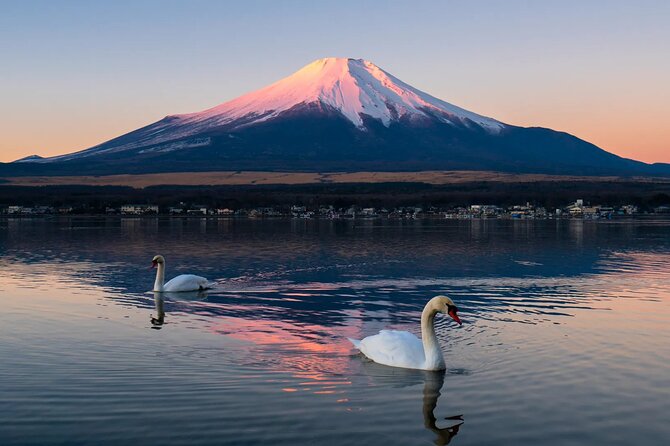
Lake Yamanaka is the largest of the Fuji Five Lakes and the closest to Mount Fuji. It is also called Swan Lake, a name reflected in the area’s identity and scenery. The lake gives you a different angle from Lake Kawaguchi, and the mountain can feel more immediate from this side.
The stop lasts about 25 minutes, so the purpose is mainly to see the view and take photographs. That short window is useful if you want variety, but limiting if you hoped to sit by the water. The route favors several distinct views over extended time at one location.
The appeal of visiting both lakes is simple: Mount Fuji changes shape and scale depending on your position. Lake Kawaguchi gives you a broad, popular viewpoint, while Lake Yamanaka brings you closer to the mountain. Seeing both helps the day feel like more than one repeated photo stop.
Oshino Hakkai: springs, food, and a slower hour
Oshino Hakkai is one of the more substantial stops, with about an hour to explore. The village is known for eight clear spring-water ponds, recognized among Japan’s Top 100 Famous Waters. The ponds are also designated a Natural Monument and form part of the Mount Fuji World Heritage area.
This is where the day gains some texture beyond scenery. You can look at the spring water, walk through the village, and find something to eat. Lunch is not included, so this is the most obvious point to arrange your own meal.
Bring cash. One person specifically advised having cash for lunch, and it is sensible advice for any meal or small purchase during a tightly scheduled day. Do not count on the tour price covering food.
An hour is more useful here than the 15 or 20-minute stops elsewhere, but it still passes quickly. If you want to examine every pond or shop, you will need to choose your priorities. Stay aware of the meeting time, since the bus cannot wait for extended browsing.
More day trips out of Tokyo:
- 1-Day Tokyo Bus Tour
★ 5.0 · 14,250 reviews - Tokyo: DisneySea 1-Day Passport
★ 4.5 · 2,726 reviews - Tokyo Disneyland 1-Day Passport
★ 4.6 · 2,512 reviews - Tokyo: Mt. Fuji 5th Station & Hakone Cruise 1-Day Bus Tour
★ 4.2 · 2,381 reviews
Lawson Fujikawaguchiko Town Hall: a quick modern photo stop
The Lawson convenience store stop is one of the route’s most unusual inclusions. The shop has become famous online because of its Mount Fuji view, turning an ordinary convenience store into a popular photograph location.
You get about 15 minutes. That makes this a quick stop for a picture, an ice cream, a drink, or a local snack. It also shows a very modern side of Japanese sightseeing: sometimes the memorable view is found beside a convenience store rather than at a formal monument.
Keep expectations in check. This is not a cultural attraction or a place for a long visit. It is a brief, distinctive photo opportunity. If you like seeing how online travel culture shapes real destinations, you will find the stop amusing. If you prefer temples, gardens, and old streets, the time may feel less important than the shrines later in the day.
Chureito Pagoda: the signature photograph
Chureito Pagoda in Arakurayama Sengen Park is the visual centerpiece of the tour for many people. The familiar composition shows the pagoda, Mount Fuji, and Fujiyoshida City together. It is one of those views that instantly identifies the region.
The stop is scheduled for about an hour. You need that time because the viewpoint involves an uphill approach and many steps. The supplied details do not state the exact number of steps, so plan for a climb rather than assuming you can reach the view directly from the vehicle.
This is also the place where timing matters most. The view may be crowded, and everyone in your group will want the same photograph. Move with purpose, leave room for others, and follow the guide’s instructions about the meeting point.
Weather again controls the result. If Mount Fuji is hidden, the pagoda and city are still worth seeing, but the famous three-part composition will not be complete. I would not judge the entire outing by one photograph. The route gives you several chances to see the mountain, and each viewpoint has a different character.
Arakura Fuji Sengen Shrine: a short historic pause
The Arakura Fuji Sengen Shrine was built in 705 and has served as the guardian shrine of Arakura Village for more than 1,300 years. It is associated with protection from bad luck and harmony, giving the stop a spiritual purpose beyond its photo value.
Only about 15 minutes are planned here. That is enough to see the grounds and recognize the shrine’s importance, but not enough for a long visit or detailed study. You will get more from it if you pause respectfully instead of treating it as just another backdrop.
The shrine also helps balance the modern Lawson stop and the natural viewpoints. The day is not only about collecting Mount Fuji images. It includes a small look at local religious tradition and the long relationship between communities and the mountain.
Hikawa Clock Shop: an ordinary street with an extraordinary backdrop
Hikawa Clock Shop is set in a quieter town away from central Tokyo. The attraction is the street itself, where Mount Fuji appears at the far end behind Japanese buildings and utility lines. It is a useful reminder that Fuji is part of daily life, not only a distant peak viewed from a formal park.
The stop lasts about 20 minutes. You will have time to compose street photographs and take in the contrast between a normal shopping area and the mountain beyond it. This view may appeal most to photographers who like context. It feels less polished than Oishi Park, but that is precisely the point.
Please keep the local setting in mind. A famous angle can still be part of an ordinary neighborhood, so follow the guide’s directions and avoid blocking the street while taking pictures.
The guide can shape the whole day
The guides are a major variable on this tour. Specific guides praised in the supplied feedback include Taiyo, Saki, Yuan, Lucy, and Kyo. Useful qualities include clear departure instructions, punctual driving, local tips, a friendly manner, and help taking photographs.
Taiyo was noted for keeping the group on schedule and using a WhatsApp group to coordinate meeting points and departure times. Saki was praised for helping with photos, while Yuan, Lucy, and Kyo were each associated with an enjoyable day. These details matter because this route has many moving parts.
The weaker side is also clear. One experience was described as little more than transportation between photo stops, with too few background stories and too much pressure around departure times. That criticism is fair. A tour covering this much ground cannot give every location a full history lesson, and a guide’s style may range from lively storytelling to basic crowd management.
I would book this for efficient sightseeing, not for a seminar on Fuji-area history. Listen for the meeting instructions first. Then ask questions when the schedule allows. Clear guidance is more valuable than a long speech if it keeps you from missing the bus.
Group size, transport, and the morning meeting
The tour has a maximum of 45 participants, and the Tokyo meeting point is STAND TJapan at 1-5-1 Marunouchi, Chiyoda City, on the first floor. The start time is 8:00 in the morning, and the tour returns to that same meeting point.
The morning gathering deserves extra care. Several busloads may meet in the same area, so finding the right group can feel disorganized. One useful criticism was that there were not enough clear ways to identify each tour group at the start.
Arrive with time to spare, keep your booking details available, and confirm the vehicle and guide before boarding. If you booked separately from relatives or friends, tell the operator at least one day ahead. Otherwise, you may be assigned to different vehicles.
The vehicle is air-conditioned, though one report described a bus with no air conditioning for the first hour or two and poor general condition. That appears to be a possible operational risk rather than a fixed feature, but it is worth keeping in mind during a long summer journey.
Bathroom opportunities were also described as inconsistent. Use facilities when you have the chance, especially at Oshino Hakkai or another stop, rather than waiting until the next planned break.
How to judge the $58.90 price
At $58.90 per person, this is a low-cost way to reach several Fuji-area sights from Tokyo. The price includes an air-conditioned vehicle and all listed fees and taxes. Since the stops themselves have no admission charge, the main value lies in transport and the carefully packed route.
You are getting a lot of coverage for the money: two lakes, a flower park, spring ponds, a convenience store, a pagoda park, a historic shrine, and a town street. Reaching all of these independently would take planning and would likely involve more transfers and more decisions during the day.
The price does not include lunch or personal expenses. Set aside money for food, drinks, ice cream, and souvenirs. Also remember that the tour’s efficiency comes from strict departure times. You trade freedom for convenience.
I consider the price fair for a first visit, especially if your priority is seeing Mount Fuji from several angles. It is less attractive if you want a relaxed day with long walks, a carefully planned meal, or extended time at one shrine.
Who should book this Fuji tour?
I would recommend it to first-time visitors staying in Tokyo who want a broad introduction to the Mount Fuji area. It also suits photographers, families who prefer organized transport, and anyone who does not want to work out the connections between the lakes, Oshino Hakkai, Arakurayama Sengen Park, and the smaller viewing spots.
It is a good match for people who accept a full day in a vehicle and enjoy collecting different views. The friendly guides and photo help can be especially useful if you are traveling alone or want pictures of your group.
I would hesitate if you dislike crowds, fixed schedules, long drives, or short visits. The maximum group size is 45, and the route can feel rushed. You will need to stay alert for departure times, and the amount of history or explanation may depend on the guide.
The mountain itself is never guaranteed. Clear weather can turn the day into a wonderful series of views, while cloud cover may leave you with lakes, villages, shrines, and a pagoda but no full Fuji profile.
Should you book it?
Book this tour if you want maximum Fuji-area coverage for a modest price and can accept a large group, a long day, and quick stops. The mix is unusually broad, and the chance to see Mount Fuji from both Lake Kawaguchi and Lake Yamanaka is a real strength.
Skip it if your ideal outing means choosing one lake, lingering over lunch, and walking at your own pace. For everyone else, this is a practical Tokyo escape with plenty of memorable viewpoints, provided you arrive early, bring cash, watch the clock, and hope for clear skies.
FAQ
How long is the Mount Fuji tour?
The tour lasts approximately 10 hours.
Where does the tour start?
It starts at STAND TJapan, 1-5-1 Marunouchi, Chiyoda City, Tokyo, on the first floor.
What time does the tour begin?
The scheduled start time is 8:00 am.
Where does the tour end?
The tour ends back at the original meeting point.
Is lunch included?
No. Lunch is not included, and personal expenses are also excluded. Bring cash for lunch and other purchases.
Is transportation included?
Yes. An air-conditioned vehicle is included, along with all listed fees and taxes.
Can I cancel for a full refund?
Yes. You can cancel at least 24 hours before the experience start time for a full refund. Cancellations or changes made less than 24 hours before the start time are not accepted for a refund.
New on our Tokyo list
- Tokyo : Kamikaze Street Drift Ride★ 5.0 · 3 reviews
- Private Zen Meditation in English in Shinjuku, Tokyo★ 5.0 · 3 reviews
- Sumi-e Experience in a relaxing green tea shop in Tokyo★ 5.0 · 3 reviews
- Onsen Spa in Tokyo and Asakusa Bar Hopping with Local Guide★ 5.0 · 3 reviews
- Easy for everyone! Now you can play handmade mini shamisen and show off to everyone! Musical instruments, sweets and live music★ 5.0 · 3 reviews
- Tokyo: Private Tsukiji Street Food & Sake with Local Guide★ 5.0 · 3 reviews
- Mt Fuji Exploration Tour with Free Japanese Kusa Mochi from Tokyo★ 4.5 · 3 reviews
- Tokyo Tsukiji Fish Market Walking and Exploring Hidden Gems Tour★ 5.0 · 3 reviews
Mt Fuji Area Tours, compared.
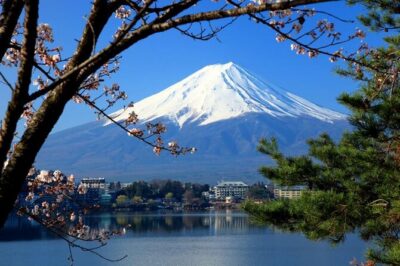
Mt Fuji and Hakone 1-Day Bus Tour Return by Bullet Train
Read our review →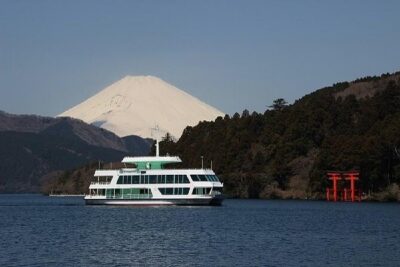
Mt Fuji & Hakone Cruise, Drum Show Bullet Train 1 Day from Tokyo
Read our review →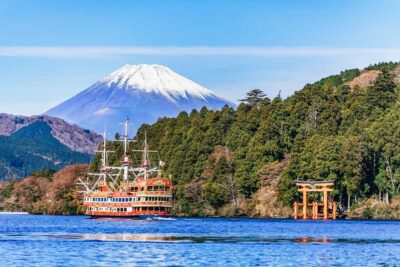
Tokyo Mt Fuji 5th St & Hakone Cruise Bus Tour w/Bullet Train
Read our review →
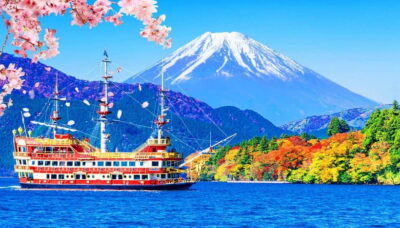
Mt. Fuji Tour, Hakone Ropeway, Owakudani, Lake Ashi
Read our review →
Mt.Fuji,Kawaguchiko Oishi Park,Arakurayama Sengen Park
Read our review →
Mt. Fuji 5th Station & Hakone Cruise 1-Day Bus Tour
Read our review →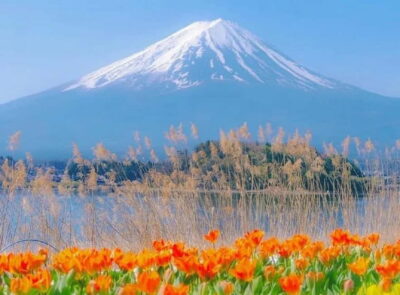
Mt Fuji Top 5 Spots Day Tour: Arakurayama Park,Oshino Hakkai
Read our review →Browse the lists this tour appears in