
Reviewed · TOKYO GO-KART EXPERIENCES
Tokyo: Premium Go-Kart Tour with Tower & Shibuya Crossing
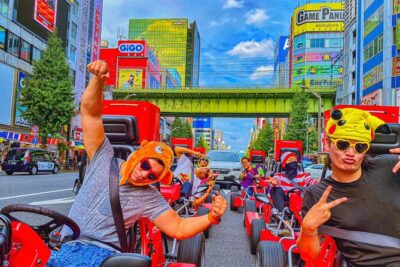
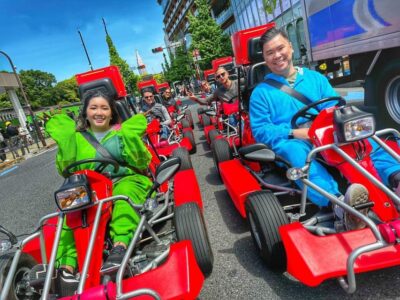
Tokyo’s famous sights take on a different feel when you are sitting only inches above the road. This small-group go-kart tour follows an English-speaking guide through Roppongi, Omotesando, Shibuya Crossing, and past Tokyo Tower, giving you a street-level view that no bus can match. Costumes and guide-taken photos add plenty of fun.
I like the well-managed group of up to eight and the guides’ clear attention to safety. Guides such as Gus, Ren, Yumi, Rafael, and Shin have earned praise for keeping groups together, explaining hand signals, and taking photos at useful stops. I also like the choice of daytime or evening departures, since Tokyo’s signs and traffic feel quite different after dark.
The main catch is the paperwork. You must have a hard-copy 1949 Geneva Convention International Driving Permit, or another license accepted under Japanese law, before you arrive. Rain can also force a change of schedule, and petrol fumes from the kart ahead may bother you.
In This Review
- Key points to know before you book
- Why Tokyo looks different from a go-kart
- The meeting point and safety briefing
- Roppongi: Tokyo at street level
- Tokyo Tower and the photo stops
- Omotesando and the polished side of Tokyo
- Shibuya Crossing: the big payoff
- Costumes, photos, and the social side
- How long the route feels
- Weather, comfort, and small drawbacks
- Who will enjoy this most
- The paperwork you must get right
- Should you book the Tokyo premium kart tour?
- FAQ
- How long does the Tokyo go-kart tour last?
- What landmarks does the route include?
- Is the tour conducted in English?
- How many people are in each group?
- What driving documents do I need?
- Are digital driving permits accepted?
- What happens if it rains?
Key points to know before you book
- Shibuya Crossing is the headline moment: You ride through one of Tokyo’s most recognizable intersections as part of a guided road route.
- Tokyo Tower gives you the best photo backdrop: The open kart puts the tower and surrounding city directly into your view.
- Guides do more than lead the way: They explain safety rules, use hand signals, manage the group, and take photos during the route.
- The group stays small: A maximum of eight participants makes it easier to follow the guide and receive individual help.
- Costumes are included: Choose a playful outfit if you want a more colorful set of photos.
- Your driving permit matters more than your booking: A soft copy, 1968 Vienna permit, FIA permit, IDA permit, or IAA permit is not accepted by Japan.
Why Tokyo looks different from a go-kart
Most sightseeing in Tokyo happens at walking speed or from inside a train. This tour gives you another angle. You are out in the open, close to the pavement, with traffic, shop signs, towers, and crowds passing at eye level.
That low seating position makes the karts feel faster than the stated route might suggest. One driver reported reaching about 50 kilometers per hour, while others singled out straight sections and a tunnel run as especially quick. Your actual pace depends on traffic, signals, road conditions, and the guide’s instructions, so this is not a racetrack session. It is a guided road experience with a strong thrill factor.
The fun comes from the mix of concentration and spectacle. You need to watch the road and stay with the group, but you also become part of the city scene. People on sidewalks, in cars, buses, and taxis may wave or take pictures. That public attention is part of the appeal, though it can feel a little self-conscious if you prefer to blend into the background.
I would describe the experience as street sightseeing with an engine, not as a serious driving tour. You see major districts from the road, but you do not stop for long visits inside museums, temples, shops, or observation decks.
More street-kart slots:
- Flagship 2-Hours Official Street Go-Kart Tour – Tokyo Bay Shop
★ 5.0 · 4,974 reviews - Official Street Go-Kart in Shibuya
★ 5.0 · 3,435 reviews - Official Street Go-Kart Tour – Akihabara
★ 5.0 · 1,578 reviews
The meeting point and safety briefing
Your exact meeting point depends on the option you book, so check the confirmation carefully rather than assuming every departure leaves from the same location. Arrive ready to show your passport and driving documents.
At the start, staff provide the kart and petrol, then explain how to operate the vehicle. The briefing covers basic driving and the hand signals used by the group. Guides have been praised for making these instructions easy to follow, including with first-time overseas drivers.
The lead guide sets the pace and controls the route through Tokyo traffic. You are not left to find the landmarks by yourself. The guide also checks the group at lights and along the route, which matters more here than it would on a simple driving course.
The tour is limited to eight people. That is a useful size for city roads. A large convoy would be harder to keep together, while a tiny group might not have the same playful energy. One participant booked alone and found the ride felt almost private, but group size can vary by departure.
You should take the briefing seriously. The karts are easy enough for many people to handle, but you are still driving on public roads. This is not suitable for anyone without a valid driving license, and pregnant women are excluded from the activity.
Roppongi: Tokyo at street level

Roppongi provides an early taste of the tour’s main strength. The district is known for nightlife, high-rise buildings, restaurants, and international energy. From a kart, you do not simply pass through a neighborhood in a vehicle. You see its signs, traffic, and building fronts from an unusually exposed position.
This part of the route helps you settle into the kart. You learn how the convoy moves, how the guide signals, and how much space to leave between vehicles. The open design gives you a clear view, but it also means weather and road air are part of the experience.
The downside is that this is still a moving tour. You may pass a street you would like to explore without stopping. If you want time to browse Roppongi’s restaurants or galleries, plan a separate visit. The kart ride is best for getting a broad feel for the district rather than examining it in detail.
Guides may share facts about the areas you pass while the group is stopped at traffic lights. That small touch turns the route into more than a convoy ride. Still, the amount of commentary depends on the guide and the conditions on the road.
Tokyo Tower and the photo stops
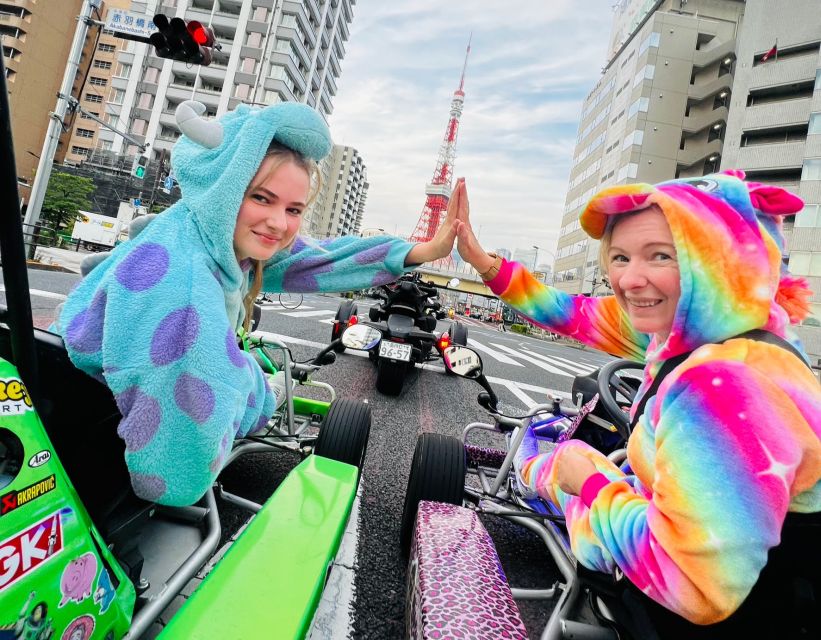
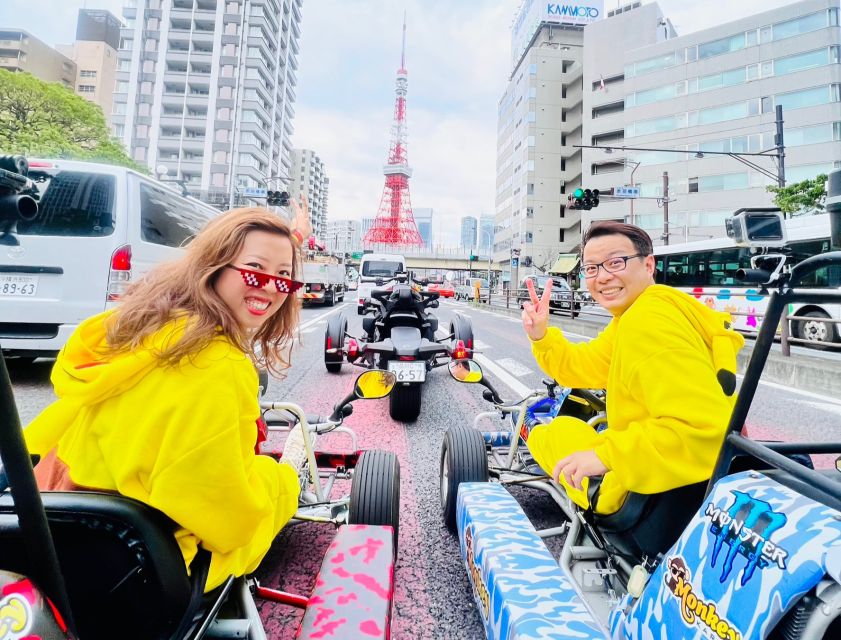
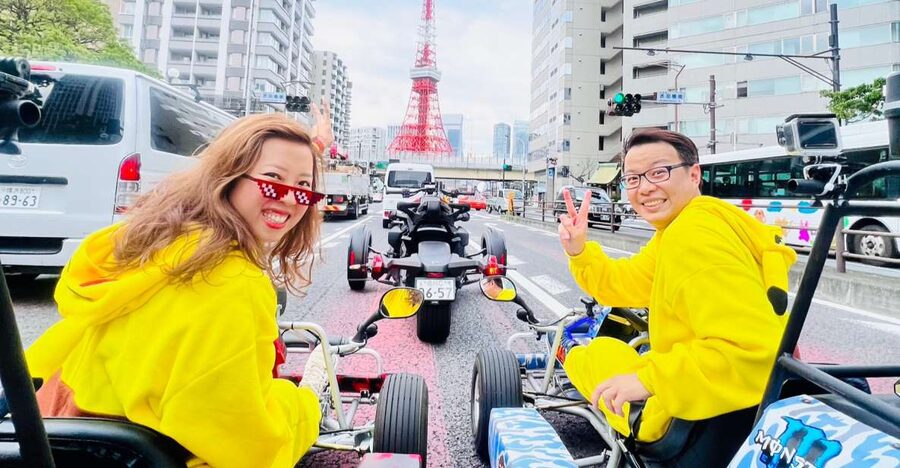
Passing Tokyo Tower is one of the clearest reasons to choose this route. The tower is a familiar Tokyo icon, but seeing it while seated in an open kart gives the moment a playful scale. You are close enough to feel connected to the surrounding streets, yet far enough away to frame the tower above the city.
The guide handles the photography, so you do not need to hold a phone while driving. Photos are taken at key points, and the package includes the guide’s photo service plus one hard-copy photo. After the ride, the remaining images are shared by AirDrop or email.
This arrangement is especially useful for couples and friends. Everyone can stay in the group instead of taking turns as the photographer. Guides including Gus, Garrett’s guide, Lewis, Yumi, and Ren have been praised for taking many pictures and choosing good moments.
You should not confuse the included photo service with a full professional portrait shoot. The tour keeps moving, and the guide must also manage traffic and safety. The value is in receiving a useful record of the experience without having to photograph yourself from the kart.
An action camera or Insta360 mount is included, but the camera itself is not. An action camera and Bluetooth speaker are not included. If you own a compatible camera, the mount may help you record the route, but do not count on the tour providing the device.
More Shibuya plans:
- Tokyo: Street Kart Experience in Shibuya
★ 4.9 · 1,484 reviews - Shibuya Meltdown Nightlife Tour: All-You-Can-Drink Bar Hopping
★ 5.0 · 1,058 reviews - Shibuya Official Street Go-Kart in Shibuya Annex
★ 5.0 · 972 reviews - Tokyo: Shibuya Food Tour (13 dishes and 4 Eateries)
★ 5.0 · 770 reviews
Omotesando and the polished side of Tokyo
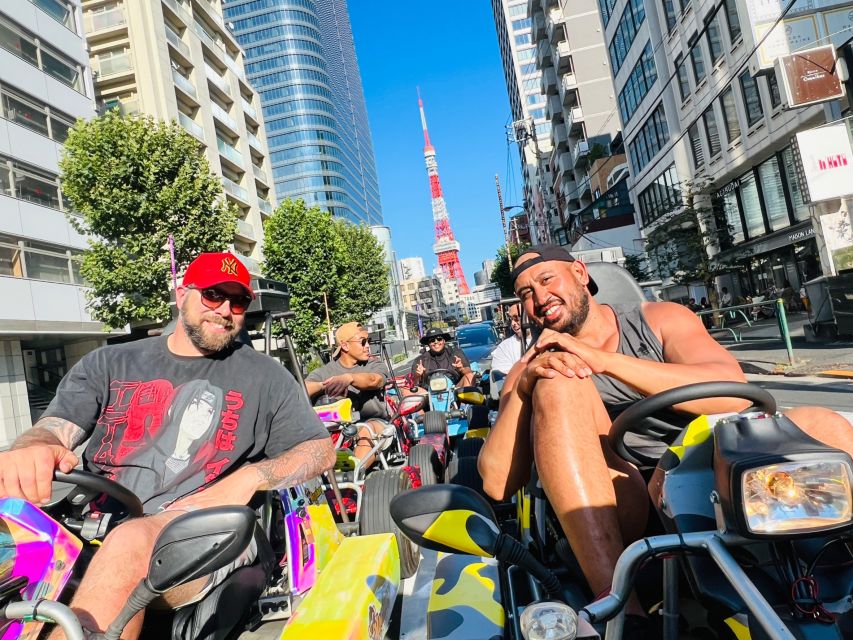
Omotesando changes the mood. Its broad, stylish avenues and modern storefronts give the route a more polished look than the denser central streets. This is where the go-kart’s open seating works well for taking in architecture and street scenes.
The route does not turn the district into a walking stop. You will see it while driving, with the guide ahead and the group moving through traffic. That is both the pleasure and the limit. You cover more ground than on foot, but you give up the freedom to pause at a café, shop, or building.
The costumes make more sense here than they might on a standard sightseeing bus. A bright outfit against Tokyo’s clean avenues creates memorable photos, and the city’s pedestrians often notice the group. Costumes are optional, so you can keep your clothing simple if dressing up is not your style.
Bring clothing suited to the weather, not just the costume. The karts are open, and rain or cool air will be felt directly. Some drivers enjoyed evening rides for the lights and atmosphere, but night departures can also feel colder and more demanding on the road.
Shibuya Crossing: the big payoff
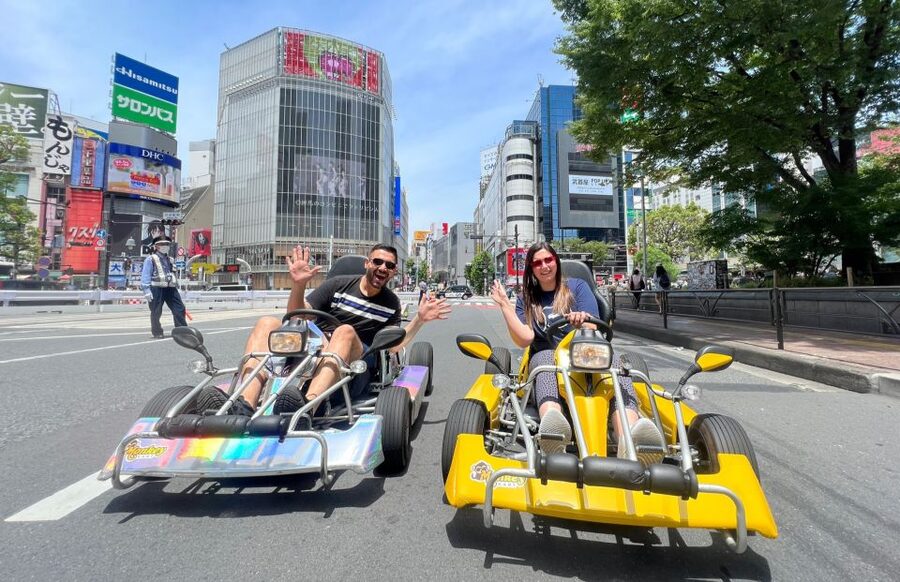
Shibuya Crossing is the tour’s most recognizable stop and usually the moment people picture when they book. The crossing is famous for the large waves of people moving in several directions at once. Passing through it in a go-kart puts you in the middle of one of Tokyo’s best-known city scenes.
The experience is not the same as standing on the pavement and watching the crossing from above. You approach as part of traffic, follow the guide, and experience the timing of the signals from the road. The kart’s low position makes the surrounding buildings and crossing crowds feel larger.
This is also where the group’s organization matters most. Shibuya traffic is busy, and you need to stay behind the guide rather than drift toward the spectacle. Several guides were praised for checking the group, timing stops, and keeping everyone together.
The crossing can be the most exciting part of the route, but it is not a guaranteed private photo session. Other vehicles, pedestrians, traffic signals, and the size of the group shape what you see. You may get a strong photo at one moment and a quick pass at another.
Evening departures can make Shibuya especially photogenic, with signs and building lights adding color. Daytime rides give you clearer views of the surrounding streets. If your schedule allows either, choose based on the mood you want, not on the assumption that one is always better.
Costumes, photos, and the social side
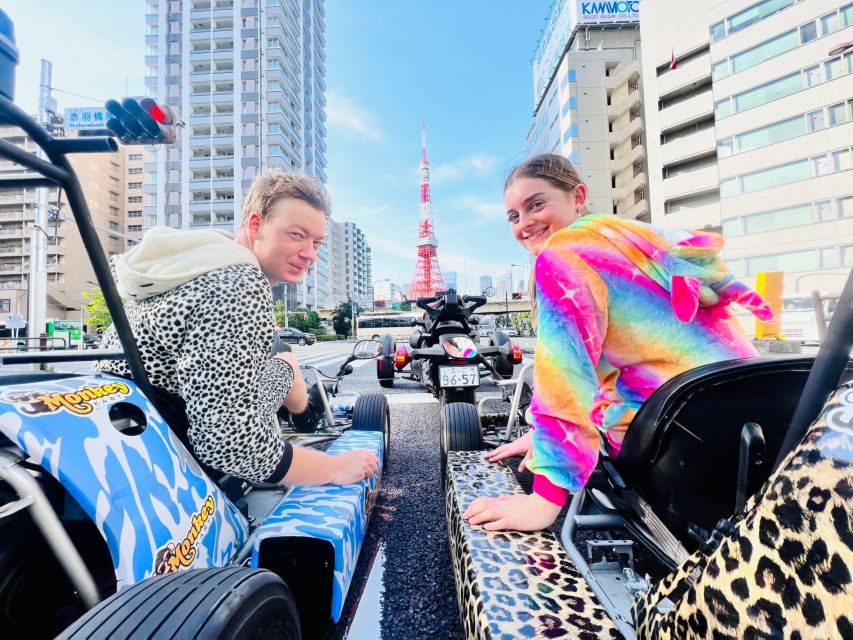
The costume selection adds a lighthearted layer to the ride. You can choose a cute character-style outfit and make the tour feel more like a celebration than ordinary transport. One parent dressed as Pikachu for the benefit of grandchildren, which shows how the costumes can work for family groups with older children and young adults.
The social reaction is part of the package, even though it is not formally listed as an inclusion. People may wave from sidewalks, cars, buses, and taxis. That attention can make the ride feel like a moving photo opportunity.
I would think about your comfort level before choosing a costume. If you dislike being noticed, the open kart already draws attention, and a character outfit increases it. If you enjoy a little theater, the costume helps turn the ride into a shared event.
The included photos are a real benefit at this price. At $116 per person, you are paying for the kart, petrol, instructor, guided route, costume access, and images. A normal sightseeing ride may cost less, but it will not give you the same driving role or the same set of guide-taken pictures.
The price makes the most sense for a special occasion, a first Tokyo visit, or a group that wants one memorable activity rather than another standard city tour. If your budget is tight and your main goal is to see landmarks efficiently, Tokyo’s trains and walking routes will give you more sightseeing time for less money.
How long the route feels
The listed duration ranges from 75 to 105 minutes. That is long enough to make the ride feel like a proper activity, not a quick lap around one block. The exact length depends on the option and starting time you select.
Expect the full experience to include arrival, paperwork checks, the safety briefing, preparation, the driving route, and the return to the starting point. The time spent actually moving through the city may vary with traffic and road conditions.
Some people felt the longer route gave them a better look at Tokyo. One guide offered a large loop, while another driver specifically recommended choosing the long tour. If you have room in your schedule, the longer option is likely the better value because the activity’s appeal comes from covering several districts.
Do not book it too close to a flight, train, dinner reservation, or timed attraction. One departure was delayed by an hour, and city traffic is not something the operator can fully control. Leave a buffer after the ride.
Weather, comfort, and small drawbacks
Rain can lead to rescheduling. A previous departure was canceled because of poor weather, but the operator accommodated a later booking. You can cancel up to 24 hours ahead for a full refund under the stated policy, and reserve now with payment later, which gives you some flexibility.
Still, a flexible policy does not remove the need for a backup plan. Tokyo weather can change, and the tour may not run as planned in rain. Keep another indoor activity in mind if this is one of the fixed highlights of your day.
The open karts also expose you to fumes from the vehicle ahead. One driver specifically noted petrol fumes as the only real negative. You may also feel more road vibration and wind than you would in a car or bus.
The reported speed adds excitement, but it can feel intimidating at times. One driver called the ride exhilarating and frightening in places, especially in rainy conditions. If you are nervous around traffic or have little confidence driving abroad, this may not be the relaxed sightseeing choice for you.
Who will enjoy this most
I would recommend the tour to couples, friends, families with young adults, and anyone who wants a story to bring home from Tokyo. It works particularly well for people who have already done a few conventional city tours and want something active.
It is also a good fit for photography-minded groups. The guide takes pictures, the costumes create colorful subjects, and Tokyo Tower and Shibuya Crossing provide strong backdrops. The small group makes it easier for the guide to check on each driver and capture individual photos.
I would be more cautious about booking it for very young children, since every participant must be over 18 and hold the required driving credentials. It is not suitable for pregnant women or anyone without a driver’s license.
The tour is offered in English. Guides have included Gus, Pol, Reece, Rakesh, Ren, Taka, Rafael, Andreas, Andres, Yumi, Shin, Pancho, Ken, Federico, and Lewis. The repeated praise for clear instructions, friendly manners, safety checks, and photography suggests that the guide can make a major difference to the day.
The paperwork you must get right
This is the most important practical point. Every driver needs a physical, hard-copy booklet of a 1949 Geneva Convention International Driving Permit issued by the official agency in their home country, such as AAA, AA, CAA, or another approved organization.
Online copies and phone images are not valid. Japan also does not recognize permits issued under the 1968 Vienna Convention, or permits from FIA, IDA, and IAA.
Drivers with licenses from France, Switzerland, Taiwan, Germany, Monaco, and Belgium need a Japanese translation of their local license. This physical translation can be obtained through the Japan Automobile Federation.
The supplied rules also warn that permits from Indonesia, Pakistan, Saudi Arabia, Mexico, Brazil, Costa Rica, Colombia, Kuwait, Qatar, and some other countries may not be accepted. Check your eligibility with the official issuing authority before leaving home. Do not wait until you reach Tokyo.
Bring your passport and international driving license to the meeting point. If your documents are wrong, the fun route and excellent guide cannot solve the problem.
Should you book the Tokyo premium kart tour?
Book it if you want an active, highly unusual way to see Tokyo’s best-known streets, and if you are comfortable driving in city traffic. The strongest reasons are the small group, careful English-speaking guides, included photos, costumes, and the chance to pass Tokyo Tower and Shibuya Crossing from the road.
Skip it if you want quiet sightseeing, dislike public attention, cannot obtain the correct driving permit, or need a weather-proof plan. At $116, it is not a cheap way to tick off landmarks, but it offers a very different kind of city experience and includes useful extras.
For most eligible adults, I would choose the longer route and consider an evening departure for the city lights. Allow extra time afterward, dress for open-air driving, and confirm your license documents before booking. Do those things, and this can be one of the most memorable hours of a Tokyo visit.
FAQ
How long does the Tokyo go-kart tour last?
The tour lasts between 75 and 105 minutes, depending on the option selected. Starting times vary, so check availability when booking.
What landmarks does the route include?
The route can include Roppongi, Shibuya Crossing, Omotesando, and a pass by Tokyo Tower. The exact meeting point and option may affect the route.
Is the tour conducted in English?
Yes. The instructor and guide service are provided in English.
How many people are in each group?
The activity is limited to eight participants.
What driving documents do I need?
You need a passport and a valid driving license for use in Japan. Most drivers must bring a physical 1949 Geneva Convention International Driving Permit issued by the official agency in their country.
Are digital driving permits accepted?
No. Online copies and soft copies are not valid. Japan also does not recognize 1968 Vienna Convention permits, or permits issued by FIA, IDA, and IAA.
What happens if it rains?
The tour may be rescheduled because of rain. You can cancel up to 24 hours before the activity for a full refund under the stated cancellation policy.
New on our Tokyo list
- From Tokyo: Mount Fuji & Hakone Full Day Private Tour★ 4.9 · 25 reviews
- Tokyo Spectacular View Day-Cruise in 90 Minutes★ 5.0 · 25 reviews
- Real Tokyo Runner Club : Daikoku Car Meet Night Tour with JDM Car★ 5.0 · 25 reviews
- 2.5 Hour-Guided Cycle Tour in the Central Tokyo★ 5.0 · 25 reviews
- Tokyo: 2-Hour Night Bike Tour of the City’s Hidden Gems★ 4.9 · 25 reviews
- Ramen Making from Scratch +Akihabara Tour –Cooking Class★ 5.0 · 25 reviews
- [Self-Drive] Tokyo & Daikoku Custom Car Driving Tour★ 4.9 · 25 reviews
- Samurai themed Entertainment show in Shinjuku★ 4.5 · 25 reviews
Tokyo Go-Kart Experiences, compared.
Flagship 2-Hours Official Street Go-Kart Tour – Tokyo Bay Shop
Read our review →
Tokyo Go Kart: Asakusa, Skytree, and Akihabara **IDP MUST**
Read our review →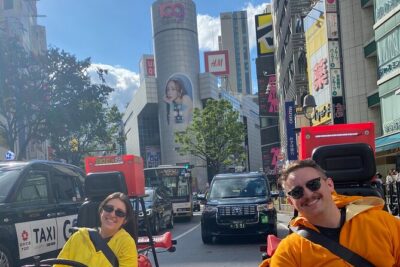
Shibuya Official Street Go-Kart in Shibuya Annex
Read our review →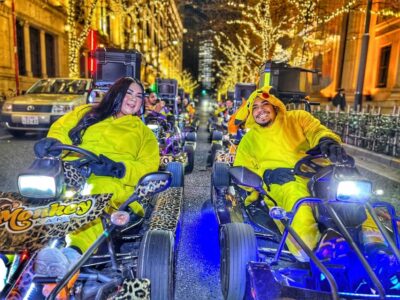
Asakusa, Skytree & Akhihabara Go-Kart City Experience
Read our review →Shibuya Kart: Premium Go-Karting Tour through Shibuya, Tokyo
Read our review →Browse the lists this tour appears in