
Reviewed · SHIBUYA TOURS
Japanese Speaking Experience Meet the locals Friend Cafe Shibuya
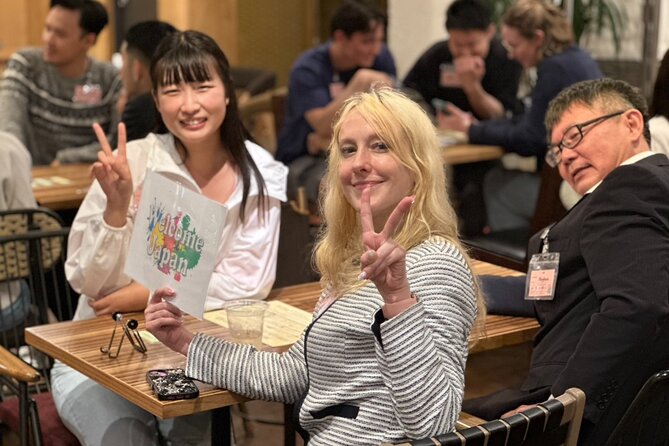
Shibuya has plenty of loud nightlife, but this two-hour meetup gives you a better reason to talk to people than simply ordering another drink. You move between small groups, switching from English to Japanese every 15 minutes, with topic cards to keep the conversation moving.
I like the low-pressure format and the chance to meet both Japanese locals and people from other countries. I also like that beginners are welcome, so you do not need polished Japanese to take part. The main catch is the setting: it is in a pub, and the nearby bowling area can be noisy, which may make conversation harder at times.
In This Review
- Key points at a glance
- A structured language exchange in the middle of Shibuya
- Six short conversation rounds, with a new face each time
- Why topic cards matter for beginners
- The pub setting: social, convenient, and sometimes noisy
- What the seat changes add to the evening
- The value of $29 for a two-hour meetup
- A useful start to a bigger Shibuya evening
- Who will get the most from this experience
- Practical details before you go
- Should you book the Shibuya language exchange?
- FAQ
- How long does the Japanese speaking experience last?
- Where does the event meet?
- Is the event suitable for Japanese beginners?
- How are the conversation groups organized?
- How often do the groups change?
- How do the English and Japanese sessions work?
- Are drinks included in the ticket?
- Can people under 18 participate?
Key points at a glance
- Small mixed groups: Staff place three or four people together, usually combining Japanese and international participants.
- A clear language schedule: Each round alternates between 15 minutes of English and 15 minutes of Japanese.
- Seats change several times: Rotations give you more than one chance to speak with different people.
- Beginner-friendly format: Topic cards help when your Japanese vocabulary runs out.
- Shibuya evening timing: The event runs on Monday from 7:30 to 9:30 PM, making it easy to pair with dinner or a later night out.
- Budget note: The $29 fee covers the event, but your drink and any food cost extra.
A structured language exchange in the middle of Shibuya
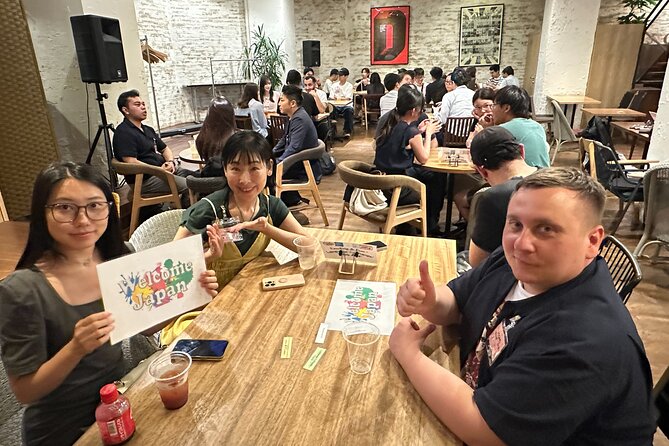
This is not a Japanese lesson with a teacher at a whiteboard. It is a guided social meetup built around short conversations. That difference matters.
You will meet at Shibuya Bowling Cafe, in the Shibuya EST building at 1-chōme-14-14 Shibuya. The cafe is on the basement level, or B1F. After checking in at reception, you buy at least one drink from the bar, take your assigned seat, and join a small group.
The staff organize the room so you do not have to walk up to strangers and ask to join. Groups usually contain three or four people, with Japanese and international participants mixed together. Topic cards are available to help you get past the awkward first minute.
That setup makes this a good choice for solo visitors. You still need to speak, of course, but the activity gives you a clear reason and a simple format. You are not trying to break into a private group at a bar. Everyone is there for the same purpose.
The activity is scheduled for about two hours. Reception begins 10 minutes before the starting time, so arrive with enough time to check in and buy your drink. The advertised session starts at 7:30 PM and ends at 9:30 PM on Mondays.
More Shibuya plans:
- Official Street Go-Kart in Shibuya
★ 5.0 · 3,435 reviews - Tokyo: Street Kart Experience in Shibuya
★ 4.9 · 1,484 reviews - Shibuya Meltdown Nightlife Tour: All-You-Can-Drink Bar Hopping
★ 5.0 · 1,058 reviews
Six short conversation rounds, with a new face each time
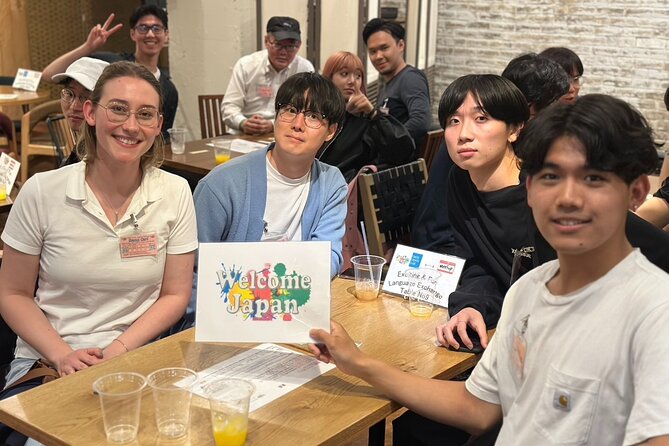
The evening follows a firm rhythm. You begin with a 15-minute English conversation, followed by 15 minutes of Japanese. After a five-minute break, the staff change the seating arrangement and repeat the pattern.
The listed program includes three English rounds and three Japanese rounds:
- English conversation
- Japanese conversation
- Five-minute break and seat change
- English conversation
- Japanese conversation
- Five-minute break and seat change
- English conversation
- Japanese conversation
- Closing group photo
This schedule is one of the strongest parts of the event. A casual language exchange can easily become one long conversation with one confident speaker. Here, the seat changes push you to meet more people and give you several fresh starts.
The 15-minute limit also keeps the pressure manageable. If a conversation feels awkward, you know it will change soon. If it goes well, you still have more chances to meet someone else. For beginners, that short window is useful because it lets you focus on simple questions rather than trying to sustain a complicated conversation for an entire evening.
The English and Japanese split also keeps the arrangement fair. Japanese participants get time to practice English, while you get a set period to try Japanese. You are not expected to speak Japanese for the entire night.
Why topic cards matter for beginners
The topic cards may sound like a small detail, but they solve a real problem. At language exchanges, the hardest moment is often the first one. You know you should speak, but you may not know what to ask beyond your name, country, and reason for visiting Tokyo.
A prompt can lead you into safer subjects such as food, travel, hobbies, work, or daily life. You can keep the language simple and still have a useful exchange. If your Japanese is limited to greetings and a few basic phrases, the card gives you a starting point.
The event description specifically welcomes people who cannot speak Japanese. That does not mean the Japanese portion becomes a lecture or a translation service. You will still need to try. The benefit is that your conversation partners and the staff understand the purpose of the meetup, so mistakes are part of the format rather than an embarrassment.
I would treat the English rounds as a chance to help Japanese participants with their English. In return, ask them to slow down, repeat a phrase, or correct a simple Japanese sentence during the Japanese rounds. The result is more useful when both sides take an active role.
The pub setting: social, convenient, and sometimes noisy
The venue is a pub, so you must be 18 or older. At check-in, you buy a minimum of one drink. Alcoholic beverages and food are not included in the $29 ticket price, and the party experience ticket covers the event fees and taxes only.
This extra cost is easy to overlook. If you are watching your budget, think of the real price as the ticket plus at least one drink. You do not need to turn the evening into a pub crawl, though. The event itself lasts around two hours, and you can treat the drink as the cost of using the venue while you practice.
The location has a social feel, which suits the idea of meeting people. It is also connected with a bowling cafe. That can bring extra energy to the room, but the noise may interfere with conversation. One participant specifically found the bowling area loud.
If hearing clearly is important to you, sit close to your group and speak up when needed. The short rounds help here too. You are not trapped in a long discussion in a noisy corner. Still, this is not the right pick if you want a quiet classroom or a calm cafe.
A few more Tokyo bookings worth comparing
- Mt Fuji and Hakone 1-Day Bus Tour Return by Bullet Train
★ 5.0 · 26,383 reviews - 1-Day Tokyo Bus Tour
★ 5.0 · 14,250 reviews - Tokyo: TOKYO SKYTREE® Admission ticket
★ 4.5 · 11,192 reviews - Tokyo: teamLab Planets TOKYO Digital Art Museum Entry Ticket
★ 4.6 · 9,779 reviews
What the seat changes add to the evening
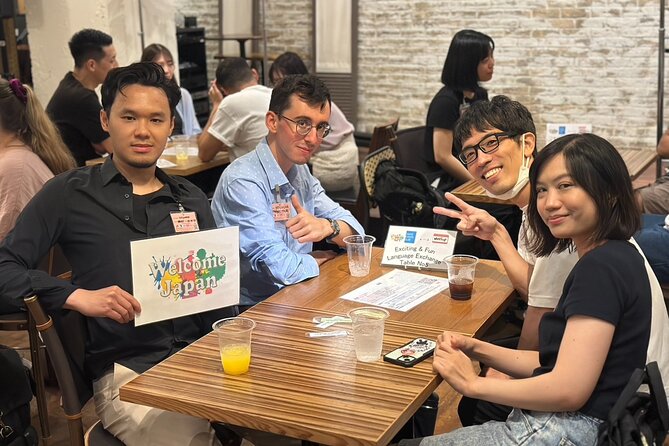
The rotations are not just a way to keep the event moving. They improve the odds of finding the type of conversation you want.
One group might include a beginner who needs simple English, a Japanese participant practicing English, and another international visitor who speaks more Japanese. The next group may feel different. By changing seats more than once, you get a broader mix of accents, language levels, and subjects.
The group size helps. Three or four people is large enough to avoid a conversation collapsing if one person is shy, but small enough for everyone to speak. A group of 20 would be hard to manage as one conversation. The staff instead organize the maximum attendance into smaller circles.
The rotations can also help solo visitors who feel nervous at first. You do not have to make one perfect connection immediately. Each new round gives you another chance to introduce yourself and try a different level of Japanese.
The tradeoff is that the system can interrupt a conversation just as it becomes interesting. If you make a promising connection, exchange contact details before the event ends. The closing group photo provides a natural final moment, but it is not a substitute for making your own plans.
The value of $29 for a two-hour meetup
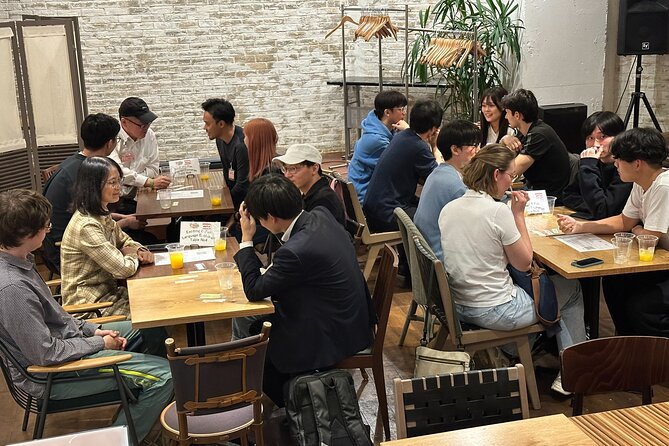
At $29 per person, this costs more than simply entering a bar and chatting with whoever happens to be there. You are paying for organization, staff supervision, prepared topic cards, group placement, and repeated seat changes.
That structure is the main value. You could practice Japanese for free in many parts of Tokyo, but finding a balanced group of Japanese and international participants at a convenient time is less certain. Here, the event gives you a two-hour framework and removes much of the guesswork.
The price is easier to justify if you want one or more of these things:
- A planned social activity in Shibuya
- A chance to meet people without joining a large tour
- Regular opportunities to speak Japanese
- Help getting started with beginner-level conversation
- A simple evening activity that can lead into a later night out
The value is weaker if you already have local friends, dislike group events, or mainly want a formal Japanese class. You may also spend more than $29 after buying a drink, so include that in your budget.
The maximum group size is 20. That is small enough for a personal feel, but the exact mix of Japanese speakers and international participants can vary by night. The event promises a Japanese and foreign participant mix, not a fixed number of native speakers for every group.
A useful start to a bigger Shibuya evening
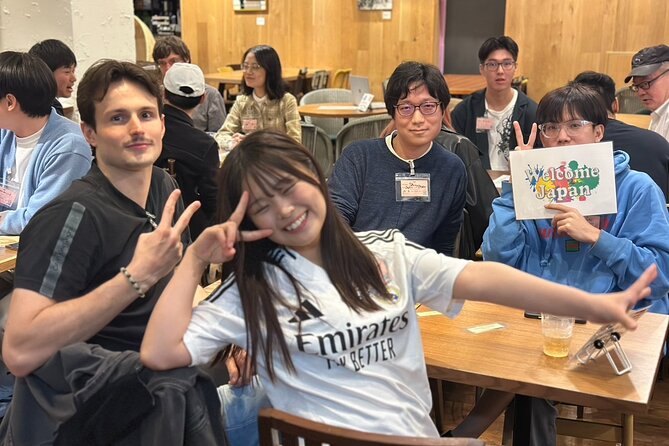
The 7:30 PM start works well as an early-night plan. You can meet at the venue, take part in the scheduled rounds, and finish at 9:30 PM with the rest of the night still open.
Shibuya is a natural place for that kind of plan, since the event is already in one of Tokyo’s best-known nightlife districts. The activity itself does not include a bar crawl, dinner, or later entertainment. You make those arrangements separately.
That limitation is also a strength. You can book this as a complete two-hour activity without committing to a full night with the same group. If you connect with people, you can continue together afterward. If not, you have still completed a focused language practice session.
The format is especially useful near the start of a Tokyo visit. You may leave with a few new contacts, a better feel for conversational Japanese, and a clearer idea of what local people enjoy talking about. Just keep your expectations practical. This is a social exchange, not a guaranteed friendship-making service or a private cultural tour.
Who will get the most from this experience
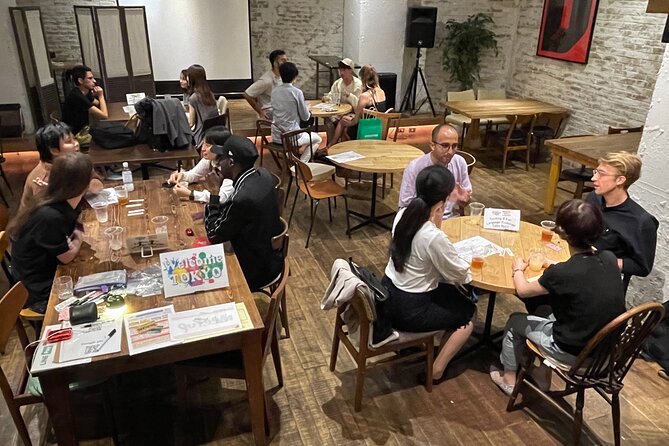
I would recommend it most strongly to solo visitors, couples who want a social night, and Japanese learners who need a reason to speak aloud. Beginners can take part, and the topic cards reduce the fear of running out of things to say.
It also suits people who want to help Japanese participants practice English. The alternating format means you are not simply asking locals to accommodate your language needs. You give something back during the English rounds.
You may enjoy it less if you prefer quiet venues, dislike seat changes, or want long conversations with one carefully chosen partner. The pub environment and bowling noise are genuine considerations. So is the required drink purchase.
The event is also for adults only. Since it takes place in a pub, anyone under 18 cannot participate.
Practical details before you go
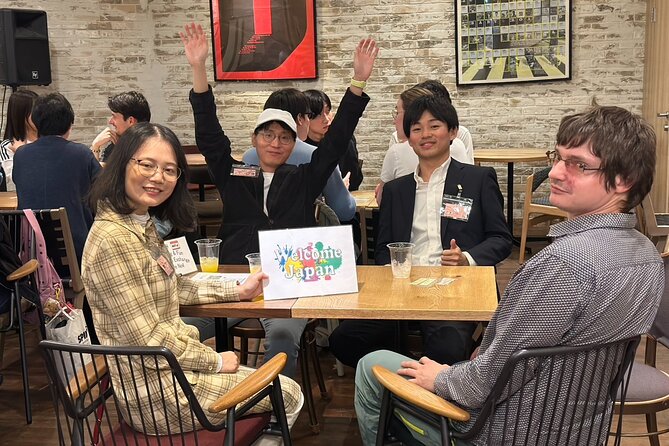
Your mobile ticket is confirmed at booking, and the meeting point is near public transportation. Look for Shibuya Bowling Cafe in Shibuya EST, then go down to the B1F cafe area.
Arrive before 7:30 PM, since reception begins 10 minutes before the activity. You will need to check in and buy a minimum of one drink before joining the conversation.
The activity ends back at the meeting point. It is listed for Mondays from 7:30 to 9:30 PM, with operating dates shown from September 10, 2023 through December 7, 2026. The date range is broad, but the weekly schedule provided is Monday evening, so check your selected date carefully when booking.
Free cancellation is available if you cancel at least 24 hours before the local start time. Cancellations or changes made less than 24 hours ahead are not refunded or accepted.
Should you book the Shibuya language exchange?
Book it if you want organized conversation rather than an unplanned bar visit. The rotating groups, topic cards, and clear English-Japanese schedule give you several chances to speak, even if your Japanese is basic.
Skip it if you need a quiet setting, a formal lesson, or a ticket that includes drinks. The $29 price is fair for the planning and staff support, but your beverage costs extra, and the bowling area may be loud.
For the right person, this is a simple and useful way to make a Monday night in Tokyo more social. Bring a few easy questions, accept that your Japanese will not be perfect, and use each 15-minute round as a fresh chance to talk.
FAQ
How long does the Japanese speaking experience last?
The activity lasts approximately two hours, from 7:30 PM to 9:30 PM on Mondays.
Where does the event meet?
You meet at Shibuya Bowling Cafe in Shibuya EST, at 1-chōme-14-14 Shibuya, Tokyo 150-0002, Japan. The cafe is on B1F.
Is the event suitable for Japanese beginners?
Yes. Beginner Japanese learners are welcome, and the event information says you can participate even if you cannot speak Japanese.
How are the conversation groups organized?
Staff place attendees into small groups of about three or four people, mixing Japanese and international participants.
How often do the groups change?
Staff change the seating after conversation blocks, giving you the chance to speak with different people more than two or three times during the event.
How do the English and Japanese sessions work?
The schedule alternates between 15 minutes of English conversation and 15 minutes of Japanese conversation. There are also five-minute breaks for changing seats.
Are drinks included in the ticket?
No. The $29 ticket includes all fees and taxes for the event, but drinks and food are not included. You must buy at least one drink at the bar, and alcoholic beverages cost extra.
Can people under 18 participate?
No. The activity takes place in a pub and is limited to people aged 18 and older.
New on our Tokyo list
- From Tokyo: Mount Fuji & Hakone Full Day Private Tour★ 4.9 · 25 reviews
- Tokyo Spectacular View Day-Cruise in 90 Minutes★ 5.0 · 25 reviews
- Real Tokyo Runner Club : Daikoku Car Meet Night Tour with JDM Car★ 5.0 · 25 reviews
- 2.5 Hour-Guided Cycle Tour in the Central Tokyo★ 5.0 · 25 reviews
- Tokyo: 2-Hour Night Bike Tour of the City’s Hidden Gems★ 4.9 · 25 reviews
- Ramen Making from Scratch +Akihabara Tour –Cooking Class★ 5.0 · 25 reviews
- [Self-Drive] Tokyo & Daikoku Custom Car Driving Tour★ 4.9 · 25 reviews
- Samurai themed Entertainment show in Shinjuku★ 4.5 · 25 reviews
Shibuya Tours, compared.

Shibuya Meltdown Nightlife Tour: All-You-Can-Drink Bar Hopping
Read our review →
Shibuya Official Street Go-Kart in Shibuya Annex
Read our review →
Premium Go-Kart Tour with Tower & Shibuya Crossing
Read our review →Browse the lists this tour appears in