
Reviewed · SHINJUKU TOURS
Tokyo Private Art Tour in Kagurazaka Shinjuku with Licensed Guide
Tokyo’s art story gets much more interesting when it leaves the museum. This private walk links Yayoi Kusama’s imaginative work with Kengo Kuma architecture, a sleek shrine, old geisha-district streets, and the stone remains of an Edo castle gate. It is a compact lesson in how old and new Tokyo share the same neighborhood.
I like the small private format, which gives you room to ask about Kusama, Edo culture, shrines, or architecture without keeping pace with a large group. I also like the route’s variety: one hour inside the Yayoi Kusama Museum is followed by free outdoor sights that show Tokyo beyond gallery walls.
The main caution is guide consistency. Nao is praised for being friendly, clear, and able to connect Kusama with Japanese history, but another published account says the guide offered little art explanation. If expert-level art commentary is your main goal, this is a point to weigh carefully.
In This Review
- Key points at a glance
- Why this Tokyo art walk is different
- One hour with Yayoi Kusama
- Akomeya Tokyo and Kengo Kuma’s design
- Akagi Shrine, where old religion meets modern form
- Kagurazaka, an Edo district with a French touch
- Ushigome Mitsuke and the end near Iidabashi
- What the guide adds, and where to be careful
- Is the $46.05 price good value?
- Timing, meeting point, and practical fit
- Who should book this experience?
- Should you book the Tokyo private art tour?
- FAQ
- How long does the Tokyo private art tour last?
- What time does the tour begin?
- Where does the tour start?
- Where does the tour end?
- Is admission to the Yayoi Kusama Museum included?
- Are the other stops free to enter?
- Can I cancel for a full refund?
Key points at a glance
- Yayoi Kusama Museum: Spend about one hour with admission included, including an introduction to Kusama’s life and work.
- Kengo Kuma architecture: Visit Akomeya Tokyo, whose building design comes from one of Japan’s best-known architects.
- A surprising shrine: Akagi Shrine pairs Shinto tradition with a modern architectural look.
- Kagurazaka’s two identities: Walk a district shaped by Edo-era traces and a refined Parisian feel.
- Samurai-era remains: Finish at Ushigome Mitsuke, an old defensive gate site near Iidabashi.
- Private, guided route: The experience begins at 2:30 pm and ends near JR Iidabashi Station.
Why this Tokyo art walk is different
Many art outings in Tokyo keep you inside one museum. This route does something more useful for a first visit: it treats the city itself as the exhibition. You begin with Kusama’s paintings and installations, then move through architecture, religion, traditional neighborhoods, and military history.
That change of subject is the route’s strength. You are not simply looking at art objects. You are learning how Tokyo, once Edo, expressed ideas through buildings, shrines, city streets, and castle defenses.
The experience lasts about two hours and 30 minutes. That is long enough for several distinct stops, but short enough to fit comfortably into an afternoon. The start time is 2:30 pm, so you can use the morning for another museum or neighborhood before meeting the guide.
Because this is a private activity, only your group participates. That matters at the Kusama Museum, where you may want to pause, ask questions, or discuss what you are seeing without a stranger’s timetable shaping the visit.
More Shinjuku nights and walks:
- Tokyo: Shinjuku Food Tour (13 Dishes at 4 Local Eateries)
★ 5.0 · 6,603 reviews - Tokyo Bar Hopping Tour in Shinjuku (All-You-Can-Drink + Dinner)
★ 5.0 · 3,587 reviews - Tokyo: Shinjuku Food Tour (15 Dishes and 4 Eateries)
★ 4.9 · 2,033 reviews
One hour with Yayoi Kusama
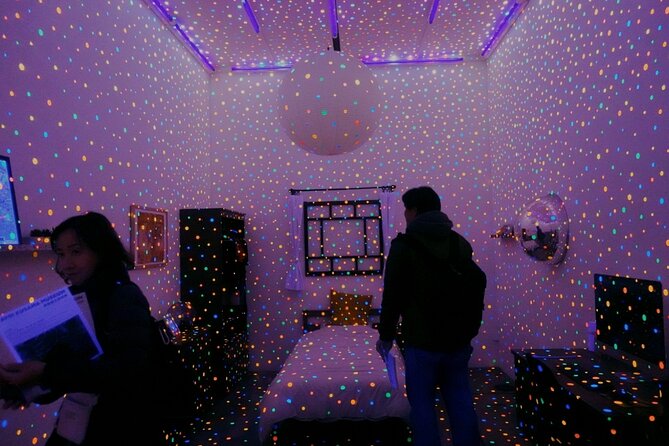
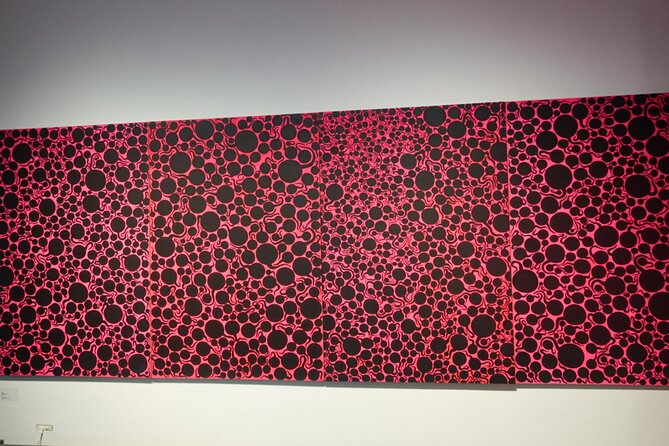
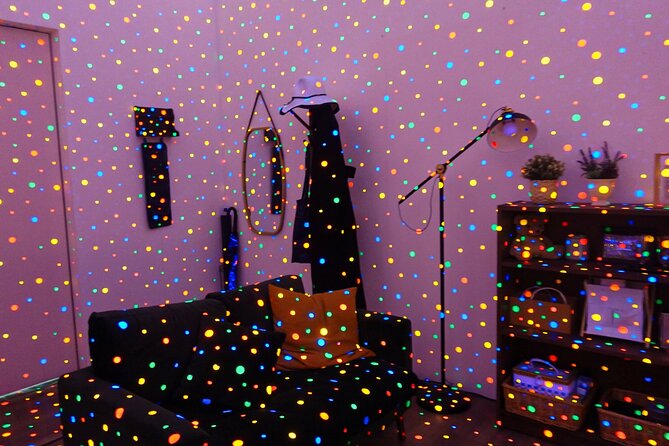
The Yayoi Kusama Museum is the main attraction and receives the largest block of time. Admission is included, and you spend about one hour exploring the artist’s world while the guide explains her biography.
Kusama is internationally famous for her repeated patterns, dots, mirrored spaces, and intense visual language. The value of having a guide here is not simply learning the titles of the works. A good explanation can help you connect the art to Kusama’s life and understand why repetition, infinity, and strong color appear so often.
The museum visit also gives the tour a clear anchor. The outdoor stops that follow are easier to understand after starting with a major modern artist whose work is strongly connected to Japan.
Still, keep your expectations measured. The guide is a licensed Tokyo guide, not necessarily a museum art specialist. One published assessment praises Nao for explaining Kusama, shrines, temples, and Japanese history in an engaging way. Another says the guide mainly pointed to wall text and seemed surprised that the booking centered on art.
That difference is important. If you want a scholarly reading of every piece, this may not be the right choice. If you want a personal guide to help you connect Kusama with the rest of Tokyo, the visit may work well, especially when you ask direct questions.
Akomeya Tokyo and Kengo Kuma’s design
After the museum, the route turns to Akomeya Tokyo. You spend about 20 minutes here, and there is no separate admission charge.
The building was designed by Kengo Kuma, a major Japanese architect known around the world. This stop shifts the focus from an artist’s work to the way a building can shape your sense of place.
Twenty minutes is not enough for a full architecture lecture, but it is enough to look carefully at the design and ask why the building feels distinctive. The guide can also place Kuma within modern Japanese architecture, giving you a useful bridge between Kusama’s visual ideas and Tokyo’s built environment.
This is one of the tour’s most practical features: you do not need to dedicate a full day to architecture to see an important example. The stop is brief and free, so it adds value without making the tour feel like a series of ticketed attractions.
Akagi Shrine, where old religion meets modern form
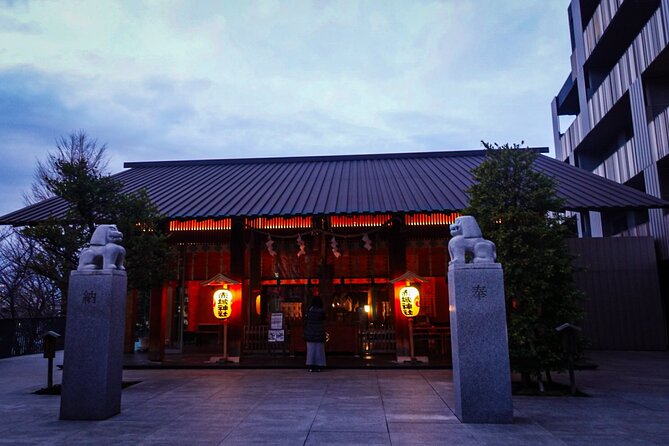
Akagi Shrine is another free stop, with about 20 minutes set aside for it. The shrine is described as very modern and sophisticated, which may surprise you if you expect every Shinto site to look like a traditional wooden complex.
That contrast is exactly why the stop belongs on an art-focused route. Architecture here becomes part of the religious experience. You can look at the shrine not only as a place of worship, but also as a modern design project within an old Tokyo setting.
The guide’s role is especially useful at a shrine. A visitor can admire the structure, but may not know what details matter or how the space relates to Japanese customs. The published feedback gives the guide credit for explaining shrines and temples, and one especially positive account pairs Akagi Shrine with Kusama as a highlight.
The time is short, so this is an introduction rather than a full religious tour. You will have enough time to see the site and hear an explanation, but not to linger at length.
A few more Tokyo bookings worth comparing
- Mt Fuji and Hakone 1-Day Bus Tour Return by Bullet Train
★ 5.0 · 26,383 reviews - 1-Day Tokyo Bus Tour
★ 5.0 · 14,250 reviews - Tokyo: TOKYO SKYTREE® Admission ticket
★ 4.5 · 11,192 reviews - Tokyo: teamLab Planets TOKYO Digital Art Museum Entry Ticket
★ 4.6 · 9,779 reviews
Kagurazaka, an Edo district with a French touch
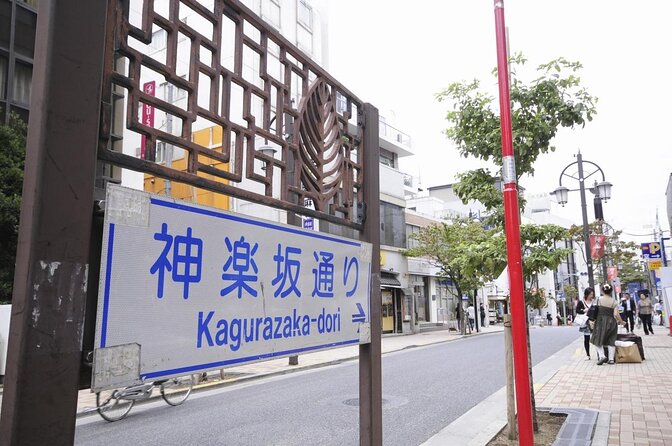
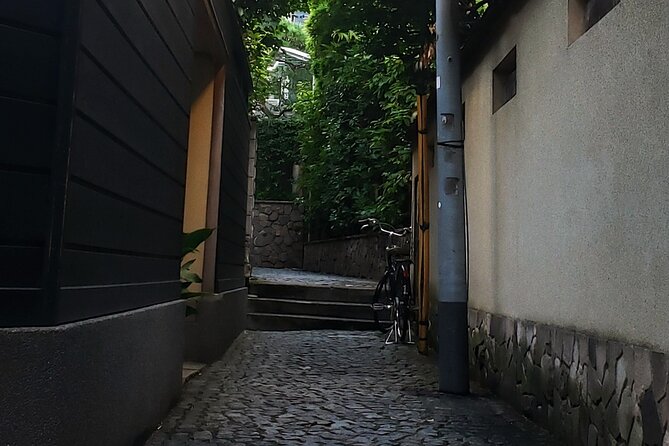
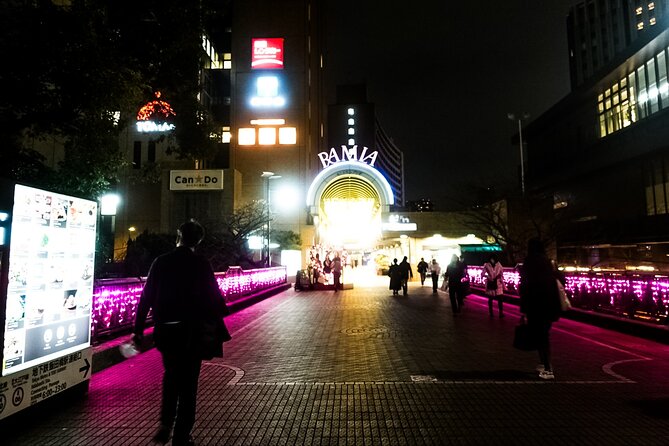
The longest outdoor stop is Kagurazaka, where you spend about 30 minutes. This neighborhood is known for retaining traces of the Edo period while also having a sophisticated Parisian atmosphere.
That combination gives the walk its strongest sense of place. You are not looking at a single monument. You are reading the character of a neighborhood, where older city patterns and more modern international influences meet.
Kagurazaka once developed as a lively district connected with entertainment and geisha culture. The supplied tour information points to its geisha-street identity and its Edo-era atmosphere. Your guide can help you notice why the area feels different from Tokyo’s large commercial districts.
Thirty minutes will give you a focused introduction, not a full neighborhood exploration. You may find yourself wishing for more time, particularly if you enjoy small streets, architecture, or traditional culture. The tradeoff is that the route also includes four other stops, so Kagurazaka is part of a broad picture rather than the entire subject.
I like this section because it brings the tour back to ordinary city space. After the controlled environment of a museum and the formal setting of a shrine, you see how history survives in streets that people still use.
Ushigome Mitsuke and the end near Iidabashi
The final stop is Ushigome Mitsuke, one of the remaining signs of the samurai era. The tour ends at 2 Chome-9 Fujimi in Chiyoda City, near Ushigome-Mitsuke and JR Iidabashi Station.
The site is connected with Edo Castle, and the guide explains its role as a historic defensive point. You may not see a grand castle building here. The appeal lies in the surviving traces of the city’s old defenses and the chance to understand Tokyo before it became the modern capital you see today.
This ending gives the walk a logical direction. You begin with a living contemporary artist, move through modern design and religious architecture, walk an old district, and finish with a reminder of the samurai government that shaped Edo.
Ending near JR Iidabashi Station is also useful. You can continue to another part of Tokyo by train rather than having to return to the starting point. The route begins near FamilyMart Evergrace Haramachi in Shinjuku City, at 1-chome 13-13 Haramachi, so the start and finish are in different places.
What the guide adds, and where to be careful
The experience is sold around the licensed guide, so the human element matters as much as the stops. A private guide can adjust the explanation to your interests and help you make links between art, architecture, shrines, and Edo history.
Nao receives especially warm praise for being easy to talk with, bright, fun, and able to keep the walk interesting. That description suggests the tour works best for people who value conversation and broad cultural context rather than a formal academic lecture.
At the same time, one strongly negative account describes a guide who did not seem prepared to discuss art and relied on labels in the gallery. The provider disputed that account and stated that the museum admission had been paid and the visit had taken place.
You should treat this as a real qualification, not a minor footnote. The overall rating is 3.7 from three published assessments, which reflects both enthusiastic and very critical reactions. If you book, go in ready to ask specific questions about Kusama’s biography, artistic themes, Kengo Kuma’s design, shrine architecture, and Edo defenses. That can help you get more from the time you have.
Is the $46.05 price good value?
At $46.05 per person, the price is reasonable if you want a private guide and plan to visit the Kusama Museum anyway. Museum admission is included, while the other listed stops have no separate admission charge.
The value comes mainly from the guide and the route design. You are paying for a structured connection between five very different places, not for a long list of costly attractions. A self-guided visitor could walk through some of these areas, but would need to research the connections in advance.
The price is less compelling if you only want to see Kusama’s work. The museum receives about an hour, and the rest of the time is spent on architecture, a shrine, Kagurazaka, and Edo remains. That mix is ideal for someone interested in Tokyo as a whole, but not for someone seeking a specialist gallery tour.
Since only your group participates, the cost may make more sense for couples, families, or friends who want a flexible conversation. Solo visitors should consider the per-person price carefully, since the private format can be more valuable with several people sharing the cost.
Timing, meeting point, and practical fit
The 2:30 pm start gives the tour a clear afternoon shape. You need to reach FamilyMart Evergrace Haramachi in Shinjuku City for the meeting, then finish near Iidabashi Station.
The route is near public transportation, and most people can participate. The details do not promise a particular level of physical accessibility, so anyone with mobility concerns should confirm the walking conditions before booking.
A mobile ticket is provided, and confirmation arrives when you book. You can cancel for a full refund up to 24 hours before the start time. Changes or cancellations made inside that 24-hour window are not accepted, with cut-off times based on Tokyo local time.
The tour is best for someone who likes moving between indoor and outdoor sights. It may feel too scattered if you prefer to spend an entire afternoon in one museum, but that variety is the point for many visitors.
Who should book this experience?
I would recommend this walk to first-time Tokyo visitors who want an introduction to several sides of the city in one short outing. It also suits anyone already interested in Kusama but curious about how modern art fits beside shrines, old streets, and Edo remains.
It is a good match for:
- Couples or families who want a private guide
- Visitors interested in both art and Japanese history
- People who enjoy architecture and neighborhood walks
- Kusama fans who also want to see more than a museum
- Anyone with a free afternoon near Shinjuku and Iidabashi
I would be more cautious if you are an art historian, museum professional, or serious Kusama specialist. The guide’s art expertise appears to vary, and the tour’s subject is broad. You may gain more from booking a dedicated museum expert if detailed formal analysis is your priority.
Should you book the Tokyo private art tour?
Book it if you want a compact, private introduction to Tokyo through art and place, and you like the idea of pairing Kusama with Kengo Kuma, Akagi Shrine, Kagurazaka, and Edo castle remains. The route has a thoughtful range, the museum admission is included, and the final location near Iidabashi makes it easy to continue your afternoon.
Skip it if your sole aim is expert Kusama interpretation or an unhurried museum visit. The tour’s best quality is its breadth, while its main risk is uneven guide performance. For the right reader, that broad view of Tokyo is worth more than a longer stay in one gallery.
FAQ
How long does the Tokyo private art tour last?
The experience lasts approximately two hours and 30 minutes.
What time does the tour begin?
The scheduled start time is 2:30 pm.
Where does the tour start?
The meeting point is FamilyMart Evergrace Haramachi, 1-chome 13-13 Haramachi, Shinjuku City, Tokyo 162-0053, Japan.
Where does the tour end?
The tour ends at 2 Chome-9 Fujimi, Chiyoda City, Tokyo 102-0071, near Ushigome-Mitsuke by JR Iidabashi Station.
Is admission to the Yayoi Kusama Museum included?
Yes. Admission to the Yayoi Kusama Museum is included in the tour.
Are the other stops free to enter?
Akomeya Tokyo, Akagi Shrine, Kagurazaka, and Ushigome Mitsuke are listed with no separate admission charge.
Can I cancel for a full refund?
Yes. You can cancel at least 24 hours before the local start time for a full refund. Cancellations and changes made less than 24 hours before the start are not accepted.
New on our Tokyo list
- Sumi-e Experience in a relaxing green tea shop in Tokyo★ 5.0 · 3 reviews
- Tokyo : Kamikaze Street Drift Ride★ 5.0 · 3 reviews
- Private Zen Meditation in English in Shinjuku, Tokyo★ 5.0 · 3 reviews
- Onsen Spa in Tokyo and Asakusa Bar Hopping with Local Guide★ 5.0 · 3 reviews
- Easy for everyone! Now you can play handmade mini shamisen and show off to everyone! Musical instruments, sweets and live music★ 5.0 · 3 reviews
- Tokyo: Private Tsukiji Street Food & Sake with Local Guide★ 5.0 · 3 reviews
- Mt Fuji Exploration Tour with Free Japanese Kusa Mochi from Tokyo★ 4.5 · 3 reviews
- Tokyo Tsukiji Fish Market Walking and Exploring Hidden Gems Tour★ 5.0 · 3 reviews
Shinjuku Tours, compared.
Shinjuku Food Tour (13 Dishes at 4 Local Eateries)
Read our review →
Tokyo Bar Hopping Tour in Shinjuku (All-You-Can-Drink + Dinner)
Read our review →
Shinjuku Food Tour (15 Dishes and 4 Eateries)
Read our review →
Best of Shinjuku: Izakaya Food Tour (4 Stops, 14+ Tastings)
Read our review →
Shinjuku Local Bar and Izakaya Guided Walking Tour
Read our review →

Tokyo Shinjuku Sumo Show & Experience with Photo
Read our review →
Tokyo Night Foodie Tour in Shinjuku – Seasonal Sushi, Wagyu Beef
Read our review →Browse the lists this tour appears in