
Reviewed · AUDIO TOURS
Tokyo: Open Top Sightseeing Bus with Audio Guide
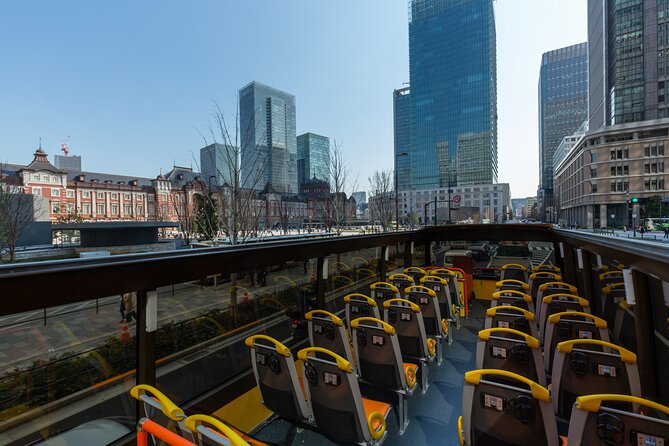
Tokyo looks different from the upper deck of a bus. In about 70 minutes, you pass Tokyo Tower, Ginza, Rainbow Bridge, Odaiba, and major central districts without wrestling with a subway map. It is a smart way to get your bearings fast, especially after a long flight or before choosing which sights deserve more time.
I like the low price of $11.71 and the useful GPS audio system, which offers commentary in Japanese, English, Chinese, French, Korean, Vietnamese, and Thai. I also like the comfortable waiting lounge near Tokyo Station, where drinks are available before departure. The main drawback is that this is a continuous sightseeing ride, not a hop-on, hop-off service, and the recorded commentary may not always line up perfectly with what you are seeing.
In This Review
- Key points to know before booking
- Why this short Tokyo bus ride works
- Choosing between the Bay Course and City Course
- Bay Course: Tokyo Tower, Rainbow Bridge, and Odaiba
- City Course: central Tokyo from the upper deck
- What the GPS audio guide adds
- The open-top advantage, and its limits
- The Yaesu meeting point near Tokyo Station
- What to bring and what to leave behind
- Is $11.71 good value?
- Who should book this ride?
- Booking, cancellation, and weather details
- Should you book the Tokyo open-top bus?
- FAQ
- How long does the Tokyo open-top bus tour last?
- Is this a hop-on, hop-off bus?
- Where does the bus tour begin and end?
- Which languages are available for the audio guide?
- Is there a live guide on the bus?
- What headphones do I need?
- What happens if it rains?
- How early should I arrive?
- Can I bring luggage?
- Can I cancel for a refund?
Key points to know before booking
- Two routes offer different views: Choose the Bay Course for Tokyo Bay, Odaiba, and Rainbow Bridge, or the City Course for central sights such as the Imperial Palace, Roppongi, Tokyo Tower, and Ginza.
- The ride lasts about 70 minutes: You remain on the bus and return to the same meeting point.
- GPS audio works in seven languages: The system follows the bus location and adjusts its timing for traffic and road changes.
- The bus may not remain open in rain: The tour runs in most weather, but the roof can be closed when it rains.
- The Yaesu meeting point has a waiting lounge: Open-top bus customers may use the facility free of charge from 40 minutes before departure.
- Arrive early: Check in 20 to 40 minutes before the scheduled time. The bus leaves promptly, and late arrivals are not refunded.
Why this short Tokyo bus ride works
This is a simple tour with a clear purpose: give you a broad look at Tokyo from the road. You are not stopping to enter temples, climb towers, or browse shops. Instead, you sit back while the city’s districts and landmarks pass around you.
That makes the ride especially useful on your first day. After a long flight, you may not want to plan a complicated route across town. From the open upper deck, you can see how Tokyo’s historic center, office districts, waterfront, and shopping streets fit together. You may also spot places you want to revisit later by train or on foot.
The bus holds up to 40 people, so this is a shared group outing rather than a private tour. The experience is relaxed, but it is not highly personal. You will have Japanese-speaking staff available for help, yet there is no live guide explaining the sights throughout the trip.
At this price, I see the ride as a city orientation rather than a full sightseeing day. You pay little more than you might spend on a casual meal, and you get a moving view of several major districts without paying admission to separate attractions.
A few more Tokyo bookings worth comparing
- Tokyo: Open Top Panoramic Sightseeing Bus with Audio Guide
★ 3.8 · 254 reviews - Tokyo: 60min Panoramic Open Top Bus Tour with Audio Guide
★ 4.0 · 40 reviews - Akihabara: Self-Guided Tour with a special brochure
★ 3.7 · 11 reviews
Choosing between the Bay Course and City Course
The available routes give you two different versions of Tokyo. Since departure schedules can change, check which course is offered for your chosen time before booking.
Bay Course: Tokyo Tower, Rainbow Bridge, and Odaiba
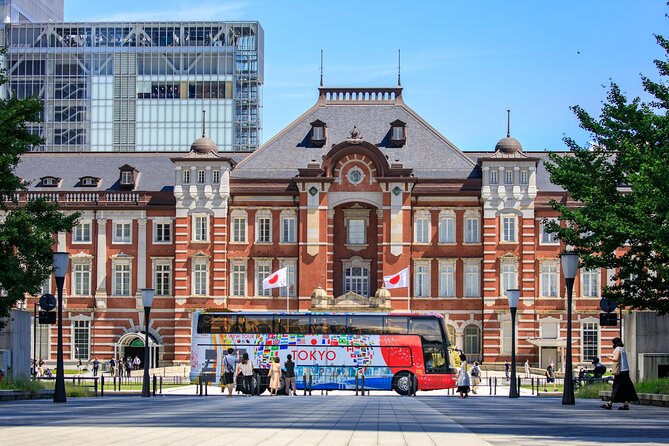
The Bay Course begins near the Tokyo Station Red Brick Station Building and moves through Marunouchi. This area gives you an early look at Tokyo’s polished business center, with broad streets and major office buildings around the station.
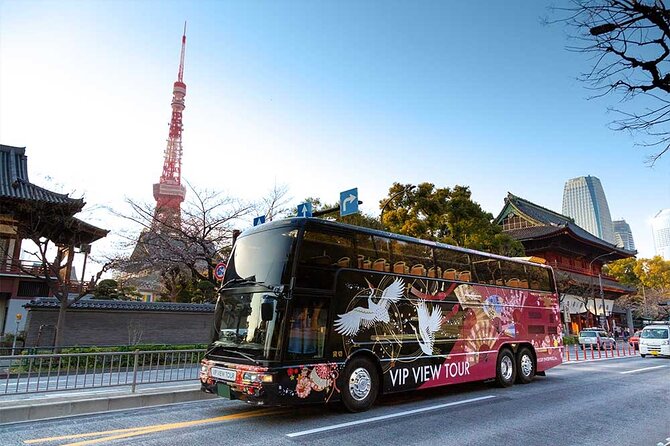
The route then passes Zojoji Temple and Tokyo Tower. The pairing is classic Tokyo: a major Buddhist temple near one of the city’s best-known modern towers. From the bus, you will see these landmarks as part of the wider city rather than as separate stops.
Next comes Shibaura and the first level of Rainbow Bridge. The bridge is one of the ride’s most memorable features, linking central Tokyo with the waterfront district. An open-top bus gives you air, height, and broad views as you cross the area, though traffic can affect the exact timing.
The Bay Course continues toward the Fuji TV Building, the Statue of Liberty, and Odaiba Seaside Park. Odaiba has a more modern, recreational feel than the older central districts. The route lets you see the waterfront from the road without arranging a separate visit.
The bus then reaches the second level of Rainbow Bridge before heading through Shiodome and Ginza. Shiodome is known for its large office and commercial buildings, while Ginza brings the ride back to one of Tokyo’s most famous shopping areas.
I would choose this route if you want the widest mix of city views. You get Tokyo Station, a temple, Tokyo Tower, the bridge, the bay, Odaiba, and Ginza in one loop. The tradeoff is that several sights are seen only from the bus, so you should not treat the route as a substitute for visiting Zojoji, Odaiba Seaside Park, or Tokyo Tower.
City Course: central Tokyo from the upper deck
The City Course focuses more closely on Tokyo’s central districts. It passes the Imperial Palace, Tokyo Midtown, Roppongi, Tokyo Tower, and Ginza.
The Imperial Palace area gives you a sense of the capital’s formal center. Tokyo Midtown and Roppongi show a different side of the city, with modern commercial and cultural development. Tokyo Tower and Ginza add two major landmarks that help anchor the route.
This course may suit you better if you want central Tokyo rather than the waterfront. It is also a practical choice if your plans already include Odaiba or Rainbow Bridge on another day. The supplied route details do not list every turn or sight on the City Course, so confirm the exact departure information if a particular neighborhood matters to you.
Same corner of Tokyo, a completely different plan:
- Mt Fuji and Hakone 1-Day Bus Tour Return by Bullet Train
★ 5.0 · 26,383 reviews - 1-Day Tokyo Bus Tour
★ 5.0 · 14,250 reviews - Tokyo: TOKYO SKYTREE® Admission ticket
★ 4.5 · 11,192 reviews - Tokyo: teamLab Planets TOKYO Digital Art Museum Entry Ticket
★ 4.6 · 9,779 reviews
What the GPS audio guide adds
The automatic audio system is one of the more useful features here. GPS tracks the bus and plays sightseeing information based on your location. It is available in seven languages: Japanese, English, Chinese, French, Korean, Vietnamese, and Thai.
That setup means you do not need to follow a printed map while watching the streets. In theory, the commentary arrives as the bus reaches each area, and the system can adjust when traffic changes the schedule.
In practice, timing may not always be exact. You might hear information slightly before or after the landmark appears, and it may not always be obvious which building the narration refers to. If you want a perfectly synchronized explanation of every sight, a live guide would be better.
There is also music between sections of commentary. Some people may find it pleasant, while others may find repeated music distracting. I suggest treating the audio as background context rather than a detailed tour lecture. Keep looking outward and use the narration to add names and basic significance to what you see.
You need earphones with a standard 3.5mm mini plug. If you do not bring your own, optional earphones are available for 100 yen. Check your headphones before departure, since the information specifically supports this plug type.
The open-top advantage, and its limits

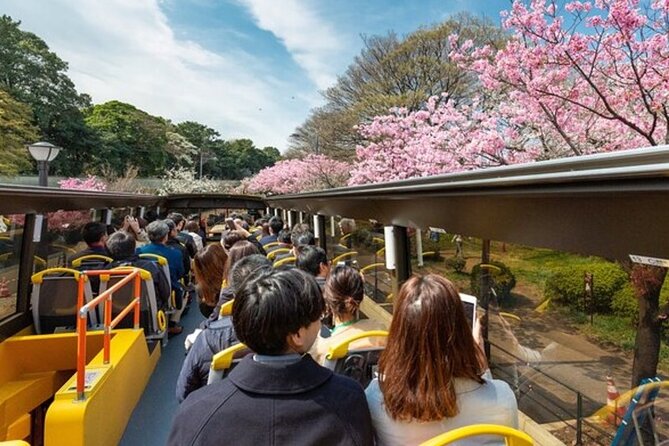
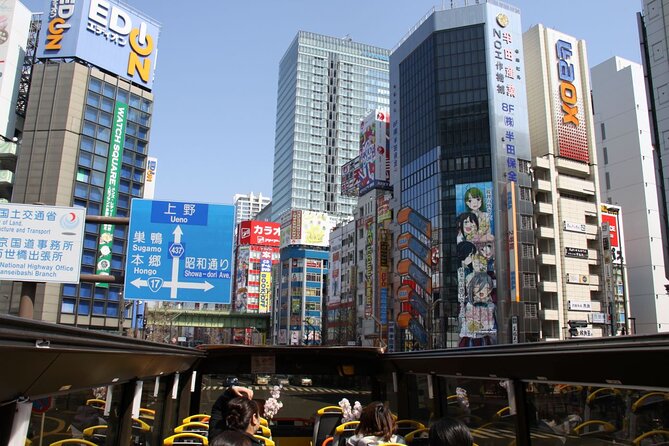
The upper deck gives you a much wider view than a regular enclosed bus. You can look above street-level obstacles, see the shape of districts, and take in bridges and towers without viewing everything through a side window.
This matters most around Rainbow Bridge, Tokyo Tower, and the bay. The open air also makes the ride feel more like a city experience than a basic transfer.
Weather is the catch. The tour operates in rain or shine except in extreme conditions such as typhoons, but the open top may be closed if it rains. You should check the forecast and dress for the conditions. An umbrella is not allowed on the vehicle, so do not plan to solve a rainy day with one during the ride.
Schedules may shift slightly because of traffic, weather, or other road conditions. Tokyo roads can be busy, and the bus cannot control the pace of the city. Build a little flexibility into the rest of your day rather than scheduling a timed attraction immediately after the ride.
The Yaesu meeting point near Tokyo Station
The departure point is Tokyo VIP Lounge at 1-chome 5-9 Yaesu, Chuo City, on the second and third floors. It is near public transportation, but you should verify the exact location in advance. The address is in the Yaesu area of Tokyo Station, where several streets and station exits can make a first visit confusing.
Check in 20 to 40 minutes before departure. The bus does not wait for late arrivals, and there is no refund if you reach the wrong location or arrive after the scheduled departure time. This is one part of the experience where a relaxed approach can work against you.
The meeting point is a paid facility shared with other users. Open-top bus customers can use it free of charge beginning 40 minutes before departure. If you arrive earlier, you may need to pay the facility fee. Drinks are available while you wait, which is a small but useful touch if you have just come from the station.
Japanese-speaking staff can help at the meeting point. There is no named live guide listed for the ride, so think of the staff as departure support rather than a person who will narrate the city from the bus.
What to bring and what to leave behind

You may bring one piece of luggage per person, provided it fits comfortably in the vehicle. Luggage stored in the trunk cannot be reached during the ride, so keep passports, medication, cameras, and other valuables with you.
The maximum trunk size is a combined height, width, and depth of 155 centimeters. If you are carrying a large suitcase, measure it before arriving. A compact bag is easier to manage on a shared sightseeing bus.
Smoking and food are not allowed. Selfie sticks and umbrellas are also prohibited. These rules make sense on an open upper deck, where loose objects and food can create problems for other passengers.
Bring earphones if you want to use the audio guide. A standard 3.5mm plug is required, and replacement earphones cost 100 yen if needed.
Is $11.71 good value?
At $11.71 per person, this is inexpensive for a 70-minute city ride in central Tokyo. The price is strongest when you value convenience, broad views, and a first look at several districts more than detailed interpretation.
You are not paying for entry to Tokyo Tower, Zojoji Temple, the Imperial Palace, Fuji TV Building, or any other attraction. You also cannot get off at those places. The value comes from seeing them without buying separate tickets or planning several train connections.
For a first visit, the ride can save mental effort. You see enough of Tokyo to decide where to return, and you do it from a comfortable seat with multilingual commentary. I especially like it as a first-day activity, when jet lag makes a demanding schedule less appealing.
The price is less compelling if you already know Tokyo well or prefer to explore on foot. You can see the city in greater detail by choosing individual districts and spending time inside the sights. The bus gives you breadth, not depth.
Who should book this ride?
I would recommend it to first-time visitors, people with limited time, and anyone who wants a calm overview before tackling Tokyo’s transport system. It also suits you if you have just arrived from a long flight and want an easy activity with a fixed start and finish.
Families and mixed-age groups may find the straightforward format useful, since most people can participate and there is no long walking route listed. The upper deck may also appeal to anyone who enjoys seeing a city from a different angle.
You should think twice if your main goal is to visit attractions rather than view them. The bus does not stop for sightseeing, and the lack of a live guide means you will need to accept some gaps in the commentary.
You should also reconsider if you need perfect audio timing. The GPS system is a helpful feature, but road conditions and the route itself can make the narration feel slightly out of sync.
Booking, cancellation, and weather details
You can cancel for a full refund up to 24 hours before the experience start time. Changes made within 24 hours are not accepted, and cancellations inside that period are not refunded.
The activity requires a minimum number of participants. If the operator cancels because that minimum is not reached, you will be offered another date or experience, or a full refund.
The bus runs in most weather, with cancellations limited to extreme conditions such as typhoons. The roof may be closed in rain, and route times can change because of weather or traffic. Contact support is not guaranteed outside Monday through Friday, 9:30 a.m. to 6 p.m. Japan time, so check your plans early.
Should you book the Tokyo open-top bus?
Book this if you want a low-cost, low-effort introduction to Tokyo, especially on your first day. The Bay Course gives you the most varied ride, with Tokyo Tower, Rainbow Bridge, Odaiba, and Ginza all included. The City Course is better for central sights such as the Imperial Palace, Roppongi, and Tokyo Midtown.
Do not book it expecting a hop-on, hop-off pass or a guided visit inside the landmarks. You remain on board, the audio may not always match the view perfectly, and rain can close the roof.
For $11.71, I think the ride makes sense as a quick orientation and a pleasant way to see Tokyo’s scale. Arrive early, bring compatible earphones, check the weather, and choose the route that matches the rest of your plans.
FAQ
How long does the Tokyo open-top bus tour last?
The ride lasts approximately 1 hour and 10 minutes, or about 70 minutes.
Is this a hop-on, hop-off bus?
No. This is a continuous sightseeing ride, and you cannot get off at the attractions during the tour.
Where does the bus tour begin and end?
It begins at Tokyo VIP Lounge in Yaesu, Chuo City, and ends back at the same meeting point.
Which languages are available for the audio guide?
The GPS audio guide is available in Japanese, English, Chinese, French, Korean, Vietnamese, and Thai.
Is there a live guide on the bus?
No. The tour includes an automatic audio guide, not a live guide. Japanese-speaking staff are available to assist at the meeting point.
What headphones do I need?
The audio system supports earphones with a 3.5mm mini plug. Optional earphones are available for 100 yen.
What happens if it rains?
The tour generally runs in rain, but the open top may be closed. Cancellations occur only in extreme weather conditions, such as typhoons.
How early should I arrive?
You should check in 20 to 40 minutes before departure. The bus leaves at the scheduled time and does not wait for late arrivals.
Can I bring luggage?
Yes. One piece of luggage per person is allowed if it fits comfortably in the vehicle. Trunk luggage cannot be accessed during the ride, and its combined dimensions must not exceed 155 centimeters.
Can I cancel for a refund?
You can cancel for a full refund if you do so at least 24 hours before the experience start time. Cancellations or changes made less than 24 hours before departure are not accepted for a refund.
New on our Tokyo list
- Sumi-e Experience in a relaxing green tea shop in Tokyo★ 5.0 · 3 reviews
- Tokyo : Kamikaze Street Drift Ride★ 5.0 · 3 reviews
- Private Zen Meditation in English in Shinjuku, Tokyo★ 5.0 · 3 reviews
- Easy for everyone! Now you can play handmade mini shamisen and show off to everyone! Musical instruments, sweets and live music★ 5.0 · 3 reviews
- Onsen Spa in Tokyo and Asakusa Bar Hopping with Local Guide★ 5.0 · 3 reviews
- Tokyo: Private Tsukiji Street Food & Sake with Local Guide★ 5.0 · 3 reviews
- Mt Fuji Exploration Tour with Free Japanese Kusa Mochi from Tokyo★ 4.5 · 3 reviews
- Tokyo Tsukiji Fish Market Walking and Exploring Hidden Gems Tour★ 5.0 · 3 reviews
Audio Tours, compared.
Open Top Panoramic Sightseeing Bus with Audio Guide
Read our review →
60min Panoramic Open Top Bus Tour with Audio Guide
Read our review →
Sumo Keiko Training Tour with Audio Guide & Photo
Read our review →Browse the lists this tour appears in