
Reviewed · HISTORICAL TOURS
Asakusa: 1400-year history exploration
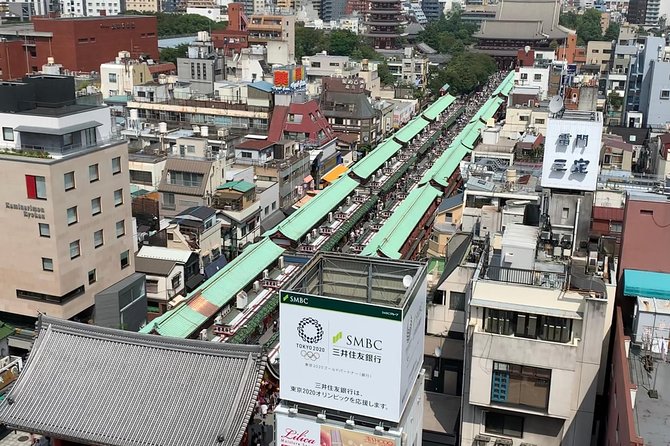
Asakusa’s appeal is not just the giant red Kaminarimon lantern or the photogenic Sensoji Temple. It is the way old Tokyo, religious tradition, street food, shopping, and modern city life all meet within a walkable district. This tour follows that story from the Sumida River to the temple grounds and into Rokku, Asakusa’s old entertainment quarter.
I like the small maximum group of eight, which makes it easier to ask questions and stay connected in crowded streets. I also like the mix of sights and tastes: you learn about Buddhism and Shinto, then sample snacks such as melon pan, rice dumplings, rice crackers, or sweet puffed rice. The main caution is simple: three and a half hours is a long time on foot, and some explanations may feel slow or detailed if you prefer a quick temple visit.
In This Review
- Key points to know before booking
- Starting beside the Sumida River
- Using the tourist center to understand Asakusa
- Under the huge lantern at Kaminarimon
- Nakamise-dori, snacks, and practical shopping advice
- Passing through Hozomon Gate
- Sensoji Temple and the story behind its survival
- Asakusa Shrine and the meeting of two faiths
- Leaving the temple crowds for Denboin Street and Rokku
- Guide style and the value of a small group
- Price, timing, and who gets the best value
- My call: book it for context, skip it for speed
- FAQ
- How long does the Asakusa tour last?
- Where does the tour begin?
- What time does the tour start?
- What sights are included?
- Are snacks included?
- Is hotel pickup provided?
- How large is the group?
- Can children join the tour?
Key points to know before booking
- The tour begins at the Sumida River, with views of Tokyo Skytree and the Asahi Breweries building.
- Sensoji Temple is the centerpiece, but the walk also includes Asakusa Shrine, Nakamise-dori, Denboin Street, and Rokku.
- A maximum of eight people gives the tour a personal feel and leaves room for questions.
- Traditional snacks are included, while other food, drinks, and hotel transfers are not.
- The electronic earphone system helps you hear the guide while walking through busy areas.
- Plan for moderate walking, comfortable shoes, water, and crowds around the temple.
Starting beside the Sumida River
The meeting point is outside Burger King Asakusa Azumabashi, with the tour starting at 1:30 pm. That location puts you close to the Sumida River, where Asakusa’s story begins.
You first cross Azumabashi Bridge and look toward Tokyo Skytree, one of the city’s clearest modern landmarks. You also see the headquarters of Asahi Breweries, recognizable by its golden flame sculpture. The contrast is useful: Asakusa is not a preserved museum district separated from modern Tokyo. It is an old neighborhood surrounded by high-rise buildings, commuter routes, river traffic, and everyday city life.
This opening stop lasts about 15 minutes and costs nothing extra. It is brief, but it gives the guide a good place to explain how the river helped Asakusa grow. Starting outdoors also lets you get oriented before entering the busiest streets.
From here, you walk toward the Asakusa Culture Tourist Information Center. The center is both a practical resource and an attraction in its own right, with eight stories devoted to helping people understand and navigate the area. You spend about 30 minutes here, making it a more substantial stop than a simple restroom or map break.
More Asakusa visits:
- Tokyo: Japanese Dance Cabaret Theater Asakusa-Kaguwa Ticket
★ 4.8 · 2,270 reviews - Tokyo: Meiji Shrine, Asakusa, Skytree Bus Tour and Cruise
★ 4.7 · 1,986 reviews - Tokyo: Roll and Authentic Sushi Making Class in Asakusa
★ 4.9 · 1,957 reviews
Using the tourist center to understand Asakusa
The Asakusa Culture Tourist Information Center helps connect the district’s major sights. For a first visit, this matters because Asakusa can feel like a maze of gates, side streets, stalls, shrines, and temple buildings.
Your guide can use this stop to point out the layout and explain how the district fits together. It is also a sensible place to gather practical information before you enter the main approach to Sensoji. The tour does not only point at attractive buildings. It gives you a framework for understanding why the buildings are there and how they relate to one another.
The pace here may suit you if you enjoy context and questions. If you want a nonstop sightseeing walk, this is one of the sections that may feel longer than necessary.
Under the huge lantern at Kaminarimon
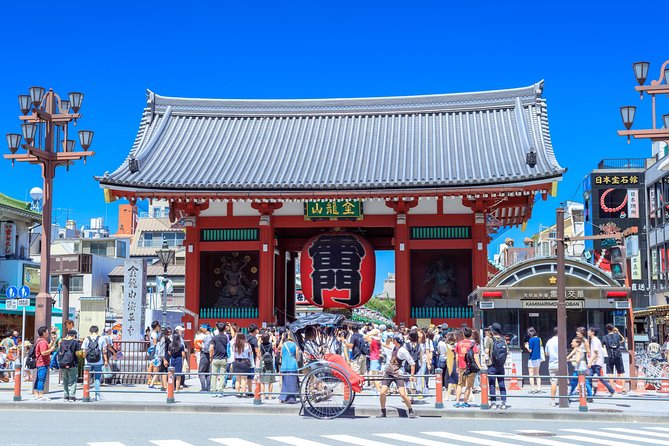
Kaminarimon means Thunder Gate, and it is the dramatic outer entrance to Sensoji. The enormous red lantern is one of Tokyo’s most recognizable photo subjects, but the gate is more than a backdrop.
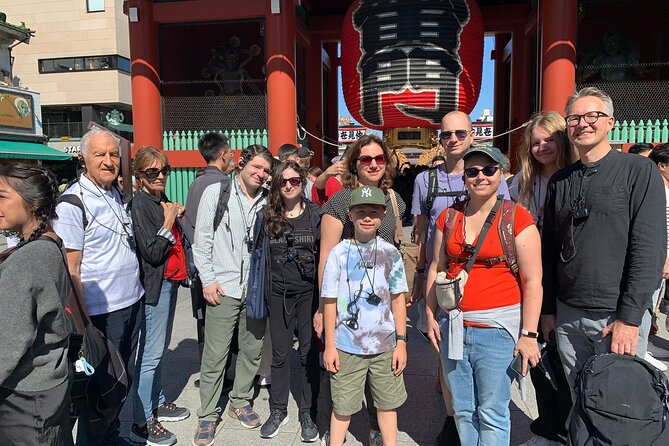
Your guide explains the gate’s role as the first of two major entrances leading to the temple. You can also look at the guardian statues on either side. Because this is a favorite meeting and photo spot, expect crowds, noise, and people moving in several directions at once.
The electronic earphone system is especially helpful here. The guide’s voice is sent directly to each participant, so you do not have to stand shoulder to shoulder or strain to hear every word. That system cannot remove the noise, but it should make the explanation easier to follow than a guide speaking to a loose group in the open air.
Nakamise-dori, snacks, and practical shopping advice
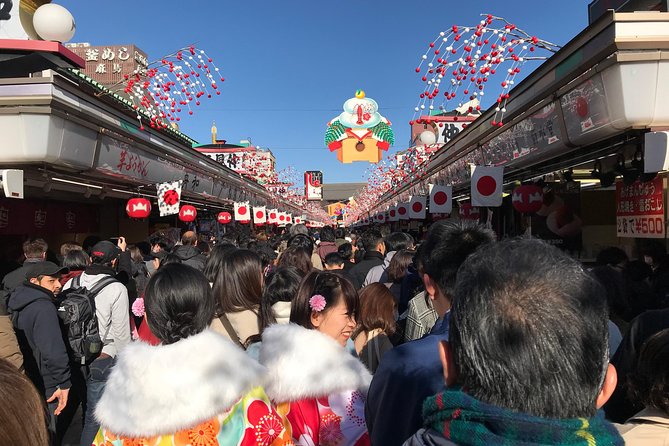
From Kaminarimon, you walk along Nakamise-dori, the approximately 250-meter approach to Sensoji’s inner gate. Shops and food stalls line both sides, selling souvenirs, sweets, small gifts, and traditional items.
This is one of the tour’s most useful sections because the guide helps you separate appealing local food from generic shopping. You sample selected Japanese sweets and street snacks, with examples including melon pan, rice dumplings, rice crackers, and sweet puffed rice. The exact selection can vary, and other food and drinks are not included.
I would treat this tasting as an introduction, not lunch. If you arrive hungry, plan to eat before or after the tour. Bottled water is recommended, and vending machines are available, but having your own water is easier on a warm afternoon.
Nakamise-dori can be packed, especially on weekends or during popular temple events. You will have less time to browse than you would on a private shopping outing, though the guide can point out useful places to return to later. This is a strong feature for first-time visitors who want help choosing gifts or snacks, but less important if shopping is not part of your plan.
A few more Tokyo bookings worth comparing
- Tokyo: Imperial Palace and Shogun Historical Walking Tour
★ 5.0 · 2,251 reviews - Tokyo: Imperial Palace Japanese History Walking Tour
★ 4.9 · 987 reviews - Tokyo: Shinjuku Historical Walking Tour & Secret Backstreets
★ 5.0 · 530 reviews - Yanaka Walking Tour: Historic and Traditional District of Tokyo
★ 5.0 · 530 reviews
Passing through Hozomon Gate
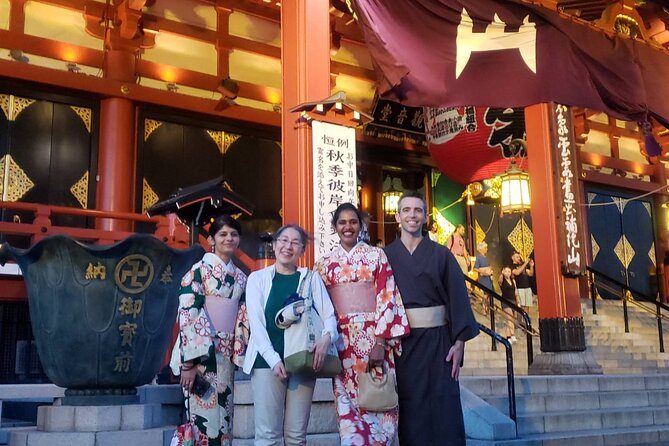
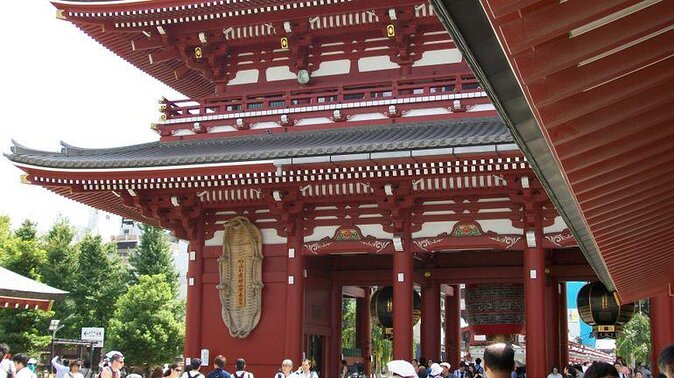
At the far end of Nakamise-dori, you reach Hozomon, the Treasure House Gate. It is the inner entrance to the Sensoji complex and has two levels, with storage space on the upper floor.
The gate provides a natural pause between the commercial approach and the temple grounds. Your guide explains how the gates shape the experience of approaching Sensoji, moving from public street life into a sacred setting. This is also another good place for photographs, though the number of people can make a quiet view difficult.
The tour allows about 15 minutes here. That is enough to look closely and hear the main points without turning the gate into a long lecture.
Sensoji Temple and the story behind its survival
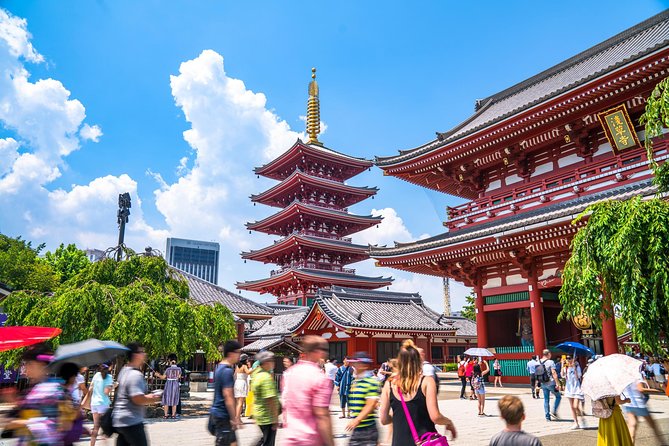
Sensoji is the heart of the walk. Its origin is tied to two fishermen brothers who found a statue of Kannon in the Sumida River. The temple’s story is also a story about rebuilding. Earthquakes, fires, war, and air raids destroyed or damaged the buildings repeatedly, yet donations from ordinary people helped restore the complex.
That background explains something you may notice right away: Sensoji has a very old identity, but many of its visible structures are newer reconstructions. The 1,400-year history belongs to the religious site and its continuing role in Asakusa, not to every current building stone.
Between Hozomon and the main hall, you see the five-storied pagoda, listed as 53 meters high and rebuilt in its current form after earlier destruction. The pagoda is associated with Buddha’s ashes and gives the temple grounds a strong vertical landmark.
The main hall offers a chance to observe worship in practice. Your guide can explain customs connected with Buddhist temple visits and help you understand what you are seeing without treating the place as a stage set. Respectful behavior matters here. Keep your voice low near worship areas, follow posted instructions, and remember that people may be visiting for religious reasons, not only sightseeing.
The Sensoji section lasts about 45 minutes. That is enough time for a proper explanation, but it is also where the tour can feel slow if you hoped to walk quickly through the grounds. The experience is designed for people who want the story behind the temple, not simply a photograph at the front gate.
Asakusa Shrine and the meeting of two faiths
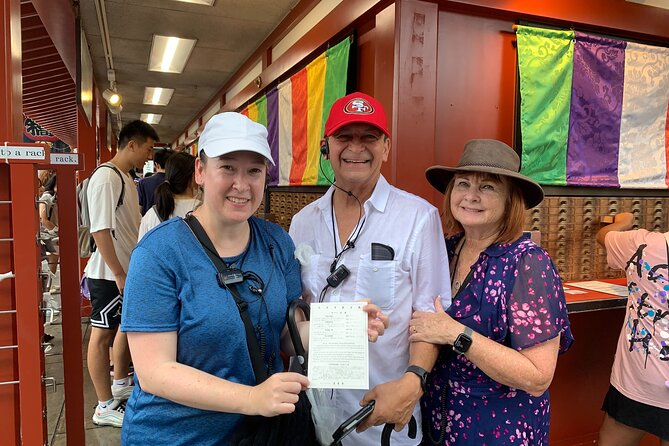
Asakusa Shrine sits on the same general grounds as Sensoji, creating one of the tour’s most interesting cultural lessons. A Buddhist temple and a Shinto shrine share the district and are connected through their origins and local worship.
For many first-time visitors, this is confusing. The tour uses the contrast to explain basic differences between Buddhism and Shinto and how the two traditions have coexisted in Japan. You do not need prior religious knowledge to follow the discussion, but you should expect more than a quick stop for a picture.
The shrine visit takes about 15 minutes. It is short enough to keep the walk moving, yet it adds an important layer to your understanding of Asakusa. Seeing both sites close together makes the relationship easier to grasp than reading a general explanation in a guidebook.
Leaving the temple crowds for Denboin Street and Rokku
After Sensoji, the tour turns toward Denboin Street and the Rokku area. This change of mood is one of the best reasons to choose the longer walk.
Rokku is Asakusa’s traditional entertainment district. The route here looks at the area’s movement from the Meiji period into present-day Tokyo, with old buildings, shops, restaurants, and streets that feel different from the formal temple approach. The district is lively, but the pace can be less compressed than Nakamise-dori.
You spend about 45 minutes in this part of Asakusa. The guide offers suggestions for places to eat, drink, and shop, which can be useful after the tour ends. You may also hear about local food such as izakaya fare and get recommendations for other Tokyo neighborhoods, including Ginza, depending on your questions and guide.
This is not a food tour with a full meal. Think of it as a walking introduction with a few included tastes and local pointers. If you want to return to Asakusa that evening, take notes when the guide identifies places that match your budget or interests.
Guide style and the value of a small group
The guide can make or break a history-focused walk. Guides named in the feedback include Aki, Sachi, Yasu, Taka, Yoko, Amy, and Emiko. The strongest pattern is clear: visitors valued guides who were friendly, patient, flexible, and willing to answer questions.
Aki is praised for combining history, culture, food, and help with photographs. Sachi is noted for detailed explanations of Asakusa’s past. Taka is described as a national government licensed guide who handled broad questions about Japanese language, garbage disposal, religion, izakaya food, and Edo Kiriko glass.
The tour caps attendance at eight people and provides each person with an earphone. That combination is important in Asakusa, where the street noise and crowds can be intense. A small group also gives you a better chance to ask about customs, restaurants, or things you notice along the way.
Still, guide style can vary. A few people found explanations too fast, too soft, too detailed, or too monotone. One person felt the tour took too long to reach the main gate, while another left early. If you prefer a quick overview, this may not be your best match. Tell the guide early if you need a slower pace, clearer volume, or fewer historical details.
Price, timing, and who gets the best value
At $91.17 per person, this is not the cheapest way to see Sensoji. You can enter the temple grounds on your own without paying an admission fee, and Asakusa is easy to reach by public transportation.
The price makes more sense if you value interpretation. You are paying for three and a half hours with an English-speaking guide, a small group, the earphone system, selected snacks, and help connecting the temple, shrine, river, shopping streets, and entertainment district. You also finish with ideas for where to eat and shop instead of simply returning to the station.
I see the tour as good value for a first visit, especially if you want cultural background and do not enjoy researching temple customs before arriving. It is weaker value for an independent sightseer who already knows Buddhist and Shinto basics or wants only the major photo stops.
The 1:30 pm start works well after a morning in another part of Tokyo. The tour returns to the Burger King meeting point after roughly three and a half hours. It operates in all weather, so dress for the forecast and wear shoes suited to steady walking.
Children under six can join free, but they do not receive the included snacks or other inclusions. The tour is recommended mainly for adults because of its historical focus, though families are welcome. Teenagers who enjoy culture may get a lot from it, especially when the guide keeps the conversation interactive.
My call: book it for context, skip it for speed
I would book this tour if you want Asakusa to make sense. The route covers the river, modern city views, temple gates, Nakamise-dori, Sensoji, Asakusa Shrine, and Rokku in one organized afternoon. The small group, snack tasting, and advice on local places add real value.
I would skip it if you want a short, self-guided visit or dislike long explanations. Crowds can make the walk noisy, and three and a half hours is a serious commitment. For most first-time visitors who want culture rather than a checklist, the 4.8 rating from 155 ratings and 95 percent recommendation point to a strong choice, with guide quality and pace worth confirming when you book.
FAQ
How long does the Asakusa tour last?
The tour lasts approximately 3 hours and 30 minutes and ends back at the meeting point.
Where does the tour begin?
It begins at Burger King Asakusa Azumabashi in Taito City, Tokyo.
What time does the tour start?
The scheduled start time is 1:30 pm.
What sights are included?
The route includes the Sumida River, Asakusa Culture Tourist Information Center, Kaminarimon Gate, Nakamise Shopping Street, Hozomon Gate, Sensoji Temple, Asakusa Shrine, and Denboin Street in the Rokku area.
Are snacks included?
Yes. A selection of Japanese sweet snacks is included, such as melon pan, rice dumplings, rice crackers, or sweet puffed rice. Other food and drinks are not included.
Is hotel pickup provided?
No. Hotel pickup and drop-off are not included. You meet the guide at the stated starting point and return there at the end.
How large is the group?
The maximum group size is eight people.
Can children join the tour?
Children younger than six may join free of charge, but they are not entitled to the included items. Families are welcome, although the tour’s historical focus is recommended mainly for adults.
New on our Tokyo list
- From Tokyo: Mount Fuji & Hakone Full Day Private Tour★ 4.9 · 25 reviews
- Tokyo Spectacular View Day-Cruise in 90 Minutes★ 5.0 · 25 reviews
- Real Tokyo Runner Club : Daikoku Car Meet Night Tour with JDM Car★ 5.0 · 25 reviews
- 2.5 Hour-Guided Cycle Tour in the Central Tokyo★ 5.0 · 25 reviews
- Ramen Making from Scratch +Akihabara Tour –Cooking Class★ 5.0 · 25 reviews
- [Self-Drive] Tokyo & Daikoku Custom Car Driving Tour★ 4.9 · 25 reviews
- Tokyo: 2-Hour Night Bike Tour of the City’s Hidden Gems★ 4.9 · 25 reviews
- Tokyo: Mt. Fuji, Owakudani, Hakone Shrine, & Open-Air Museum★ 4.7 · 25 reviews
Historical Tours, compared.

Imperial Palace and Shogun Historical Walking Tour
Read our review →
Yanaka Walking Tour: Historic and Traditional District of Tokyo
Read our review →
Shinjuku Historical Walking Tour & Secret Backstreets
Read our review →
Mt. Fuji Heritage Tour: Traditional Villages, Lakes & Shrine
Read our review →
The Best of Izakaya in Shinjuku Food & Cultural Tour
Read our review →
Yanaka Historical Walking Tour in Tokyo’s Old Town
Read our review →Browse the lists this tour appears in