
Reviewed · ASAKUSA TOURS
Tokyo Asakusa Rickshaw Tour
Asakusa is where old Tokyo and modern Tokyo sit side by side. From the seat of a rickshaw, you glide past Edo-era houses, small shrines, and maple-lined streets, then look across the Sumida River toward the Tokyo Skytree and Asahi Beer’s famous golden flame. It is a quick way to get your bearings without spending the whole day on foot.
I like two things here: the guide can shape the ride around your interests, and the private format keeps the experience personal. Guides such as Koko, Micchy, Kei, Taisei, and Issy have been praised for friendly conversation, cultural explanations, and taking good photos. The main drawback is space: a rickshaw is only 74 centimeters wide, so two adults may find it snug.
In This Review
- Key points to know before you book
- Why a rickshaw works so well in Asakusa
- Meeting your guide near Asakusa Station
- Old Tokyo streets, raccoon figures, and entertainment history
- Ushijima Shrine and its unusual three-part gate
- Sumida River views and the best Skytree photo stop
- Honryuin Matsuchiyama Shoden and the mystery of the radishes
- Imado Shrine and its beckoning cats
- Sensoji, Asakusa Shrine, and an important riding restriction
- Asahi Beer headquarters and modern Tokyo
- Price, timing, and the real value
- Who will enjoy this ride most
- Should you book the Tokyo Asakusa Rickshaw Tour?
- FAQ
- Where does the Tokyo Asakusa Rickshaw Tour start?
- Where does the tour end?
- How long does the rickshaw tour last?
- Is the tour private?
- Can I customize the route?
- Is the rickshaw allowed inside Sensoji Temple?
- How many adults fit in one rickshaw?
- Can young children ride for free?
- Is an English-speaking guide available?
- What happens if bad weather cancels the tour?
Key points to know before you book
- You choose the pace: Options run from 30 minutes to about three hours, with longer rides able to cover more of Asakusa.
- The route is flexible: Ask for shrines, traditional streets, gardens, photo stops, entertainment history, or a mix.
- The ride is private: Only your own group participates, which makes questions and route changes easy.
- The best sights are varied: You may see Ushijima Shrine, Imado Shrine, Honryuin Matsuchiyama Shoden, Sumida Park, and the Asahi headquarters.
- The rickshaw is compact: Two adults can ride together, but booking separate rickshaws may be more comfortable for larger passengers.
- The weather matters: Poor weather can lead to a rescheduled ride or full refund.
Why a rickshaw works so well in Asakusa
Asakusa can feel confusing at first. Sensoji Temple draws crowds, Nakamise shopping street is packed with shops, and the quieter lanes spread out in several directions. A rickshaw gives you a moving introduction to the neighborhood while your guide points out details you could easily miss on your own.
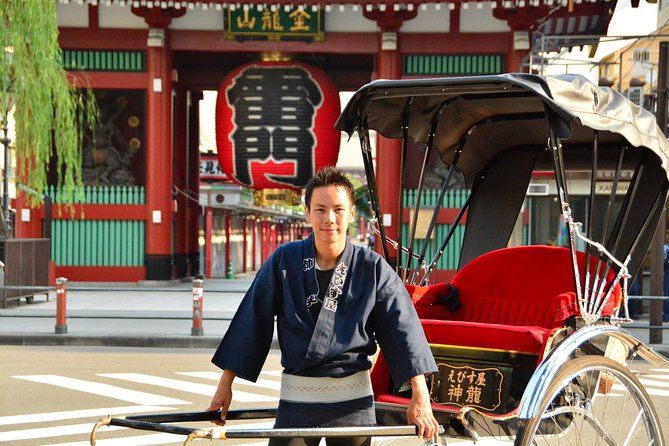
You sit high enough to see over some street-level clutter, but low enough to notice shopfronts, old homes, shrine gates, and local decorations. The ride is not just transportation. Your driver pedals, navigates, explains, and often helps with photos.
The guides are a major part of the experience. The assigned guide may be English or Japanese-speaking, depending on availability, so state your preferred language when booking. Guides mentioned by name include Koko, Micchy, Kei, Issy, BUCHI, Taisei, Nene, Yusuke, Takumi, and Kazumasu-san. You cannot assume you will receive a particular person, but the repeated praise for humor, energy, patience, and cultural explanations gives you a good sense of the service style.
A 30-minute ride is useful if you simply want an overview. A 45-minute or one-hour option gives you more time for stops and photographs. The three-hour ride is the better choice if Asakusa is a major part of your Tokyo plan and you want several temples, old streets, river views, and entertainment areas in one outing.
More Asakusa visits:
- Tokyo: Japanese Dance Cabaret Theater Asakusa-Kaguwa Ticket
★ 4.8 · 2,270 reviews - Tokyo: Meiji Shrine, Asakusa, Skytree Bus Tour and Cruise
★ 4.7 · 1,986 reviews - Tokyo: Roll and Authentic Sushi Making Class in Asakusa
★ 4.9 · 1,957 reviews
Meeting your guide near Asakusa Station
You make your own way to the meeting point at 1-chome-1-4 Asakusa, near Asakusa Station. Look for the rickshaw stand and your guide. The pickup is not from your hotel, so allow time to reach the area by public transportation.
After a short introduction, tell the guide what interests you. You might focus on Shinto and Buddhism, old Tokyo, anime-related sights, gardens, architecture, photography, or local customs. One useful feature is that the finishing point can be discussed with the guide on the day, although a drop-off away from the usual stand may cost extra.
The private setup helps here. You are not waiting for a large group to catch up, and you can ask a question as soon as something catches your attention. Families also get a little more breathing room for stops, though the children’s seating rules matter.
Old Tokyo streets, raccoon figures, and entertainment history
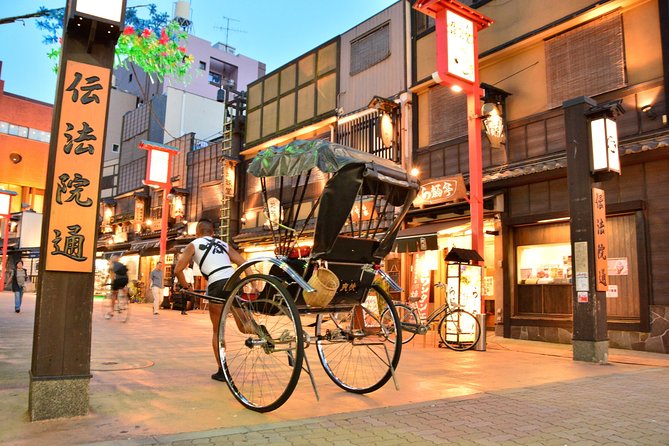
The first part of the route may take you through historic streets lined with store and housing facades dating from the Edo period. These streets give you a better feel for everyday Asakusa than the grand temple entrance alone. Your guide can explain how the neighborhood mixes commercial, religious, traditional, and quirky elements.
One especially unusual street uses raccoons as its theme. Raccoon figures appear every few meters, giving the street a playful character and making it an easy photo stop. This is the sort of small detail that is hard to find when you follow only the major Tokyo attractions.
You may also pass one of Japan’s oldest amusement parks, still operating today. The stop connects present-day Asakusa with its long role as a place for leisure and entertainment. The nearby Rokku Street adds more context. Before the war, it was one of Tokyo’s leading entertainment districts, filled with cinemas and theaters.
Another venue in the area remains a center for comedy and shows. If you like popular culture, ask your guide to include these streets. If you care more about temples and gardens, a shorter tour may be better spent elsewhere.
Ushijima Shrine and its unusual three-part gate
Ushijima Shrine is one of the central stops on the longer routes. You get about 15 minutes there, and admission is not included, though the supplied tour information does not list a separate admission charge.
The shrine’s gate has three entrances instead of the more familiar single opening. That detail gives your guide a natural starting point for discussing Japanese shrine design and religious practice. It is a small architectural feature, but it helps turn a quick visit into a lesson in how Shinto spaces are arranged.
The shrine also fits well into a route that includes the Sumida River and Skytree. You can move from a quiet religious site to a broad city view within a short ride. That contrast is one of Asakusa’s great strengths.
A few more Tokyo bookings worth comparing
- Mt Fuji and Hakone 1-Day Bus Tour Return by Bullet Train
★ 5.0 · 26,383 reviews - 1-Day Tokyo Bus Tour
★ 5.0 · 14,250 reviews - Tokyo: TOKYO SKYTREE® Admission ticket
★ 4.5 · 11,192 reviews - Tokyo: teamLab Planets TOKYO Digital Art Museum Entry Ticket
★ 4.6 · 9,779 reviews
Sumida River views and the best Skytree photo stop
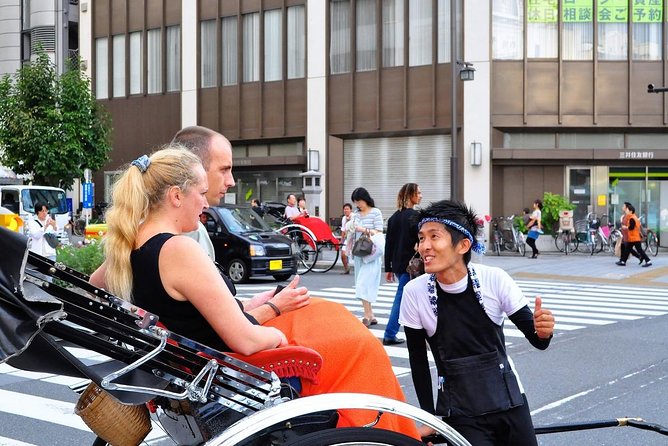
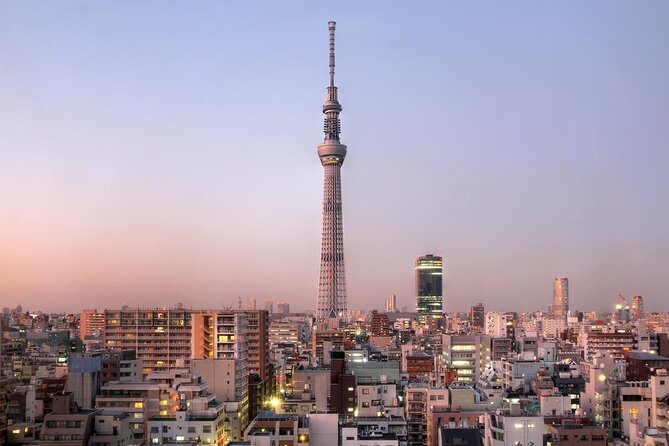
Across the Sumida River, you get an excellent view of the Tokyo Skytree. This is one of the tour’s clearest photo opportunities, especially if you want a picture that places a major modern landmark beside the older streets and temples of Asakusa.
The ride may also pass Sumida Park, a long green strip beside the river. In spring, its cherry trees make it a popular place for blossoms. At other times, it offers a place to pause, rest, and look across the water.
The park is valuable for another reason: it breaks up the sightseeing. A temple-heavy walking route can become tiring, but a rickshaw lets you sit while your guide does the work. Several rides have also used blankets and seat warmers in cooler weather, while rain protection helped keep the ride comfortable during wet conditions.
Honryuin Matsuchiyama Shoden and the mystery of the radishes
Honryuin Matsuchiyama Shoden is a Buddhist temple connected with Sensoji Temple. You spend about 15 minutes here on routes that include it, with admission not included.
The temple is known for its many radishes, which appear around the site and on its lanterns. Your guide explains why they matter, giving you a memorable way to understand a religious tradition rather than simply photographing another temple gate.
This stop is especially useful if you want to understand the difference between Buddhism and Shinto. Asakusa places both traditions close together, and the ride helps explain how they coexist in Japanese religious life. The setting also differs from the broad, formal approach to Sensoji, making it feel more intimate.
Imado Shrine and its beckoning cats
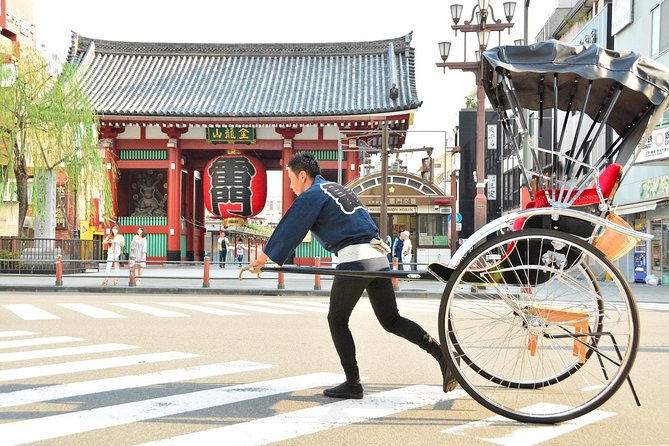
Imado Shrine is another 15-minute stop on longer routes. It is a Shinto shrine filled with cat figures, especially manekineko, the familiar beckoning cat associated with good fortune.
The cats give the visit a lighter, more playful mood after the formal architecture of larger temple grounds. If you enjoy Japanese symbols, small statues, and unusual local customs, this is a stop worth requesting.
The shrine also helps show how each religious site in Asakusa has its own visual identity. Ushijima Shrine is known for its three-part gate, Honryuin Matsuchiyama Shoden for radishes, and Imado Shrine for cats. A longer ride lets you compare them rather than treating every site as simply another temple or shrine.
Sensoji, Asakusa Shrine, and an important riding restriction
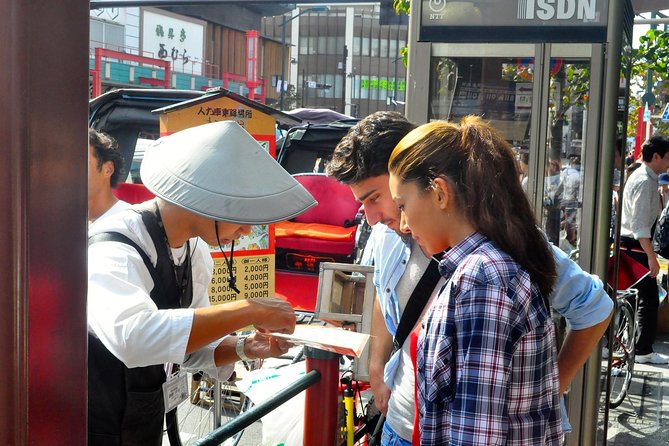
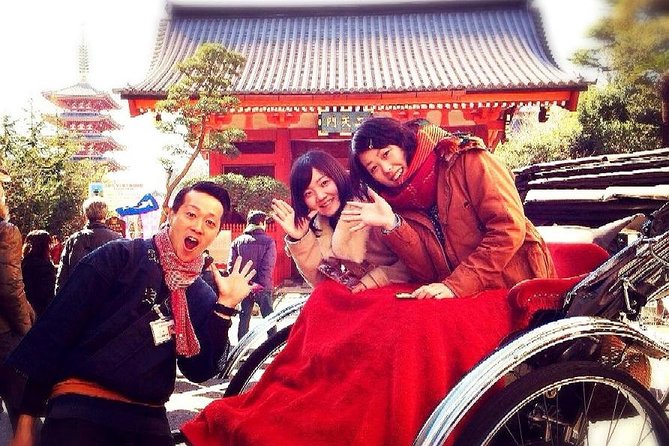
The colorful gate leading to Sensoji Temple and Asakusa Shrine is likely to be one of the most recognizable parts of the route. Sensoji is an impressive temple complex, while Asakusa Shrine is a Shinto shrine located on the temple grounds.
Your guide can explain the differences between the two faiths and how they share the same setting. That practical explanation is more helpful than trying to remember textbook definitions while walking through a busy religious complex.
There is one rule you should know before booking: rickshaws cannot ride inside the Sensoji and Asakusa Temple area. That includes the temple buildings, temple grounds, and Nakamise shopping street. The rickshaw will take you near the area, but you will need to walk through the restricted section if you want to see it closely.
This is not a flaw, but it affects your expectations. The ride is best for connecting the major sights and reaching less obvious areas, not for replacing all walking in the Sensoji complex.
Asahi Beer headquarters and modern Tokyo
The Asahi Beer headquarters provides one of the route’s sharpest changes in scenery. Its iconic golden flame sits on top of the building, creating an unmistakable view from across the river.
From the rickshaw, the building helps show how compactly Asakusa combines old and new. A traditional shrine, an Edo-period street, a river park, and a famous modern headquarters can all fit into the same short tour.
This stop is most useful as part of a wider route rather than as a destination by itself. Ask your guide to pause for a photograph if the view matters to you. The exact order of stops depends on the time you book and the route you choose.
Price, timing, and the real value
The advertised price is $42.90 per person. That is reasonable if you value a private guide, a personal route, and an easy overview of Asakusa in a limited amount of time. You are paying for more than a seat: the driver provides local explanations, navigation, and help with photographs.
The price is easier to justify for a first visit, for families, or for anyone who wants to cover ground without a long walk. It is less compelling if you already know Asakusa well and prefer to explore every temple and lane at your own speed.
This experience is booked an average of 54 days ahead, so reserving early is sensible if your dates are fixed. Group discounts are available, and mobile tickets make the booking side simple. Adult pricing applies from age six. Children five and under can ride free on an adult’s lap, with no more than two young children sharing a rickshaw with two adults.
A rickshaw holds up to two adults, but the 74-centimeter width is worth taking seriously. Two adults can fit, and one pair reported a snug but comfortable ride, yet separate rickshaws may be a better choice for larger passengers. If you need an extra rickshaw, book it in advance because a second vehicle with an English-speaking guide may not be available later.
Who will enjoy this ride most
I would recommend this tour to first-time visitors who want a fast introduction to Asakusa, couples looking for a memorable photo outing, and families who need a break from walking. It also suits anyone who enjoys asking questions about customs, shrines, neighborhood history, and Japanese culture.
The ride works well for photography. Guides such as Yusuke and Taisei have been praised for taking thoughtful pictures, and the route includes clear Skytree and river viewpoints. If you have a child interested in anime, one guide even pointed out a location connected with Demon Slayer.
Choose a longer option if you want several religious sites and the entertainment district. Choose a shorter ride if you mainly want the old streets, river view, and a taste of the neighborhood.
The tour requires good weather. If rain or other poor conditions cause cancellation, you can take a different date or receive a full refund. You can cancel for a full refund up to 24 hours before the start time, but changes or cancellations inside that window are not refunded.
Should you book the Tokyo Asakusa Rickshaw Tour?
Book it if you want a personal introduction to Asakusa rather than a simple ride past famous buildings. The best part is the combination of local conversation, small religious sites, odd details such as the raccoon street and cat figures, and big views of the Skytree and Asahi headquarters.
I would book at least 45 minutes if your budget and schedule allow. Ask for the places you care about, confirm your preferred guide language, and consider separate rickshaws if two adults may feel cramped. Skip it only if you prefer complete independence or plan to spend several hours walking every corner of Asakusa yourself.
FAQ
Where does the Tokyo Asakusa Rickshaw Tour start?
The meeting point is at 1-chome-1-4 Asakusa, Taito City, Tokyo 111-0032, Japan, near Asakusa Station.
Where does the tour end?
The listed ending point is near Kan’non-dōri at 1-chome-2-11 Asakusa. You can discuss a different finishing location with your guide, but an extra drop-off fee may apply.
How long does the rickshaw tour last?
Available durations range from about 30 minutes to three hours. Shorter options cannot include every listed landmark.
Is the tour private?
Yes. Only your own group participates in the activity.
Can I customize the route?
Yes. Tell your guide what interests you, such as temples, shrines, traditional streets, gardens, entertainment history, or photo stops.
Is the rickshaw allowed inside Sensoji Temple?
No. Rickshaws cannot enter the Sensoji and Asakusa Temple area, including the temple buildings, temple grounds, and Nakamise shopping street.
How many adults fit in one rickshaw?
A maximum of two adults can ride in one rickshaw. The vehicle is 74 centimeters wide, so separate rickshaws may be more comfortable for some passengers.
Can young children ride for free?
Children aged five and under may ride free when seated on an adult’s lap. If a five-year-old uses one of the two rickshaw seats, the child must be booked as an adult.
Is an English-speaking guide available?
An English or Japanese-speaking driver-guide is available subject to availability. State your preferred language at checkout.
What happens if bad weather cancels the tour?
You will be offered a different date or a full refund. The experience requires good weather.
New on our Tokyo list
- From Tokyo: Mount Fuji & Hakone Full Day Private Tour★ 4.9 · 25 reviews
- Tokyo Spectacular View Day-Cruise in 90 Minutes★ 5.0 · 25 reviews
- Real Tokyo Runner Club : Daikoku Car Meet Night Tour with JDM Car★ 5.0 · 25 reviews
- 2.5 Hour-Guided Cycle Tour in the Central Tokyo★ 5.0 · 25 reviews
- Ramen Making from Scratch +Akihabara Tour –Cooking Class★ 5.0 · 25 reviews
- [Self-Drive] Tokyo & Daikoku Custom Car Driving Tour★ 4.9 · 25 reviews
- Tokyo: 2-Hour Night Bike Tour of the City’s Hidden Gems★ 4.9 · 25 reviews
- Samurai themed Entertainment show in Shinjuku★ 4.5 · 25 reviews
Asakusa Tours, compared.
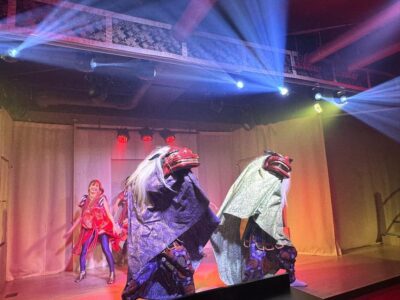
Japanese Dance Cabaret Theater Asakusa-Kaguwa Ticket
Read our review →
Meiji Shrine, Asakusa, Skytree Bus Tour and Cruise
Read our review →
Roll and Authentic Sushi Making Class in Asakusa
Read our review →
Asakusa Walking Tour with Sensoji Temple Visit
Read our review →
Tokyo Panoramic 1 Day: Meiji Shrine, Asakusa, Odaiba and SKYTREE®
Read our review →
Tokyo Go Kart: Asakusa, Skytree, and Akihabara **IDP MUST**
Read our review →
Asakusa, Skytree & Akhihabara Go-Kart City Experience
Read our review →
Matcha Making Experience with Mochi Sweets in Asakusa
Read our review →Browse the lists this tour appears in