
Reviewed · TEMPLE & SHRINE TOURS
Tokyo: Meiji Shrine Walking Tour — Shinto & Imperial System
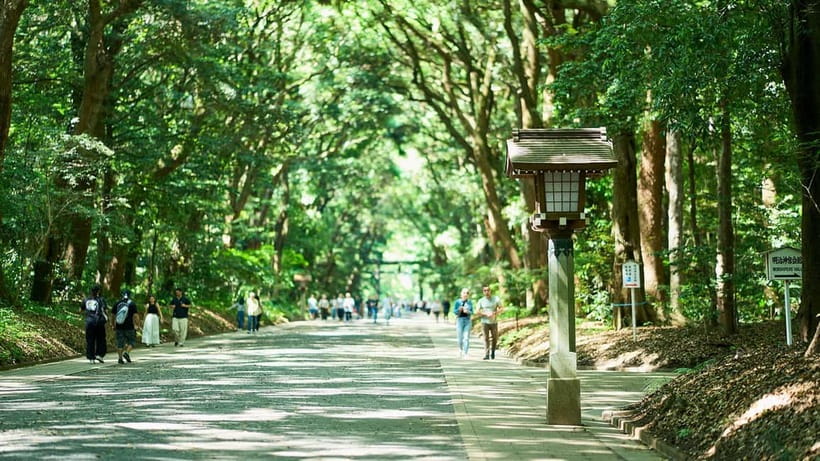
Meiji Shrine is Tokyo’s great escape hatch: a forest of roughly 100,000 trees where the city noise fades surprisingly fast. This small-group walk connects that calm setting to Japan’s 2,600-year-old imperial system, the Meiji era, and the country’s shift from samurai rule to modern Japan.
I like two things here. First, the guide shows you how to behave at a Shinto shrine, from approaching the torii to making an offering, so you can continue visiting shrines with confidence. Second, the group size is capped at 10 people, and guides such as Keiko, Yuuka, Ayaka, Yuki, and Nonoka have been praised for clear explanations and personal help with photos, fortunes, and questions.
The main consideration is the pace. The tour lasts between 90 and 135 minutes, includes a fair amount of walking, and is conducted in English only. If you want a long, quiet visit for photography or personal prayer, the guided format may leave less free time than exploring alone.
In This Review
- Key points to know before you book
- Why Meiji Shrine works so well as a first Tokyo tour
- From Harajuku Station to the first torii
- The forest path and the art of quiet
- Sake barrels, wine barrels, and Meiji-era symbolism
- The 12-meter Big Torii
- Emperor Meiji, Empress Shoken, and Japan’s imperial system
- Meiji Shrine: customs, prayer, and free time
- Forest Terrace and Mori no Terrace
- What $23 buys you
- Who should book this walk
- Practical advice for getting more from the experience
- Should you book the Meiji Shrine walking tour?
- FAQ
- How much does the Meiji Shrine walking tour cost?
- How long does the tour last?
- What language is the tour conducted in?
- How many people can join the group?
- Where does the tour begin and end?
- What will I see on the walk?
- Can I cancel for a full refund?
Key points to know before you book
- A forest walk in central Tokyo: The shrine path passes under towering trees and quickly leaves Harajuku’s city noise behind.
- The 12-meter cypress torii: The largest wooden torii here was made from 1,500-year-old Taiwanese cypress.
- Practical Shinto instruction: You learn where to walk, how to approach the shrine, and how to make an offering respectfully.
- Imperial history with a clear timeline: The tour links Emperor Meiji, Empress Shoken, the samurai era, and Japan’s move toward modern government.
- Useful cultural details: You can ask about omamori protective charms and the Omigokoro fortune poems.
- A small-group English setting: Up to 10 participants makes it easier to hear the guide and ask questions.
Why Meiji Shrine works so well as a first Tokyo tour
Harajuku is usually associated with youth fashion, crowded shopping streets, and bright signs. Meiji Shrine offers the opposite mood. From the station, you move toward a broad entrance and then into a shaded path lined with trees. The change is quick enough to feel almost theatrical, but the forest is not a decorative set. It is the setting that gives the shrine its quiet force.
This is a useful first stop in Tokyo because the tour explains customs you will see all across Japan. Shinto shrines can be beautiful but puzzling if you do not know what the gates, purification areas, offerings, and fortunes mean. A good guide turns those details into things you can use for the rest of your trip.
The tour also gives Meiji Shrine a place in modern Japanese history. It is not presented only as a peaceful religious site. You learn why Emperor Meiji and Empress Shoken matter, how the imperial system is understood, and how Japan changed from a samurai society into a modern state.
The guides use different styles, but the strongest theme is personal attention. Yuuka has helped people with customs, photos, and old images showing what the area looked like before construction. Ayaka has been praised for answering difficult questions and explaining the site in an easy, friendly way. Yuki has led tours focused on Shinto, the imperial system, and the move from the samurai period to modern Japan.
More temples and shrines near Tokyo:
- Tokyo: Meiji Shrine, Asakusa, Skytree Bus Tour and Cruise
★ 4.7 · 1,986 reviews - Tokyo: Asakusa Walking Tour with Sensoji Temple Visit
★ 4.8 · 1,583 reviews - Nikko: Kegon Falls, Lake Chuzenji & Toshogu Temple
★ 4.6 · 1,577 reviews
From Harajuku Station to the first torii
The walk begins at one of two listed starting options at Harajuku Station, with the exact meeting point depending on the booking choice. The supplied meeting coordinates are 35.6700901, 139.7024662, so check your confirmation carefully before setting out.
That small bit of planning matters here. Harajuku is a busy part of Tokyo, and a guide may be waiting at a particular station exit or nearby point. The tour returns to Harajuku Station, which makes it easy to continue to Takeshita Street or another part of the city afterward.
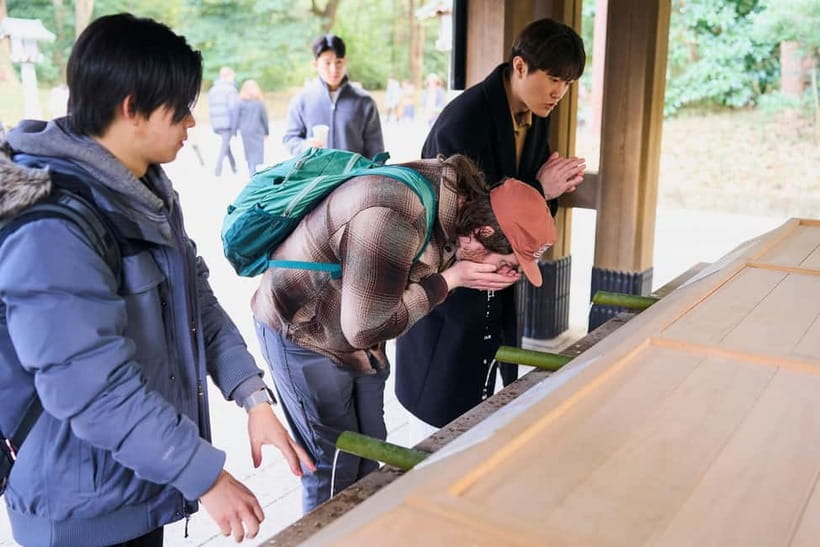
The first stop is Meiji Jingu Ichino Torii, the initial gate into the shrine grounds. Your guide introduces the idea that a torii marks the boundary between ordinary space and sacred space. You do not need to treat the entrance like a museum procedure, but you should slow down and pay attention.
One practical rule comes early: keep to the side of the path when passing through a torii. The center, called seichu, is traditionally reserved for the deities. This is one of those simple details that makes the visit feel more respectful without turning it into a long lesson in formal behavior.
The forest path and the art of quiet
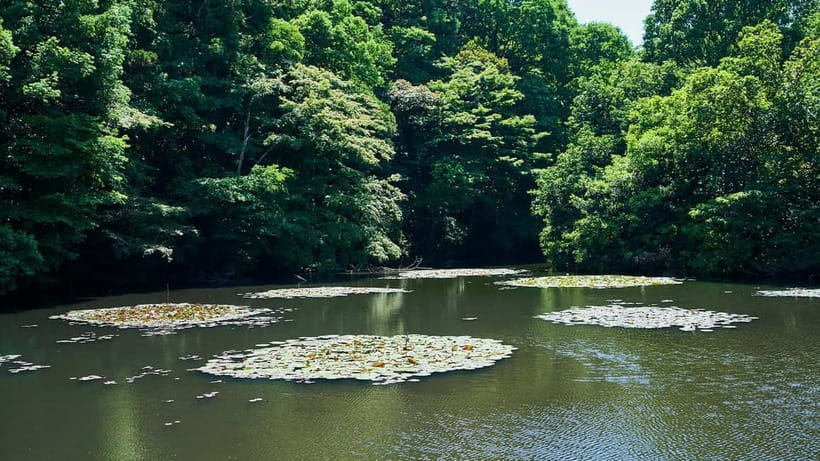
The path toward the shrine takes about 10 minutes in the stated schedule, though the experience can feel longer because the setting changes so much from the streets outside. You hear birdsong, see dense plantings, and walk beneath shade. The description of the forest as a place where noise disappears is not just sales language. It points to the main pleasure of the visit.
Do not expect complete solitude. Meiji Shrine is Tokyo’s most popular Shinto shrine, and other people will be present. Even so, the trees create a strong buffer from the surrounding city. I would treat this part as a chance to settle into the tour rather than rushing toward the main building.
The guide may point out details you could easily pass without noticing. The tour is designed to explain the meaning behind the grounds, not just identify the next landmark. That is especially useful if you have never visited a Shinto shrine before.
The walking surface and shade also shape the experience. Wear shoes you can comfortably use for a prolonged walk. The tour is not described as strenuous, but you are on foot for most of the 90 to 135 minutes, with the longest stop at the shrine itself.
Sake barrels, wine barrels, and Meiji-era symbolism
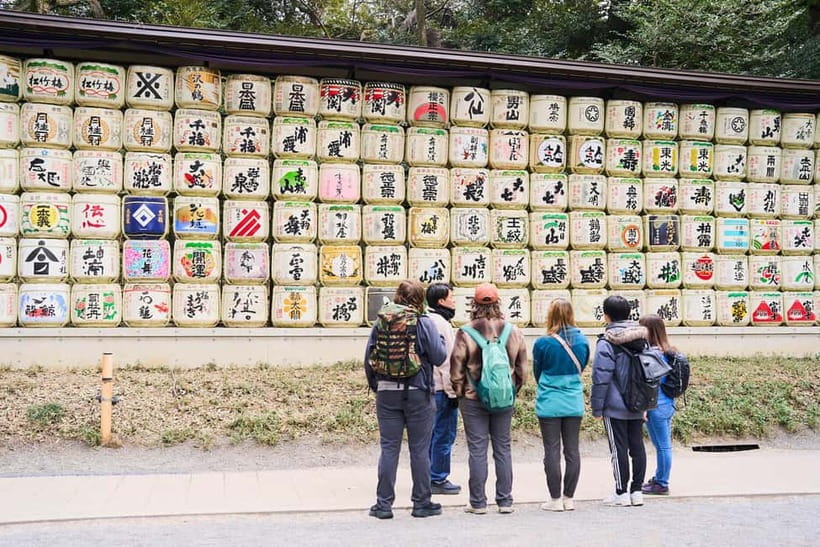
Along the route, you stop at the consecrated wine barrels and sake barrels. These make excellent photo stops, but they are more than colorful backdrops. Your guide explains why the barrels are connected with the shrine and how they fit into Japanese religious and cultural traditions.
The pairing of wine and sake reflects the Meiji period’s position between inherited Japanese customs and growing international contact. The tour uses these objects to show that the shrine’s story is tied to a period of major national change, not to an isolated ancient past.
The scheduled stops are short, roughly five to 10 minutes each. That is enough time for an explanation and photographs, but not a long pause. If you want carefully composed pictures of every barrel, you may need to return on your own after the tour.
This is one place where a guide adds real value. A row of barrels can seem like a pleasant visual detail when you walk past alone. With context, it becomes part of the larger story of Meiji Shrine and the way old customs were presented in a changing Japan.
More walking routes in Tokyo:
- Tokyo Tsukiji Fish Market Food and Culture Walking Tour
★ 5.0 · 3,184 reviews - Tokyo: Imperial Palace and Shogun Historical Walking Tour
★ 5.0 · 2,251 reviews - Tokyo: Shinjuku Local Bar and Izakaya Guided Walking Tour
★ 4.9 · 1,794 reviews - Tokyo: Tsukiji Fish Market Food and Walking tour
★ 5.0 · 1,724 reviews
The 12-meter Big Torii
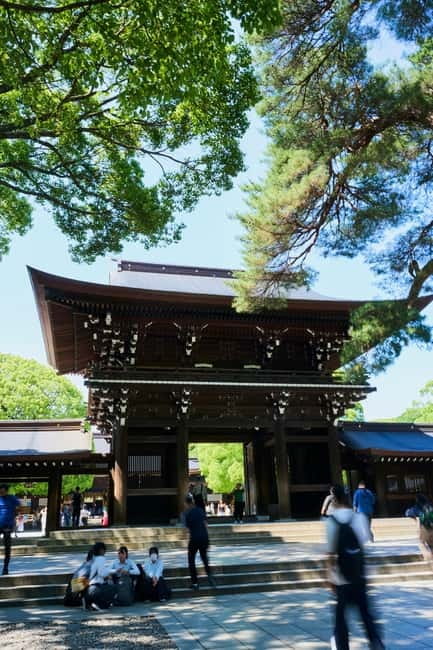
The Big Torii is the tour’s most dramatic physical landmark. It rises about 12 meters and was made from a 1,500-year-old Taiwanese cypress. That age gives the timber a striking story before you even consider the gate’s size.
Your guide explains how to pass through it and why the central line is treated differently. Take a moment here. The scale is best understood from below, and the shaded approach gives you time to notice how the torii frames the road ahead.
The stop is listed as about 10 minutes, so expect a guided introduction and a photo opportunity rather than a long meditation. Still, this is the point where the shrine’s presence becomes unmistakable. The gate announces that you are leaving the city’s ordinary rhythm behind.
The material itself may raise questions about conservation and replacement. The information supplied for this tour identifies the cypress and its age, but it does not promise a detailed discussion of forestry or restoration. Ask your guide if those subjects matter to you.
Emperor Meiji, Empress Shoken, and Japan’s imperial system

The history section is the intellectual center of the walk. You learn about Japan’s imperial system, described here as 2,600 years old, and about the Meiji period’s role in Japan’s transition from samurai rule to a modern nation.
This topic can become confusing quickly. The value of a live guide is that you can stop and ask what a term means, how the imperial system fits into Japanese history, or why the shrine was created. Guides such as Yuki, Yuuki, and Nonoka have been especially appreciated for explaining broad historical ideas in plain language rather than simply reciting dates.
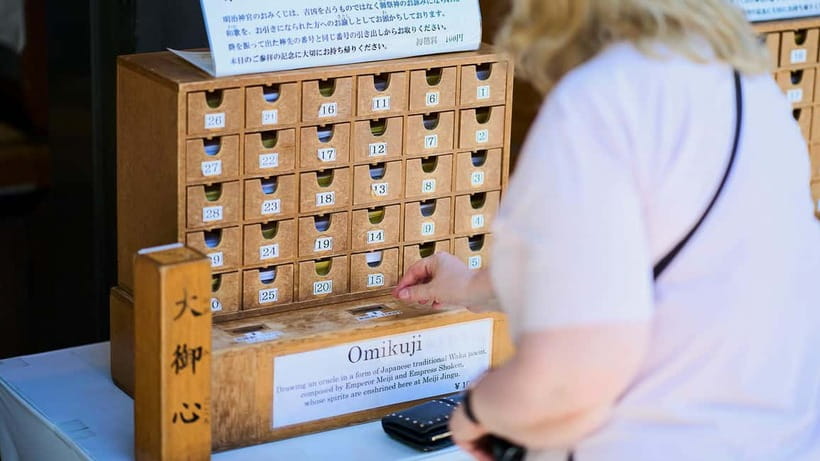
The tour also introduces the imperial poetry connected with Emperor Meiji and Empress Shoken. The Omigokoro fortune uses poems written by the emperor and empress, with English translations available. That makes this activity more accessible than a fortune written only in Japanese, since you can consider the meaning rather than simply take the paper home unread.
The poetry stop is scheduled for about 10 minutes. It will not provide a full course on Japanese literature, and you should not expect an academic treatment of waka. It does, however, offer a human connection to the imperial figures at the heart of the shrine.
A useful distinction may also come up between Shinto shrines and Buddhist temples. One detailed tour account praised Nonoka for explaining this difference, along with the difference between haiku and waka. Those are the kinds of comparisons that help you make sense of later stops around Japan.
Meiji Shrine: customs, prayer, and free time
The main shrine visit lasts about 45 minutes, making it the longest and most flexible part of the experience. You receive a guided introduction, then have time for photos, shopping, and the shrine activities themselves.
Your guide explains how to approach the main area and make an offering. One guide was specifically praised for supplying coins when participants did not have any, but treat that as a helpful possibility rather than a guaranteed inclusion. It is sensible to carry a few small coins of your own.
The point is not to perform a ritual perfectly. The point is to understand that the shrine is an active place of worship, not simply a historic building. Your guide can help you avoid blocking worshippers, mishandling an offering, or treating every sacred object as a prop.
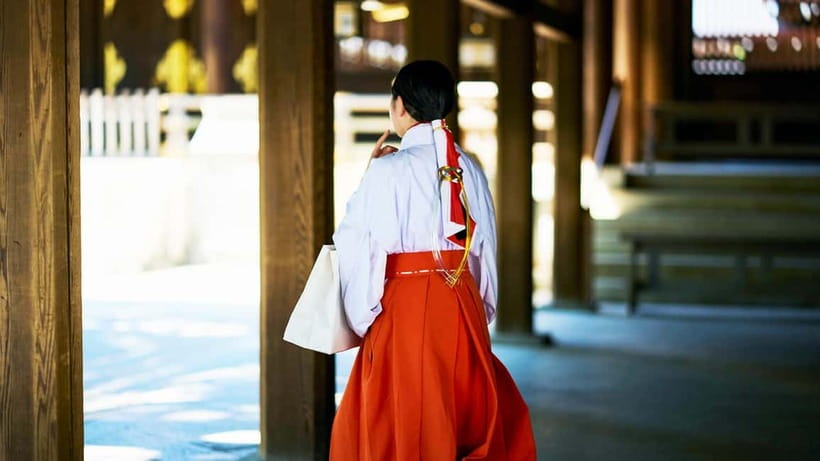
You can purchase omamori, the protective charms associated with Japanese shrines. There is also the Omigokoro fortune, whose translated poems make it a distinctive souvenir. If you are visiting near the New Year period, the shrine can be especially busy, and the extra help with customs becomes more useful.
The main grounds are also where you may see ceremonies or everyday acts of devotion. One tour participant described seeing a wedding while visiting with a guide. Such moments cannot be scheduled, but they show how the shrine functions in present-day Tokyo.
The 45-minute allocation is generous compared with the earlier photo stops, though it is still not unlimited. If you want a slow personal prayer, extensive shopping, or many photographs, use the tour to learn the layout and return later.
Forest Terrace and Mori no Terrace
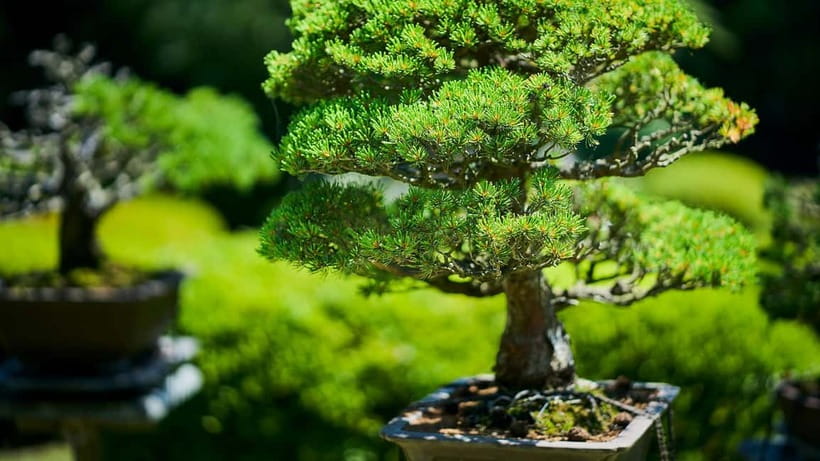
After the shrine, the tour winds down at Forest Terrace Meiji Jingu and Café Mori no Terrace. The listed break lasts about 15 minutes and includes time for a photo, a visit, shopping, and a light refreshment stop.
This is a sensible ending. After the walking and concentration required at the shrine, Japanese tea and light snacks give you a place to pause before returning to the station. The café also lets you keep the forest atmosphere for a little longer rather than stepping straight back into Harajuku’s busy streets.
The gift shop offers souvenirs with a strong connection to the site. Look for eco-blocks made from fragrant Japanese camphor and miniature barrels of sacred sake. These are more distinctive than generic Tokyo merchandise, though the information provided does not state prices or stock levels.
Do not mistake this stop for a full meal. The experience promises tea and light snacks, not lunch. If you need a substantial meal, plan to eat afterward in Harajuku.
What $23 buys you
At $23 per person, this is priced as an affordable introduction rather than a luxury private tour. You are paying for an English guide, a planned walking route, explanations of Shinto and imperial history, and help with customs that are difficult to learn from signs alone.
The value is strongest if Meiji Shrine is new to you. A solo visit costs less in direct terms, but the main shrine grounds are free to enter, so the real comparison is between self-guided sightseeing and paying for interpretation. If you already know Shinto etiquette and the Meiji period, you may prefer to walk independently and spend longer at the café or shrine.
The small group helps justify the fee. With no more than 10 participants, the guide can answer questions and help with photos without the feel of a large bus tour. Some departures may be even smaller, and one person received what was effectively a private experience because nobody else joined that departure.
Duration varies from 90 to 135 minutes. Check the available start times and allow enough time to reach the meeting point. A morning start can work well if you want to visit before a full day of sightseeing, but the supplied details do not promise a particular crowd level or weather advantage.
Cancellation is flexible: you can cancel up to 24 hours in advance for a full refund, and you can reserve now and pay later. Those terms are useful when your Tokyo schedule is still shifting.
Who should book this walk
I would recommend it to first-time visitors who want cultural context without committing to a full-day tour. It also suits anyone who feels unsure about shrine etiquette, wants to ask questions in English, or prefers a guide to connect a beautiful site with political and religious history.
Families can benefit from the interactive format, especially if children are curious about the giant torii, sake barrels, fortunes, or the forest. Couples and solo visitors may also appreciate the easy social setting and the chance to have their photos taken.
This is a good choice for people who have already visited Meiji Shrine but felt they missed the point. One repeat visitor found that a second visit became more meaningful after learning about Shinto and the site’s history.
I would be less inclined to book it if you want complete silence, a private guide, or a highly specialized lecture. It is conducted in English only, so it is not suitable if you require Japanese-language support. The route is also a guided walk, not a leisurely café outing or a long photography session.
Practical advice for getting more from the experience
Arrive ready to walk and keep your phone available for the meeting details. The exact meeting point can vary by the option booked, and the route begins and ends around Harajuku Station.
Bring a few coins for an offering, even though a guide may be able to help. Listen closely during the first torii explanation, because the basic etiquette introduced there will make the later shrine visit feel natural.
Save questions for the guide. The strongest part of this experience is not simply seeing the torii or forest. It is being able to ask why a custom exists, how Shinto differs from Buddhism, or how the Meiji period changed Japan.
Plan your next stop before the tour ends. Since you return to Harajuku Station, you can continue into the surrounding district after Mori no Terrace. The tour itself does not include a full meal, so arrange lunch separately if needed.
Should you book the Meiji Shrine walking tour?
Book it if you want meaning behind the scenery. For $23, the combination of a quiet forest walk, a 12-meter cypress torii, practical shrine etiquette, imperial history, and a small English-speaking group is a solid deal.
The best guide match is not guaranteed, but the experience has featured guides including Keiko, Yuuka, Ayaka, Yuki, Nonoka, Nono, Tomo, and others praised for warmth, clear English, patience, and personal attention. If your schedule allows, choose a departure that gives you close to the full 135 minutes.
Skip it only if you prefer to explore at your own pace or already have a firm grasp of Japanese religious customs and Meiji-era history. For most first visits, I would choose the tour, then return alone later if the forest and shrine call for more quiet time.
FAQ
How much does the Meiji Shrine walking tour cost?
The tour costs $23 per person.
How long does the tour last?
The advertised duration is between 90 and 135 minutes, depending on the selected departure and availability.
What language is the tour conducted in?
The tour is conducted in English only. Japanese-language support is not available.
How many people can join the group?
The group is limited to 10 participants.
Where does the tour begin and end?
The listed starting and ending area is Harajuku Station, though the exact meeting point may vary by the option booked.
What will I see on the walk?
The route includes Meiji Jingu Ichino Torii, consecrated wine and sake barrels, the Big Torii, imperial poetry connected with Emperor Meiji and Empress Shoken, Meiji Shrine, and Café Mori no Terrace.
Can I cancel for a full refund?
Yes. You can cancel up to 24 hours in advance for a full refund. Reserve now and pay later is also available.
New on our Tokyo list
- From Tokyo: Mount Fuji & Hakone Full Day Private Tour★ 4.9 · 25 reviews
- Tokyo Spectacular View Day-Cruise in 90 Minutes★ 5.0 · 25 reviews
- Real Tokyo Runner Club : Daikoku Car Meet Night Tour with JDM Car★ 5.0 · 25 reviews
- 2.5 Hour-Guided Cycle Tour in the Central Tokyo★ 5.0 · 25 reviews
- Ramen Making from Scratch +Akihabara Tour –Cooking Class★ 5.0 · 25 reviews
- [Self-Drive] Tokyo & Daikoku Custom Car Driving Tour★ 4.9 · 25 reviews
- Tokyo: 2-Hour Night Bike Tour of the City’s Hidden Gems★ 4.9 · 25 reviews
- Samurai themed Entertainment show in Shinjuku★ 4.5 · 25 reviews
Temple & Shrine Tours, compared.
Meiji Shrine, Asakusa, Skytree Bus Tour and Cruise
Read our review →
Asakusa Walking Tour with Sensoji Temple Visit
Read our review →

Kamakura & Enoshima Day Trip including Temple Tickets
Read our review →
Nikko Toshogu Shrine and Kegon Waterfall Tour
Read our review →
Tokyo Panoramic 1 Day: Meiji Shrine, Asakusa, Odaiba and SKYTREE®
Read our review →
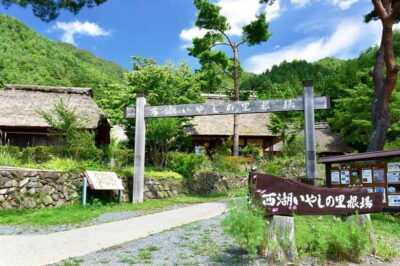
Mt. Fuji Heritage Tour: Traditional Villages, Lakes & Shrine
Read our review →Browse the lists this tour appears in