
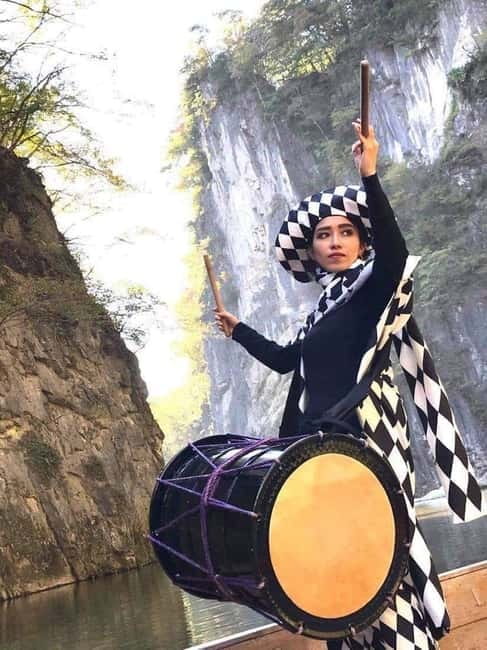
Reviewed · JAPANESE CULTURE WORKSHOPS
Tokyo’s Authentic and Finest Taiko Drumming Experience
Tokyo’s taiko workshop is more than a quick photo opportunity with Japanese drums. In 90 minutes, Eva Kestner takes you from basic stick technique to a traditional regional piece and a contemporary work, with a short cultural history lesson along the way. You also receive a personal video of your playing.
I like two things here: Eva teaches as a working artist, with serious performance and composition credentials, and the session gives you something useful to take home, not just a memory. The recorded performance can help you practice your form later, while the live demonstration shows what polished taiko sounds and looks like.
The main catch is physical. This is an active class, and several parts involve constant movement, strong arm work, poses, and concentration. The room can feel warm, so comfortable clothes and water are not minor suggestions.
In This Review
- Key points
- Why this taiko class feels like a real lesson
- The first minutes: sticks, stance, and basic control
- Rhythm training: where the fun becomes work
- The traditional piece: a taste of regional taiko
- The contemporary piece: traditional sound with a fresh edge
- Eva’s demonstration: hear the difference training makes
- The personal video: a useful souvenir
- How strenuous is 90 minutes?
- Location and timing in a Tokyo itinerary
- Is $120 a fair price?
- Who should book this experience?
- What makes Eva the right instructor?
- Final decision: should you book it?
- FAQ
- How long is the taiko drumming workshop?
- Where does the experience take place?
- Who teaches the workshop?
- Is the workshop taught in English?
- Do I need previous taiko or musical experience?
- What will I learn during the class?
- Are the drums and sticks provided?
- Do I receive a recording of the experience?
- What should I bring and wear?
Key points
- Learn two styles of taiko: The session includes a traditional piece and a contemporary piece.
- Study with Eva Kestner: Eva founded and served as first musical director of Cornell University’s Taiko Drumming group.
- See a live demonstration: Your instructor performs before or during the lesson, giving you a clear model to follow.
- Take home a personal video: You receive a recording of yourself playing, useful for practice and as a travel keepsake.
- Expect a workout: Rhythm drills, poses, switching between drums, and repeated playing can leave your arms sore.
- No experience is needed: Eva teaches the foundations in English or Japanese and builds the class step by step.
Why this taiko class feels like a real lesson
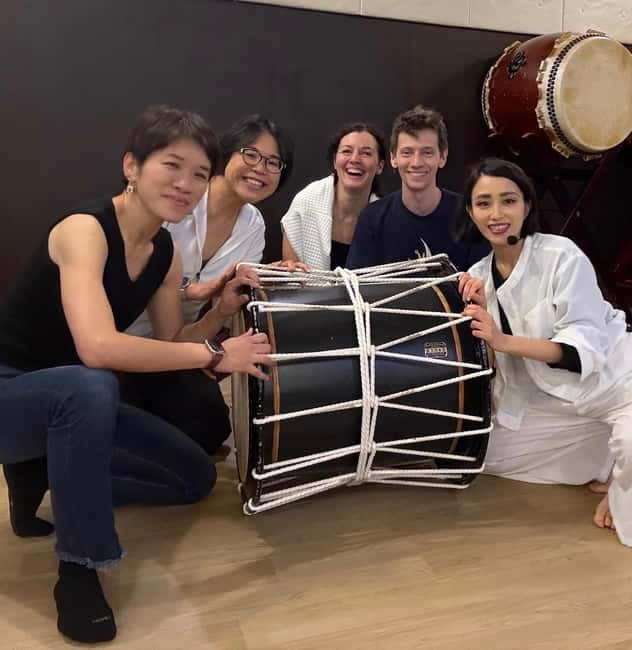
Many cultural activities give you a brief turn at a traditional object, followed by a picture and a polite goodbye. This class takes a different route. You learn how to hold the sticks, how to use your body, how rhythm is built, and how a full taiko passage comes together.
That matters because taiko is not simply loud drumming. The reviews describe close attention to form, style, timing, movement, and posture. You are learning a performance tradition, not just trying to make the biggest possible sound.
Eva Kestner leads the workshop in English or Japanese. Her background is unusually strong for a short visitor class. She founded Cornell University’s Taiko Drumming group, served as its first musical director, received an excellence award from the Tokyo University of the Arts New Artists Competition, and has original music published by HarperCollins and the Cambridge International Curriculum.
You do not need to know any of that to enjoy the class, of course. But it helps explain why the teaching goes beyond a simple tourist demonstration.
More craft workshops in Tokyo:
- Tokyo Shinjuku Chopsticks Making Class
★ 5.0 · 1,763 reviews - Kintsugi Experience: Art of Golden Joinery in Tokyo
★ 5.0 · 467 reviews - Authentic Pure Gold Kintsugi Workshop with Master Taku in Tokyo
★ 5.0 · 217 reviews
The first minutes: sticks, stance, and basic control
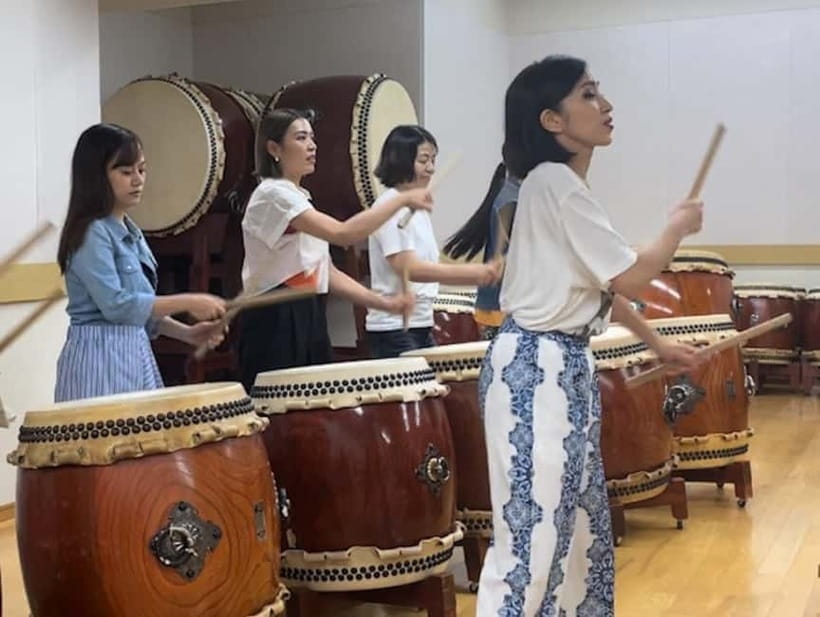
The lesson begins with foundation training. You learn how to hold the taiko sticks and how to approach the drum with the right stance and movement.
This early stage is important. If you have never played taiko, the temptation is to use only your wrists and arms. The class instead introduces a more deliberate physical style. Your posture, timing, and gestures all matter, and the visual shape of a taiko performance is part of the music.
Eva’s teaching style is described as clear, patient, energetic, and well organized. That combination should suit beginners who may feel awkward at first. She breaks the work into manageable pieces, then adds speed or complexity as you improve.
You should still expect to work. The class is not a seated music talk with a few gentle taps. You will be on the move, and the physical effort builds quickly.
Rhythm training: where the fun becomes work
Once the basic technique is in place, the class moves into rhythm training. You practice different beat patterns, often building from simple sequences toward more involved combinations.
This section gives the workshop its pulse. You are not memorizing a single line and repeating it for an hour. You shift between rhythms and learn to listen closely, keep time, and respond to the people around you.
Some participants work in pairs. One activity includes different beats and poses for each person in the pair, while another involves switching on and off the drum. These exercises keep the class social and require more than arm strength. You need focus, memory, and awareness of when to play and when to stop.
That is one reason the experience can suit families and friends. You create a shared rhythm together, and mistakes become part of the fun rather than a private struggle. A private group option is also available, which may make the class more comfortable for people who prefer to learn with their own party.
The traditional piece: a taste of regional taiko
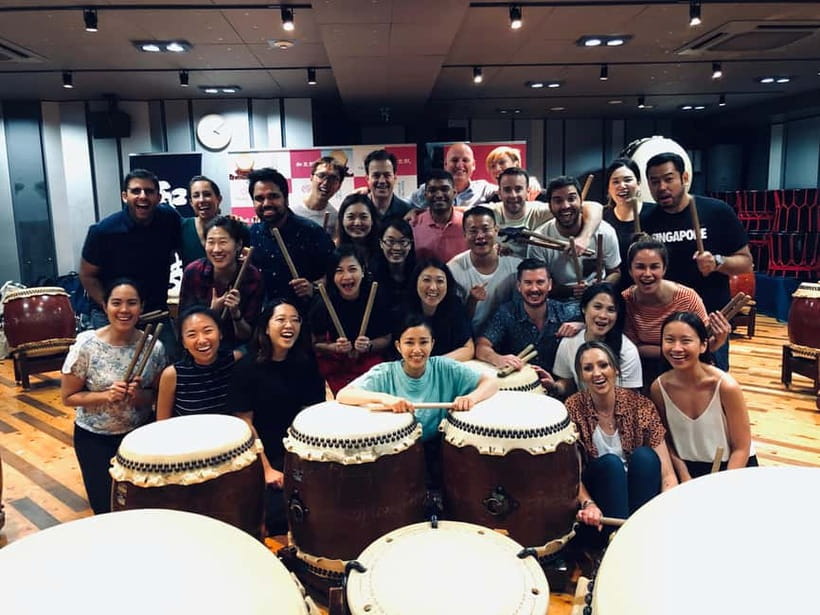
The central challenge is learning a genuine traditional composition. The precise selection can vary, but the session may include a regional piece from Miyake Island, one of the islands near Tokyo.
This gives the class cultural weight. You are not only copying a generic festival rhythm. You are learning a piece connected to a particular Japanese place and tradition, with its own patterns, movement, and performance style.
The traditional section can be demanding, especially after the rhythm drills have already used your arms and concentration. Eva guides you through the piece in stages, making the task possible even for first-time players. Still, do not expect to master it like a professional in one session. The goal is a serious introduction and a satisfying performance by the end.
I like this balance. The class gives you enough structure to feel that you have learned something real, but it does not pretend that a 90-minute lesson replaces years of training.
A few more Tokyo bookings worth comparing
- Mt Fuji and Hakone 1-Day Bus Tour Return by Bullet Train
★ 5.0 · 26,383 reviews - 1-Day Tokyo Bus Tour
★ 5.0 · 14,250 reviews - Tokyo: TOKYO SKYTREE® Admission ticket
★ 4.5 · 11,192 reviews - Tokyo: teamLab Planets TOKYO Digital Art Museum Entry Ticket
★ 4.6 · 9,779 reviews
The contemporary piece: traditional sound with a fresh edge
The session also includes a contemporary taiko piece. This helps you hear how taiko can move beyond its traditional setting while keeping its physical power and rhythmic focus.
For a first lesson, the contrast is useful. The traditional composition connects you with regional Japanese practice. The contemporary work shows that taiko is still a living art form, open to new arrangements and performance ideas.
You may notice that the two pieces ask for different kinds of attention. One may feel tied to a set regional form, while the other can offer a more modern approach to rhythm or staging. The supplied details do not specify the exact contemporary selection, so you should treat it as a second style lesson rather than expect a named work.
Eva’s demonstration: hear the difference training makes
At some point, Eva gives a demonstration performance. This is more than a pleasant interlude. It lets you see the posture, force, timing, and clean movement that the class is trying to teach.
Taiko can sound simple when you hear a finished performance. Watching an accomplished drummer makes the hidden work easier to notice. The rhythm may be strong, but the body position, controlled pauses, poses, and coordination are just as important.
This is also where Eva’s role as both performer and teacher matters. Her energy sets the tone of the room, yet the class is built for beginners. You get a professional example without being expected to perform at that level yourself.
The personal video: a useful souvenir
After the workshop, you receive a personalized video of yourself playing taiko. This is one of the best practical features of the experience.
Many activity photos show you standing beside an object. A video shows what you actually learned. You can watch your stick position, stance, timing, and movement later. One participant specifically valued having a recording for practicing form at home.
The video also captures the group performance and the feeling of the class better than a still photograph can. If you are booking this for a family, the recording gives everyone a shared souvenir. If you are traveling alone, it provides a record of your own performance rather than a standard promotional clip.
The details do not specify the exact delivery method, although one session provided a private YouTube link. You should confirm the current video arrangements when booking if that matters to you.
How strenuous is 90 minutes?
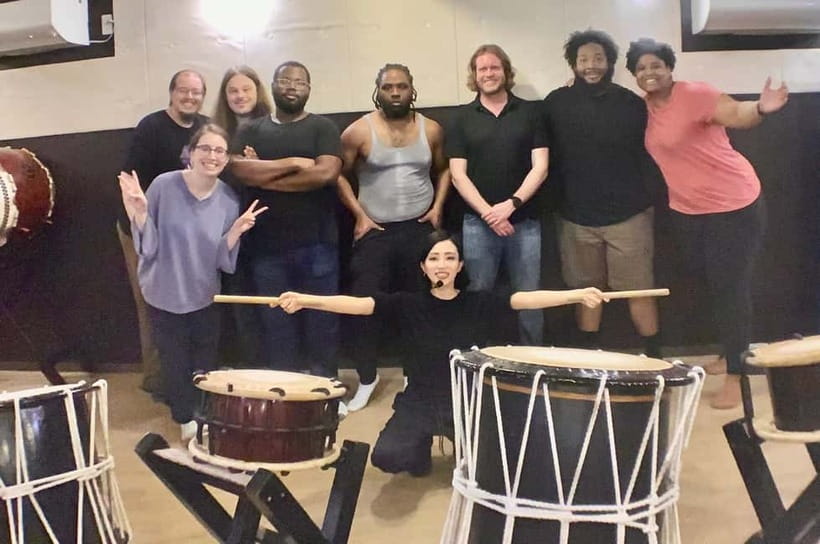
You should plan for a workout. Several participants described the session as tiring, with sore arms afterward. One person called it an unexpected workout, while another advised wearing shorts because the room became warm.
That physical demand is part of the appeal, but it can also be the main drawback. Taiko performance uses repeated arm movements, firm strikes, body positioning, and concentration. If you are looking for a quiet cultural talk, this is the wrong choice.
Wear clothing that lets you move freely. Bring water. Lightweight clothes may be more comfortable than restrictive sightseeing outfits, and you may want to avoid scheduling a demanding activity immediately afterward.
No prior taiko experience is required. The class is designed to teach the basics from the beginning, so beginners should not feel they need musical training. You still need to be ready for an active lesson and able to take part in repeated movement.
Location and timing in a Tokyo itinerary
The experience is in the Tokyo area on Honshu, with the studio described as about 20 minutes from Shibuya by train. The exact meeting point can vary according to the option booked, so check your confirmation carefully before setting out.
The 90-minute length fits neatly into a Tokyo day. You can place it between sightseeing blocks rather than give up a full morning or afternoon. Do allow extra time for the train ride and finding the studio, since the advertised duration covers the workshop itself.
For large groups over 20 people, you need to contact Eva directly to coordinate arrangements. A studio 20 minutes from Shibuya by train is used for large groups. Private groups are available, which may be especially helpful for families, school groups, corporate outings, or friends who want a more personal session.
Is $120 a fair price?
At $120 per person, this is not a bargain-bin activity. The value depends on what you want from a cultural experience.
You are paying for a full 90-minute workshop with an accomplished instructor, drums and sticks, foundation training, rhythm work, two styles of music, a demonstration, a short history of taiko, and a personal video. The professional teaching is the main reason the price can make sense. You are not simply renting a drum for a few minutes.
The recording also adds lasting value. If you would otherwise spend money on a staged cultural show and still want something hands-on, this class gives you both instruction and a performance memory.
The price may feel high if you only want to try taiko once with no interest in technique. It is easier to justify if you value direct instruction, authentic context, and a souvenir you can revisit. The perfect buyer is someone who wants to understand how the art works, not just hear a loud beat.
Flexible booking terms help. You can cancel up to 24 hours before the activity for a full refund, and reserve now while paying later. Check the available start times because they can vary by date.
Who should book this experience?
I would recommend it most strongly to:
- First-time visitors who want an active Japanese cultural lesson
- Families with older children who can follow rhythm and movement instructions
- Couples, siblings, and friends who enjoy doing something together
- Music lovers interested in traditional and contemporary Japanese performance
- Private groups that want a tailored activity
- Anyone who likes a physical challenge along with cultural context
It is less suitable for someone seeking a passive attraction, a short photo stop, or a low-effort afternoon. The class asks you to concentrate and move. That is why it feels rewarding, but it is also why you should dress for exercise.
The activity is taught in English and Japanese, which makes it practical for international visitors. The clear structure should help even if you have no musical background.
What makes Eva the right instructor?
The strongest feature is the instructor. Eva’s credentials are not just decorative. They connect directly to what you experience in the room: professional performance skill, original composition, and experience building a taiko group from the ground up.
Her teaching also receives consistent praise for clarity, patience, kindness, and high energy. Those traits matter more than a long biography in a beginner workshop. A brilliant performer who cannot explain technique would not make a good teacher. Here, the available information points to both abilities.
You can expect Eva to lead the room firmly and keep the pace moving. That pace helps you cover several rhythms and two pieces in a short time, but it also means you need to stay alert.
Final decision: should you book it?
Book this taiko experience if you want hands-on culture with real instruction. The traditional regional piece, contemporary work, professional demonstration, and personal video make it more substantial than a quick tourist activity.
Think twice if you have limited energy, dislike repetitive arm movement, or want a calm indoor lesson. For everyone else, $120 buys a focused introduction to a powerful Japanese art form, led by an accomplished artist and shaped into a complete 90-minute class.
Wear comfortable clothes, bring water, and arrive ready to sweat a little. You may leave with sore arms, but you should also leave knowing why taiko depends on far more than strength.
FAQ
How long is the taiko drumming workshop?
The workshop lasts 90 minutes.
Where does the experience take place?
It takes place in the Tokyo area on Honshu, in a studio described as about 20 minutes from Shibuya by train. The meeting point may vary depending on the option booked.
Who teaches the workshop?
Eva Kestner teaches the class. She is a professional taiko drummer, founded Cornell University’s Taiko Drumming group, and served as its first musical director.
Is the workshop taught in English?
Yes. The listed instruction languages are English and Japanese.
Do I need previous taiko or musical experience?
No prior taiko drumming experience is required.
What will I learn during the class?
You will learn foundation technique, rhythm exercises, a traditional taiko piece, and a contemporary taiko piece. The class also includes a brief history of taiko drumming.
Are the drums and sticks provided?
Yes. Taiko drums and taiko drum sticks are provided.
Do I receive a recording of the experience?
Yes. You receive a personalized video of yourself playing the taiko drums.
What should I bring and wear?
Bring a water bottle and wear comfortable clothes. The class can be physically tiring, so clothing that allows free movement is recommended.
New on our Tokyo list
- From Tokyo: Mount Fuji & Hakone Full Day Private Tour★ 4.9 · 25 reviews
- Tokyo Spectacular View Day-Cruise in 90 Minutes★ 5.0 · 25 reviews
- Real Tokyo Runner Club : Daikoku Car Meet Night Tour with JDM Car★ 5.0 · 25 reviews
- 2.5 Hour-Guided Cycle Tour in the Central Tokyo★ 5.0 · 25 reviews
- Ramen Making from Scratch +Akihabara Tour –Cooking Class★ 5.0 · 25 reviews
- [Self-Drive] Tokyo & Daikoku Custom Car Driving Tour★ 4.9 · 25 reviews
- Tokyo: 2-Hour Night Bike Tour of the City’s Hidden Gems★ 4.9 · 25 reviews
- Buddha, Bamboo & Zen – Bespoke Kamakura Private Walking Tours★ 5.0 · 25 reviews
Japanese Culture Workshops, compared.
Kintsugi Experience: Art of Golden Joinery in Tokyo
Read our review →
Authentic Pure Gold Kintsugi Workshop with Master Taku in Tokyo
Read our review →
KABUKI Show at Kabukiza Theatre Admission Ticket
Read our review →
KABUKI, BUNRAKU, etc. presented by National Theatre
Read our review →
Kintsugi Workshop Class in Shibuya, Tokyo with mon cadeau
Read our review →
Browse the lists this tour appears in