
Reviewed · HISTORICAL TOURS
Asakusa: 2-hour history exploration
Asakusa makes a fine first lesson in old Tokyo, and this two-hour walk gives you the backstory that signs and guidebooks often skip. You’ll trace the neighborhood from the Sumida River to Senso-ji Temple, stopping for temple rituals, local legends, shopping advice, and a traditional snack along the way.
I like the high, open view from the Asakusa Culture Tourist Information Center, which lets you see the route before you walk it. I also like the practical touches: headsets for groups of three or more, plus guides such as Choco, Yasu, and Amy who explain clearly in English and answer questions. The main drawback is pace. Two hours covers a lot, so the tour may feel brisk, and one past participant wanted a more tightly structured presentation.
In This Review
- Key points to know before booking
- Why a guided walk improves Asakusa
- Starting beside the Sumida River
- The best orientation comes from the eighth floor
- Kaminarimon and its giant red lantern
- Nakamise is more than a souvenir strip
- Hozomon reveals the temple’s scale
- Senso-ji turns customs into something you can practice
- Asakusa Shrine explains two religions side by side
- The guides make the difference
- Who should book this two-hour walk?
- My verdict on value and timing
- Should you book it?
- FAQ
- How long does the Asakusa history tour last?
- What time does the tour start?
- Where does the tour begin?
- Where does the tour end?
- Is hotel pickup included?
- Is the tour conducted in English?
- Are headsets provided?
- Can I cancel for a full refund?
Key points to know before booking
- See Asakusa in historical order: Begin at the Sumida River, where the neighborhood’s story starts, then follow the route toward Senso-ji.
- Get a useful bird’s-eye view: The eighth-floor terrace at the Asakusa Culture Tourist Information Center previews the major sights ahead.
- Learn how to behave at Senso-ji: Your guide explains incense, purification, prayer, and omikuji fortune slips.
- Taste something local: A traditional Asakusa snack is included, with the exact choice shaped by the group’s preferences.
- Expect a central, easy start: Meet at 9:30 a.m. by Burger King Asakusa Azumabashi, close to public transportation.
- Best for first visits: The tour suits you if Asakusa is new to you and you want context rather than a quick photo stop.
Why a guided walk improves Asakusa
You can visit Senso-ji on your own without paying for a tour. The gates are easy to find, Nakamise Shopping Street is impossible to miss, and the temple grounds are open to casual wandering. The trouble is that Asakusa’s details can blur together: a Buddhist temple, a Shinto shrine, a giant lantern, a pagoda, fortune slips, incense, and crowds moving in every direction.
This walk gives those details an order. You start beside the Sumida River, learn how the district developed, and approach Senso-ji through the same gates used by generations of worshippers and sightseers. That sequence matters. You are not just checking off famous structures. You are seeing how the temple, the shopping street, the river, and local religious life fit together.
The guide speaks live in English, and a group of three or more receives headsets. That is a worthwhile feature in Asakusa, where voices can disappear beneath street noise and the movement around Kaminarimon. The maximum group size is 20, so this is not a private walk, but it is still small enough for questions when the group stays together.
The tour costs $64.55 per person. I would call that a reasonable price if you care about Japanese history, local customs, and a guide who can make sense of what you are seeing. It is less compelling if you only want photographs of Senso-ji and Kaminarimon. You are paying for explanation, route planning, and the snack, not admission to a paid attraction. Every listed stop is free to enter.
More Asakusa visits:
- Tokyo: Japanese Dance Cabaret Theater Asakusa-Kaguwa Ticket
★ 4.8 · 2,270 reviews - Tokyo: Meiji Shrine, Asakusa, Skytree Bus Tour and Cruise
★ 4.7 · 1,986 reviews - Tokyo: Roll and Authentic Sushi Making Class in Asakusa
★ 4.9 · 1,957 reviews
Starting beside the Sumida River
The meeting point is outside Burger King Asakusa Azumabashi, at 2-chome-20-6 Kaminarimon. The tour begins at 9:30 a.m., a useful time for seeing Asakusa before the day becomes even busier. Since hotel pickup is not included, you need to reach the meeting point yourself.
The first 15 minutes take place around the Sumida River and Azumabashi Bridge. This is more than a scenic opening. The river helped shape Asakusa’s growth, and the tour uses it as the starting point for the neighborhood’s story.
From the bridge, you can see Tokyo Skytree and the Asahi Breweries headquarters, including its famous golden flame object. The view gives you a quick contrast between old and new Tokyo: a historic riverside district in front of modern towers and corporate architecture.
I like this beginning because it helps you get oriented. You see the city’s landmarks before moving into the tighter streets around the temple. The stop is also short, so you will not spend the first part of the tour standing still while the guide gives a long lecture.
The best orientation comes from the eighth floor
From the river, you walk to the Asakusa Culture Tourist Information Center. The building itself is part of the stop. Designed by Japanese architect Kengo Kuma, it looks like separate wooden structures stacked at different angles.
The eighth-floor observation terrace gives you a preview of the full route. From here, you can pick out Tokyo Skytree and the Asahi flame again, then identify Kaminarimon, Nakamise, Hozomon, Senso-ji, and other points you will soon reach on foot.
This is one of the tour’s smartest features. Asakusa’s central sights are close together, but the crowds and narrow approach can make the area feel confusing. A view from above turns the route into a simple picture. You know where you have been, where you are going, and how the temple complex relates to the surrounding streets.
The stop lasts about 15 minutes and does not require an admission ticket. It is especially helpful on a first visit, though the terrace may feel brief if you want to linger over photographs.
Kaminarimon and its giant red lantern
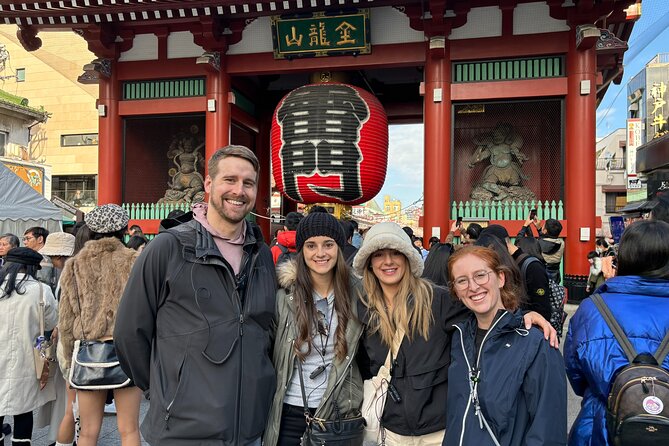
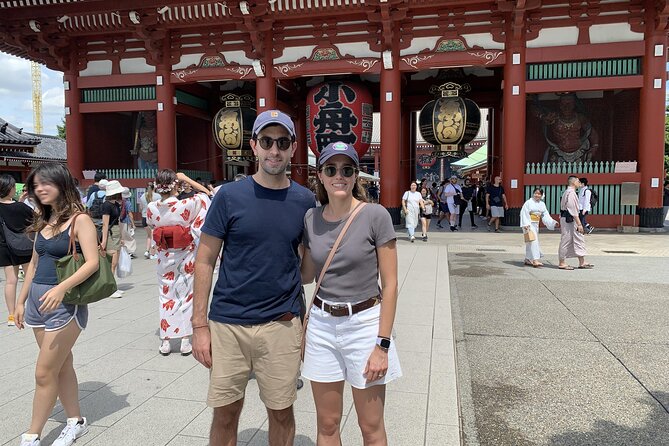
Kaminarimon means Thunder Gate. It is the outer gate leading toward Senso-ji, and its enormous red lantern is one of the most familiar sights in Asakusa.
The gate is easy to photograph, but the guide adds the part you cannot get from a quick picture. You learn what the lantern and nearby statues represent, and why this entrance carries such visual weight. The 15-minute stop is short enough to keep the walk moving while giving you a clearer reason to look beyond the obvious photo.
This is also where headsets earn their keep. Kaminarimon is a natural meeting point, and people constantly gather beneath the lantern. You may be standing a short distance from the guide while looking up at the gate, so clear audio helps you follow the explanation without pressing close to the group.
A few more Tokyo bookings worth comparing
- Tokyo: Imperial Palace and Shogun Historical Walking Tour
★ 5.0 · 2,251 reviews - Tokyo: Imperial Palace Japanese History Walking Tour
★ 4.9 · 987 reviews - Yanaka Walking Tour: Historic and Traditional District of Tokyo
★ 5.0 · 530 reviews - Tokyo: Shinjuku Historical Walking Tour & Secret Backstreets
★ 5.0 · 530 reviews
Nakamise is more than a souvenir strip
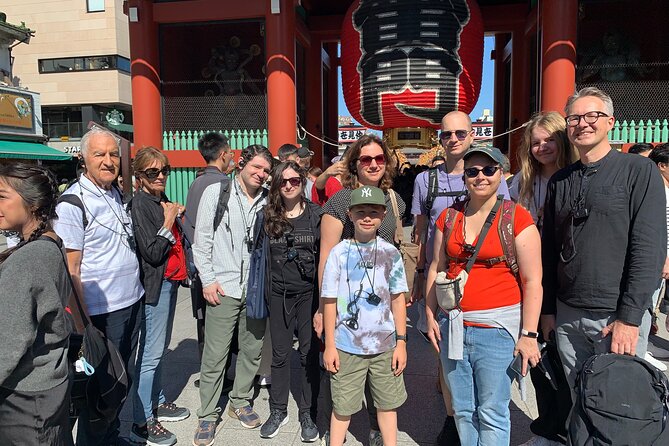
Nakamise Shopping Street runs about 250 meters between Kaminarimon and Hozomon. Its shops sell souvenirs, snacks, and traditional goods, making it one of the most commercial stretches of the walk.
It is tempting to rush through while hunting for a souvenir. The guide helps you slow down and make sensible choices. You can ask where to look for the type of item you want, and the guide may point out shops that fit your interests. One past participant even received help finding a Japanese knife, which shows the practical value of asking specific questions.
The tour also includes a traditional Japanese snack in Asakusa. The guide may choose the location based on the group’s preferences, so do not expect one fixed item every time. This is a small inclusion, but it gives you a taste of the district rather than another explanation delivered from the side of the street.
Near the far end of Nakamise, you will see history tablets showing how Asakusa began and developed around Senso-ji. This is a good place to connect the market street with the temple’s long influence. The scheduled time here is about 30 minutes, the longest stop on the route.
The tradeoff is that you have limited free-shopping time. If you find a shop you like, you may need to return after the tour. Think of this section as a guided introduction to the street, not a dedicated shopping session.
Hozomon reveals the temple’s scale
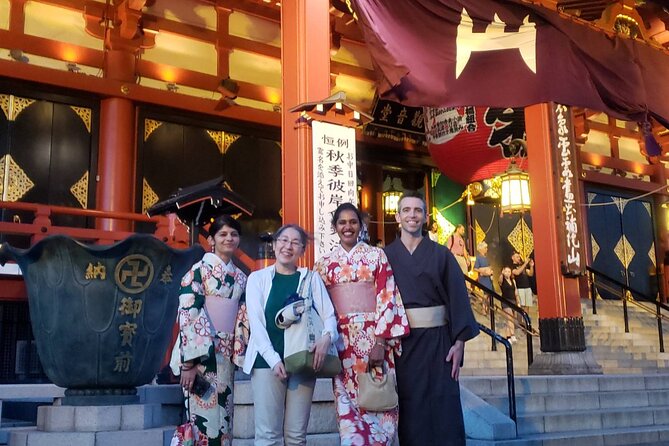
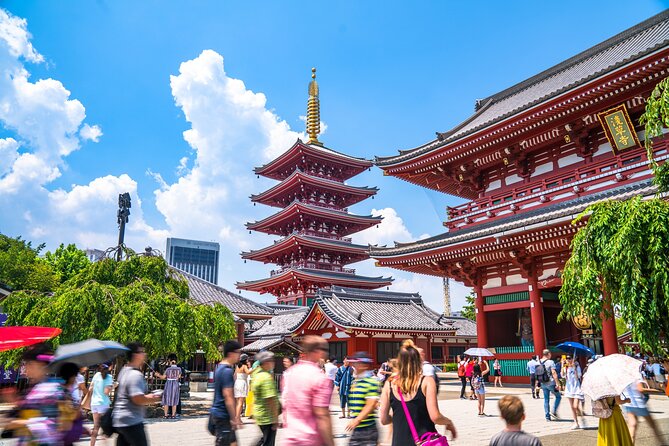
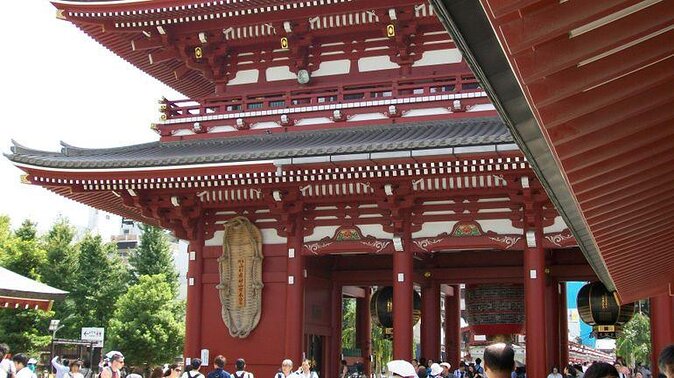
Hozomon is the inner gate of the Senso-ji approach. It is a two-story structure, and the upper level stores temple treasures. On the lower level, you will see two statues, three lanterns, and two large sandals.
The gate works as both a religious entrance and a lesson in scale. After the commercial energy of Nakamise, you pass into a more imposing part of the temple grounds. The guide helps you notice objects that can be easy to miss when you are focused on reaching the main hall.
The stop lasts around 15 minutes. You should have enough time to understand the gate and take photographs, but not enough for a slow architectural study. If you have a special interest in Buddhist buildings, make a note of what catches your eye and return later on your own.
Senso-ji turns customs into something you can practice
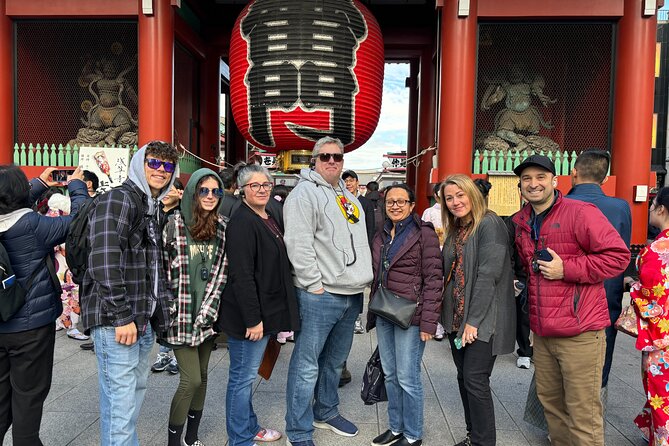
Senso-ji is the heart of the walk. Its origins reach back about 1,400 years, and the route between Hozomon and the main hall includes several customs you can observe or try.
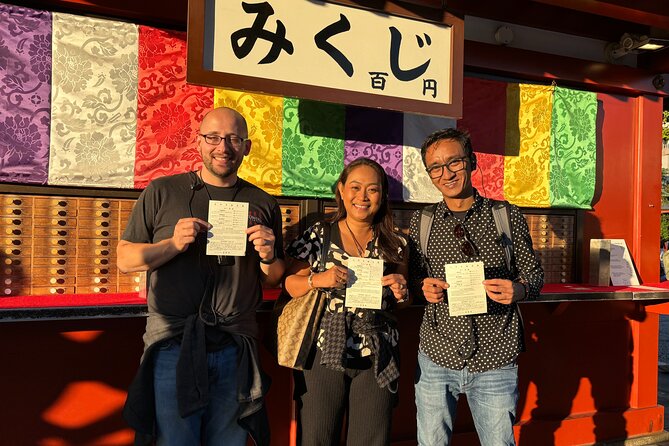
The first is omikuji, a paper fortune. You may draw one to receive a prediction about your future. This is an engaging part of the visit because it gives you something to do, not just something to look at. If the fortune is unfavorable, the custom includes tying it at the temple, leaving the bad luck behind.
Next comes the large bronze incense burner. Many people move their hands and faces through the smoke as a traditional way to ward off illness before praying. Your guide can explain the meaning, but you decide how much of the ritual you want to take part in.
You will also see the water purification fountain. Visitors use it to purify themselves before entering the main hall and offering prayers. The guide’s explanation is useful here because the actions have an order, and it is easy to copy others without knowing what you are doing.
A five-story pagoda rises nearby. At 53 meters, it is the second-highest pagoda in Japan, and its top floor holds Buddha’s ashes given by the Sri Lankan government. That detail connects the temple to Buddhist practice beyond Japan, while the pagoda itself provides one of the strongest views in the complex.
The listed time at Senso-ji is about 15 minutes, which is the one part of the route that may feel compressed. There is a lot to see between the gate and main hall. You can learn the customs and get the main historical points, but you will not have much time for quiet reflection or a detailed look at every building.
Asakusa Shrine explains two religions side by side
Asakusa Shrine sits on the same grounds as Senso-ji. For someone unfamiliar with Japanese religious life, a Buddhist temple and Shinto shrine sharing the same setting can seem puzzling. That contrast is exactly why this stop matters.
The guide explains how the two institutions relate to Asakusa’s origins and how Buddhism and Shinto can both form part of ordinary Japanese life. You do not need a background in religion to follow the explanation. The point is not to turn the stop into a theology class. It is to show you why the temple and shrine are both important and why people may visit them during the same outing.
The shrine stop is scheduled for about 15 minutes. It gives the tour a fitting final lesson: Asakusa is not an old-time display set apart from modern Tokyo. Its religious customs remain part of everyday life, alongside shopping streets, restaurants, office towers, and a major tourist route.
The walk ends at Saryo Ichimatsu, 1-chome-15-1 Kaminarimon, the restaurant where a geisha activity is held. That makes the ending convenient if you have another booked activity there, though you should not assume the geisha experience itself is included in this walking tour.
The guides make the difference
The quality of a history walk depends heavily on the person holding the headset. The available guides named in the tour details include Choco, Yasu, and Amy.
Choco is described as speaking English clearly and taking particular pleasure in using the language. Yasu is praised for explaining Asakusa’s founding and adding stories to the main facts. Amy is noted for her knowledge of Tokyo’s history and her willingness to answer questions, including practical shopping questions.
That range matters. You may want dates and religious context, or you may care more about local shops and customs. A good guide can adjust the emphasis. The tour has also included an unexpected origami lesson at the end for one group, though you should treat that as a possible bonus rather than a promised feature.
One useful caution: the tour seems designed to share many details in a short period. If you ask a lot of questions, the route may feel less tightly timed. One participant wanted more structure, and the provider acknowledged that too many details can sometimes crowd out a planned story. I would solve this by arriving ready to say what interests you most: temple customs, architecture, Tokyo history, food, or shopping.
Who should book this two-hour walk?
I would choose this tour for a first visit to Asakusa, especially if you want to understand what you are seeing rather than simply pass through the main gate. It suits anyone interested in Japanese history, Buddhist and Shinto customs, architecture, or traditional snacks.
It is also a good fit if you prefer a gentle walk instead of a bus tour. The route is active but leisurely, and the total duration is about two hours. Most people can participate, and service animals are allowed. The group can reach up to 20 people, so this is not the choice for travelers seeking a private, quiet walk.
You may want to skip it if you have already spent a full day studying Senso-ji and Asakusa. In that case, the explanations may repeat what you know, and the fixed route leaves less time for independent shopping. You should also consider the 9:30 a.m. start and the need to reach the meeting point without hotel pickup.
The tour is available with mobile ticketing, and group discounts are listed. Its current rating is 4.9 from 32 ratings, with 97 percent recommending it. Those numbers suggest a strong experience, but the more important point is what the price buys you: a guide, historical context, a snack, clear audio for larger groups, and a route that makes sense.
My verdict on value and timing
At $64.55, this is not a bargain-priced orientation walk. Still, the price is fair if you would otherwise spend time trying to decode the temple grounds, religious customs, and shopping street on your own. The tour concentrates the key sights into a clear two-hour visit and leaves you with enough information to return independently.
I especially value the river opening and the information center terrace. Together, they prevent Asakusa from feeling like a string of disconnected photo stops. The snack is a pleasant extra, while the headsets solve a real problem in crowded streets.
The biggest limitation is the short time at Senso-ji itself. If you want to pray, draw omikuji, photograph the pagoda, study the gates, and browse Nakamise at leisure, plan to return after the guided walk. Use the tour to learn the layout, then enjoy the temple at your own speed.
Should you book it?
Book this tour if you are new to Asakusa and want a compact, human explanation of its temples, gates, riverfront, and customs. The strongest reasons are the clear English guiding, the useful high-level view, the practical shopping advice, and the chance to sample a traditional snack.
Skip it if you mainly want free time or already know Senso-ji well. For most first-time visitors, though, two hours with Choco, Yasu, Amy, or another local certified guide is a sensible way to begin the neighborhood. Just keep your expectations realistic: this is a focused introduction, not a slow temple retreat or a full shopping afternoon.
FAQ
How long does the Asakusa history tour last?
The tour lasts approximately two hours.
What time does the tour start?
The tour starts at 9:30 a.m.
Where does the tour begin?
You meet outside Burger King Asakusa Azumabashi, at 2-chome-20-6 Kaminarimon, Taito City, Tokyo.
Where does the tour end?
The tour ends at Saryo Ichimatsu, 1-chome-15-1 Kaminarimon, the restaurant where the geisha activity is held.
Is hotel pickup included?
No. Hotel pickup is not included.
Is the tour conducted in English?
Yes. A local certified expert guide provides live guiding in English.
Are headsets provided?
Headsets are provided for groups of three or more so you can hear the guide clearly from a distance.
Can I cancel for a full refund?
Yes. You can cancel up to 24 hours before the experience start time for a full refund. Cancellations or changes made less than 24 hours before the start time are not accepted for a refund.
More 2-Hour Experiences in Tokyo
- Ninja Samurai 2-hour hands-on lesson by Japanese master in Tokyo
★ 5.0 · 194 reviews - Tokyo 2-Hour Genuine Samurai Experience: Kendo in Japan
★ 5.0 · 112 reviews - Tokyo: Flagship 2-Hour Street Go-Kart Tour by Street Kart
★ 4.9 · 94 reviews - Tokyo: Shinjuku Izakaya and Golden Gai Bar Hopping Tour (2h)
★ 4.9 · 67 reviews
New on our Tokyo list
- From Tokyo: Mount Fuji & Hakone Full Day Private Tour★ 4.9 · 25 reviews
- Tokyo Spectacular View Day-Cruise in 90 Minutes★ 5.0 · 25 reviews
- Real Tokyo Runner Club : Daikoku Car Meet Night Tour with JDM Car★ 5.0 · 25 reviews
- 2.5 Hour-Guided Cycle Tour in the Central Tokyo★ 5.0 · 25 reviews
- Ramen Making from Scratch +Akihabara Tour –Cooking Class★ 5.0 · 25 reviews
- [Self-Drive] Tokyo & Daikoku Custom Car Driving Tour★ 4.9 · 25 reviews
- Tokyo: 2-Hour Night Bike Tour of the City’s Hidden Gems★ 4.9 · 25 reviews
- Samurai themed Entertainment show in Shinjuku★ 4.5 · 25 reviews
Historical Tours, compared.
Imperial Palace and Shogun Historical Walking Tour
Read our review →
Yanaka Walking Tour: Historic and Traditional District of Tokyo
Read our review →
Shinjuku Historical Walking Tour & Secret Backstreets
Read our review →
Mt. Fuji Heritage Tour: Traditional Villages, Lakes & Shrine
Read our review →
The Best of Izakaya in Shinjuku Food & Cultural Tour
Read our review →
Yanaka Historical Walking Tour in Tokyo’s Old Town
Read our review →Browse the lists this tour appears in