
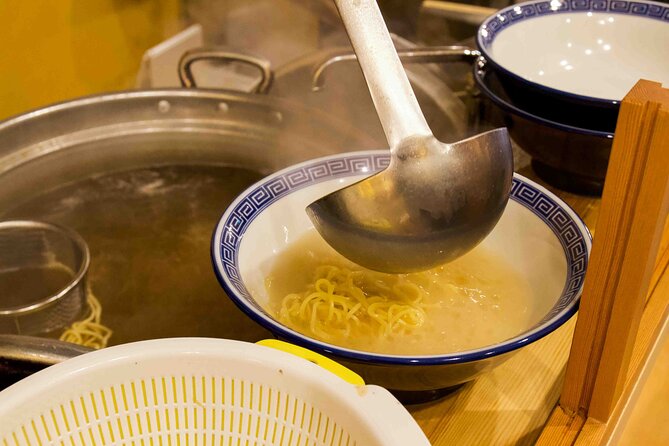
Reviewed · RAMEN EXPERIENCES
Exclusive Ramen Kitchen Experience
An award-winning ramen shop is a far better classroom than a generic cooking studio. Here, you get a close look at how a real Tokyo shop prepares its noodles, broth, and toppings, then take part in two classic noodle techniques: temomi, massaging the noodles, and tebo, shaking off their cooking water. I like the small six-person limit and the fact that you eat the bowl you help assemble.
I also like that the session cuts out the long waits that make true ramen production impractical in one hour. The broth alone takes about 10 hours to prepare, so you are seeing the key steps without pretending to make an entire bowl from raw ingredients. The main drawback is clear: chicken, pork, and fish are all used, so this is not suitable for vegetarians, vegans, or anyone avoiding those ingredients.
In This Review
- Key points about this Tokyo ramen session
- What you actually do in the ramen kitchen
- Temomi and tebo: the two skills worth remembering
- From prepared ingredients to your own Tokyo ramen
- Why the working shop setting matters
- Meeting point, timing, and the location question
- Is $78.38 a fair price for one hour?
- Who will get the most from this experience?
- Booking advice and cancellation terms
- Final call: should you book the ramen kitchen experience?
- FAQ
- How long does the ramen kitchen experience last?
- What ramen techniques will I learn?
- Do I make the ramen completely from scratch?
- What meat and seafood are in the ramen?
- How many people can join the activity?
- Where does the experience start?
Key points about this Tokyo ramen session
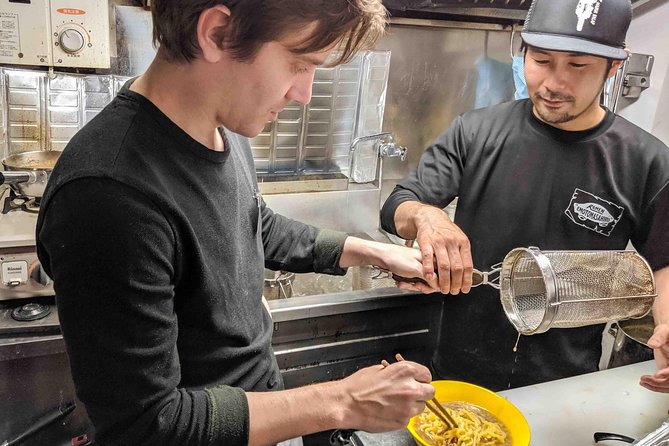
- Exclusive access to a working ramen kitchen: You get a behind-the-counter look at an award-winning shop, rather than cooking in a separate classroom.
- Two real noodle skills: You practice temomi, or massaging noodles, and tebo, the quick shaking motion used to remove water.
- Your meal is part of the lesson: After preparing the components, you add toppings and eat your own ramen.
- Small maximum group of six: The limited size should make it easier to see demonstrations and ask questions.
- One hour, not an all-day class: The experience focuses on the practical parts of ramen preparation while the long broth-making process happens beforehand.
- Check the meeting point carefully: The booking information gives 2-chōme-12-6 Nezu, Bunkyo City, as the start and end point, while the itinerary also names Nakameguro Koukashita.
What you actually do in the ramen kitchen
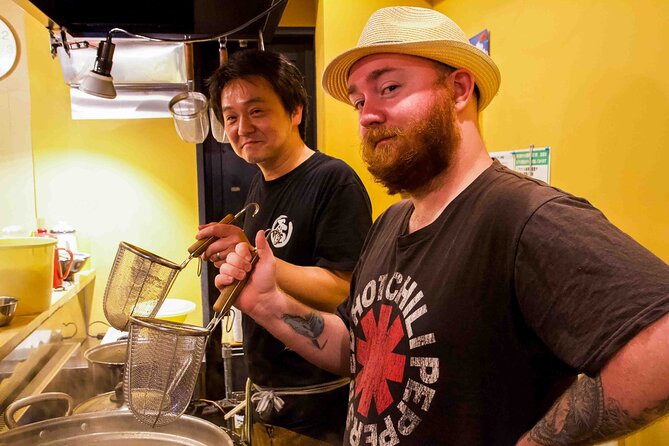
This experience is best understood as a short kitchen visit with hands-on work, not a full recipe course. You are not spending half a day making broth, preparing every ingredient, and waiting for dough to rest. Instead, you step into the working rhythm of a professional ramen shop and handle the parts that can be taught and completed during a one-hour visit.
The session begins with an explanation of the ingredients and their jobs in the finished bowl. That matters because good ramen is not simply noodles, soup, and toppings tossed together. The chef can explain where the ingredients come from, how they are prepared, and why each one affects the taste and texture.
You then get the chance to see what happens behind the counter. The sights and sounds of an actual ramen kitchen give this activity its character. You are not merely watching a chef give a polished demonstration in a quiet studio. You are learning in the kind of place where ramen is made for customers every day.
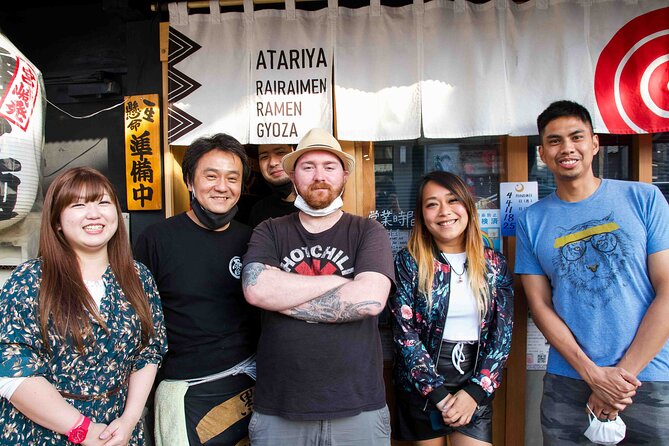
The experience has several guides, so the person leading your session may vary. No guide names are provided, but the chef is described as kind, helpful, and willing to answer questions about recipes and the place of ramen in Japanese cuisine. That openness is useful if you want more than a quick photo and a bowl of noodles.
More ramen stops:
- Eat and Drink Like a Local: Tokyo Ueno Food Tour-Taverns&Ramen
★ 5.0 · 957 reviews - Ramen & Gyoza Cooking Class in Tokyo with Local Supermarket Visit
★ 5.0 · 823 reviews - Tokyo: Ramen Tasting Tour with 6 Mini Bowls of Ramen
★ 4.9 · 432 reviews
Temomi and tebo: the two skills worth remembering
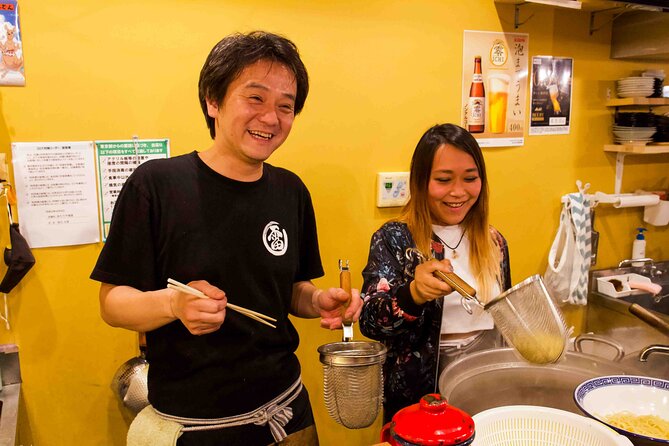
The most distinctive part of the session is the noodle work. Temomi means massaging the noodles. It sounds simple, but the technique helps you understand that noodle texture is a deliberate part of ramen, not an afterthought.
You will handle the noodles and work them as shown by the ramen professional. The point is not to master a lifelong craft in a few minutes. The point is to feel how the noodles respond and to see how a shop treats this important part of the dish.
Then comes tebo, the shaking motion used to remove water from the noodles. In a ramen kitchen, timing and movement matter. Too much water left on the noodles can affect the broth, while rough handling can change the texture. The activity lets you try this skill yourself, under guidance, before your noodles go into the bowl.
These two steps add real value because they show you the mechanics behind a familiar food. You may have eaten many bowls of ramen in Japan, but handling the noodles gives you a better sense of why one bowl feels springy and another feels soft or heavy.
From prepared ingredients to your own Tokyo ramen
The ingredients are partly prepared in advance so the activity can fit into about an hour. That is a sensible compromise. Traditional ramen production involves long cooking times, careful preparation, and repeated steps. The broth alone can take 10 hours, and there is no honest way to make a complete professional bowl from scratch during a brief visit.
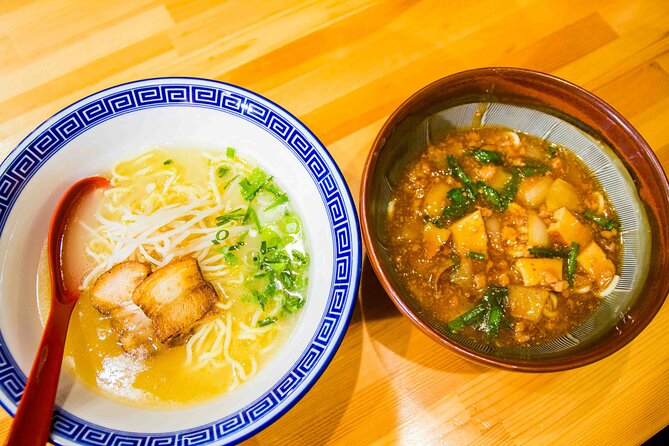
You will instead learn about the prepared broth and other ingredients, then take part in putting the bowl together. The final stage includes choosing or adding your preferred toppings from what is provided. This gives you some control over the finished meal without turning the session into an unfocused buffet.
The reward is immediate: you eat the ramen you helped prepare. That makes the activity more satisfying than a demonstration where you watch someone else cook and receive a separate sample at the end. It also gives the session a clear finish, moving from explanation to technique to lunch or dinner.
The food contains chicken, pork, and fish. This is important enough to check before booking. The information does not describe substitutions, so you should not assume that a dietary adjustment is available. If you have allergies or strict food restrictions, contact the provider before paying rather than hoping the kitchen can change the recipe on the day.
Why the working shop setting matters
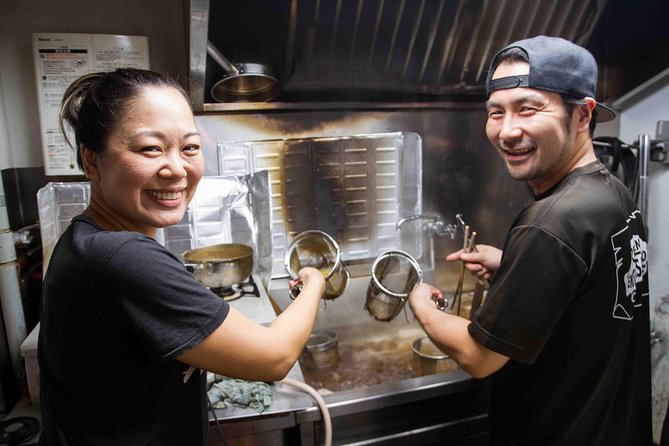
Tokyo has no shortage of ramen shops, but most places do not let customers behind the counter to handle the noodles. The special feature here is the access itself. You get to see a professional kitchen up close and take part in a process that normally happens out of sight.
The award-winning setting adds interest, but it should not be the only reason you book. Awards can tell you that the shop has earned recognition, yet they do not guarantee that this short activity matches your taste or dietary needs. The real value is the combination of a respected kitchen, direct instruction, and a meal at the end.
I especially like the chance to ask about recipes and ramen’s role in Japanese cuisine. That kind of conversation can turn a quick food stop into a useful introduction to a major part of everyday Japanese dining. If you are curious about the difference between broth styles, noodle texture, and topping choices, bring questions.
The group cap of six is another strong point. In a larger class, noodle handling could become a quick turn at a crowded station. With six people at most, you have a better chance of seeing the demonstrations clearly and receiving help with temomi and tebo. The available information does not promise private instruction, so think of this as a small-group class, not a one-on-one chef lesson.
A few more Tokyo bookings worth comparing
- Mt Fuji and Hakone 1-Day Bus Tour Return by Bullet Train
★ 5.0 · 26,383 reviews - 1-Day Tokyo Bus Tour
★ 5.0 · 14,250 reviews - Tokyo: TOKYO SKYTREE® Admission ticket
★ 4.5 · 11,192 reviews - Tokyo: teamLab Planets TOKYO Digital Art Museum Entry Ticket
★ 4.6 · 9,779 reviews
Meeting point, timing, and the location question
The experience lasts about one hour and ends where it begins. That makes it easy to fit between other Tokyo plans, especially if you want a food activity without giving up an entire afternoon.
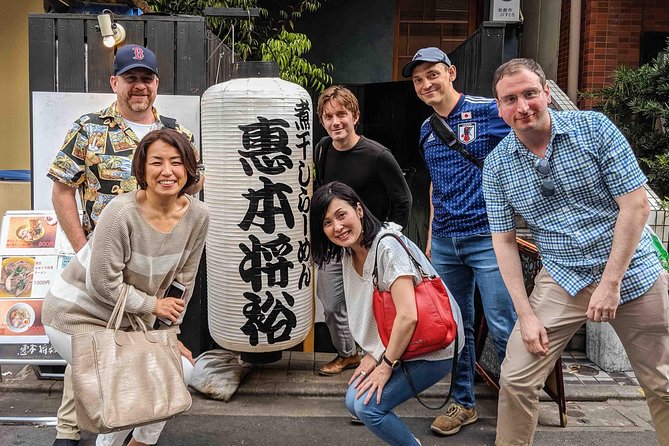
There is one practical detail you should confirm before setting out. The start and end meeting point is listed as 2-chōme-12-6 Nezu, Bunkyo City, Tokyo 113-0031. The itinerary also names Nakameguro Koukashita. Because those are different location references, check the final booking instructions and confirm the exact meeting place with Tokyo Ramen Tours.
The activity is near public transportation, which helps, but the conflicting location information means you should not simply type the first place you see into a map and leave. Allow extra time to get your bearings, especially if your schedule includes a museum visit, a train connection, or a meal immediately afterward.
The mobile ticket is convenient. Keep the confirmation accessible on your phone, and remember that the meeting location is in Tokyo local time. Confirmation is provided at booking.
Is $78.38 a fair price for one hour?
At $78.38 per person, this is not a budget bowl of ramen. If your only goal is to eat a good lunch, you can spend much less at a Tokyo ramen counter. The price needs to be judged as a food activity, kitchen visit, and guided lesson combined.
The short duration helps its value. You are not paying for a long class filled with waiting time, and you are not spending hours making broth that cannot reasonably be finished during the visit. The experience concentrates on the most engaging parts: understanding the ingredients, working the noodles, assembling the bowl, and eating it.
The small group also supports the price. A maximum of six gives the session a more personal feel than a large cooking demonstration. Exclusive access to an award-winning shop is hard to compare with a standard restaurant meal because the access itself is part of what you are buying.
I would recommend it more readily to someone who already enjoys ramen, wants a food-focused activity, or values unusual behind-the-scenes access. I would be less likely to recommend it to someone counting every yen, someone seeking a full cooking course, or someone who simply wants to sample several ramen styles.
The high rating and full recommendation rate are encouraging, and the most praised details are the helpful chef, the clear explanation of ramen’s place in Japanese cuisine, and the delicious finished meal. Still, the sample size is small, with 13 ratings, so use those figures as a positive signal rather than a guarantee.
Who will get the most from this experience?

This is a good match for first-time visitors who want a direct introduction to ramen culture without committing to a long class. It also suits returning visitors who have eaten plenty of ramen but have never seen how a professional shop handles noodles.
Families and small groups may appreciate the short format and limited capacity, though the supplied information does not state a minimum age. You should ask Tokyo Ramen Tours about age suitability if children are part of your group.
Food lovers will get the most from the ingredient discussion and the chance to ask about recipes. The activity is also useful for anyone who wants a break from temples, shopping, and major sights. It gives you a closer look at everyday Japanese food culture through one dish.
This is not the right choice if you need a vegetarian, vegan, pork-free, chicken-free, or fish-free meal. It is also not the right choice if your main aim is to learn every step of ramen production from scratch. The kitchen has already handled the long broth process, allowing you to focus on the parts that fit the schedule.
Booking advice and cancellation terms
The experience is commonly reserved about 16 days ahead, so booking early makes sense if your Tokyo dates are fixed. The group maximum is six, and small sessions can fill faster than large sightseeing tours.
You can cancel for a full refund up to 24 hours before the start time. Changes or cancellations inside that 24-hour window are not accepted for a refund, and the cut-off uses Tokyo local time.
The activity requires a minimum number of participants. If that minimum is not met and the experience is canceled, you will be offered another date or experience, or a full refund. Keep that possibility in mind if you are building a tightly timed itinerary.
Final call: should you book the ramen kitchen experience?
Book it if you want more than a bowl of noodles. The strongest reasons are the working award-winning kitchen, the chance to practice temomi and tebo, the small group, and the fact that you finish by eating your own ramen. The friendly chef interaction and useful food context add substance to a short activity.
Skip it if you need dietary flexibility, want a full from-scratch cooking course, or think $78.38 is too much for a one-hour meal activity. Before booking, confirm the meeting point because Nezu and Nakameguro Koukashita are both named in the supplied details.
For a ramen fan, this is a compact and memorable way to see what happens behind the counter. Just arrive with the right expectations: you are learning the craft in a real shop, not making a 10-hour broth from the first simmer.
FAQ
How long does the ramen kitchen experience last?
The activity lasts approximately one hour and ends back at the meeting point.
What ramen techniques will I learn?
You will learn temomi, the process of massaging the noodles, and tebo, the technique of shaking water from the noodles.
Do I make the ramen completely from scratch?
No. The long preparation work is completed in advance, including the broth, which can take about 10 hours to make. You learn about the ingredients, work with the noodles, add toppings, and assemble your bowl.
What meat and seafood are in the ramen?
The ramen contains chicken, pork, and fish. The supplied information does not confirm that substitutions are available.
How many people can join the activity?
The maximum group size is six people. The experience may also have multiple guides.
Where does the experience start?
The stated start and end point is 2-chōme-12-6 Nezu, Bunkyo City, Tokyo 113-0031, Japan. Nakameguro Koukashita is also named in the itinerary, so confirm the exact meeting location before the day of the activity.
New on our Tokyo list
- Sumi-e Experience in a relaxing green tea shop in Tokyo★ 5.0 · 3 reviews
- Tokyo : Kamikaze Street Drift Ride★ 5.0 · 3 reviews
- Private Zen Meditation in English in Shinjuku, Tokyo★ 5.0 · 3 reviews
- Onsen Spa in Tokyo and Asakusa Bar Hopping with Local Guide★ 5.0 · 3 reviews
- Easy for everyone! Now you can play handmade mini shamisen and show off to everyone! Musical instruments, sweets and live music★ 5.0 · 3 reviews
- Tokyo: Private Tsukiji Street Food & Sake with Local Guide★ 5.0 · 3 reviews
- Mt Fuji Exploration Tour with Free Japanese Kusa Mochi from Tokyo★ 4.5 · 3 reviews
- Tokyo Tsukiji Fish Market Walking and Exploring Hidden Gems Tour★ 5.0 · 3 reviews
Ramen Experiences, compared.

Eat and Drink Like a Local: Tokyo Ueno Food Tour-Taverns&Ramen
Read our review →
Ramen & Gyoza Cooking Class in Tokyo with Local Supermarket Visit
Read our review →

Easy Ramen Cooking Experience in Kabukicho, Shinjuku
Read our review →
Ramen and Sushi Cooking Class with Sake Pairing Set in Tokyo
Read our review →
Professional Ramen & Gyoza with Ramen Chef in a restaurant!
Read our review →
Ramen Dojo Tokyo | Make All 3 (Tonkotsu/Shoyu/Miso)
Read our review →Ramen Dojo Tokyo | Make All 3 (Tonkotsu/Shoyu/Miso)
Read our review →Browse the lists this tour appears in