
Reviewed · WALKING TOURS
Tokyo: Asakusa Walking Tour with Japanese Comedian
Asakusa is easiest to enjoy when someone explains what you are looking at, and this tour adds an unusual twist: your guide, Ryo, is a stand-up comedian. In about 90 minutes, he leads you from the Asakusa Culture Tourist Information Center through temple grounds, shrines, old gates, shopping streets, and quieter corners most visitors could pass without noticing.
I like the small-group format, which leaves room for questions and conversation. I also like the early-start option: an 8 a.m. walk can give you cooler, calmer temple grounds before crowds arrive around 9 a.m. The main drawback is pace. With 12 stops in a short tour, you get a useful introduction rather than a long, meditative visit at each site.
In This Review
- Key points
- Why a comedian makes sense in Asakusa
- Starting above Asakusa at the Tourist Information Center
- Kaminarimon and Nakamise Shopping Street
- Bentendo and the Bell of Time
- Nisombutsu and Nitenmon Gate
- Asakusa Shrine, Yogodo, and Awashimado
- A sweet break at Asakusa Nishisando
- Hozomon and the main hall of Senso-ji
- What the 90-minute format gives you
- Group size, language, and flexibility
- The best time to book
- Who will get the most from this walk
- Price, cancellation, and practical planning
- Should you book the Asakusa comedian walking tour?
- FAQ
- How long is the Asakusa walking tour?
- Who is the guide?
- Where does the tour start?
- Where does the tour finish?
- How large is the group?
- Is the tour offered in English?
- Does the tour include temple admission fees?
- Can I start the tour early?
- Is food included?
- What is the cancellation policy?
Key points
- Ryo brings two skills to the walk: He combines local knowledge from his former work as an Asakusa rickshaw driver with stand-up comedy and good English.
- The route covers more than Senso-ji: You’ll see Buddhist temples, Shinto shrines, historic gates, a bell, statues, shopping streets, and small cultural details.
- An early start matters: The area is quieter at 8 a.m., while crowds build from about 9 a.m. and many market stalls open around 10 a.m.
- The group is kept small: The tour is described as capped at six, while the additional booking information lists a maximum of eight people.
- Melon pan is part of the fun: At Asakusa Nishisando, you can stop at Kagetsudo for this sweet Japanese bread.
- The price is modest: At $37.99 per person, the tour offers a focused way to put Asakusa’s sights into context without paying entrance fees.
Why a comedian makes sense in Asakusa
Asakusa has no shortage of famous sights. The trouble is that the district can become a blur of red gates, incense, statues, souvenir shops, and temple buildings if you do not know what matters.
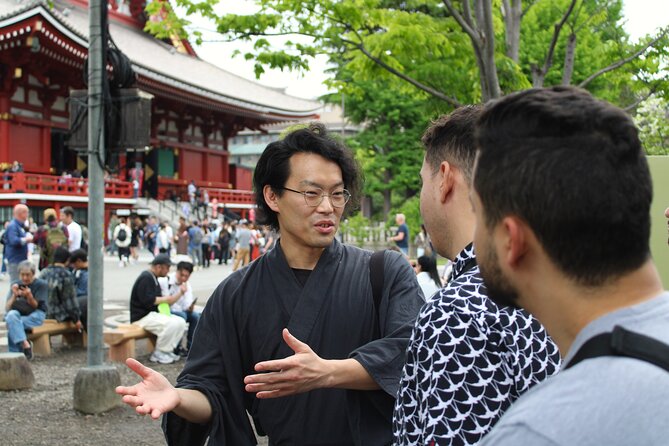
Ryo’s approach is meant to keep the facts moving. He explains Japanese history and customs, answers questions, and uses humor to make the walk feel like a conversation rather than a lecture. The comedy is not the whole point. It is the device that helps the history stay lively.
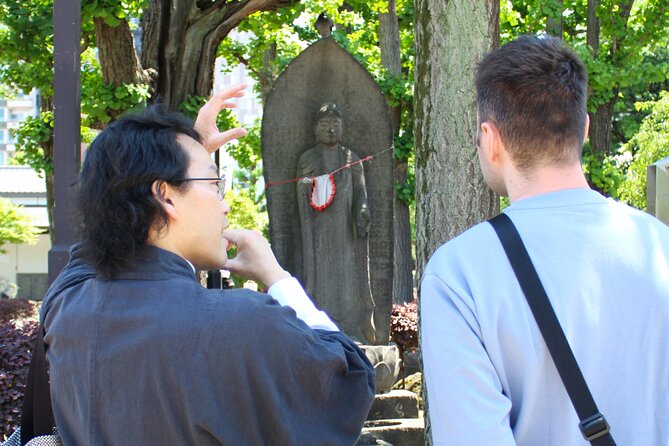
That balance matters here. A guide can point out why a Buddhist temple and Shinto shrine share the same neighborhood, explain the symbolism of a statue, or show you a small memorial you would never notice alone. Ryo’s background as a former rickshaw driver also gives him a practical connection to Asakusa and its streets.
The tour works especially well if you enjoy asking questions. Several parts of the walk are compact, and a small group gives you a better chance to pause and ask about customs, local shops, souvenirs, Japanese culture, or the meaning of what you see.
More Asakusa visits:
- Tokyo: Japanese Dance Cabaret Theater Asakusa-Kaguwa Ticket
★ 4.8 · 2,270 reviews - Tokyo: Meiji Shrine, Asakusa, Skytree Bus Tour and Cruise
★ 4.7 · 1,986 reviews - Tokyo: Roll and Authentic Sushi Making Class in Asakusa
★ 4.9 · 1,957 reviews
Starting above Asakusa at the Tourist Information Center
The meeting point is at Tokyo Cruise Asakusa Pier, at 1-chōme-1-1 Hanakawado. The first stop is the Asakusa Culture Tourist Information Center, where you go up to the eighth floor for a view.
This is a smart opening. Before walking into the temple district, you get a look across the area and a sense of how Asakusa fits together. The viewpoint also helps you get your bearings, particularly if this is your first time in the neighborhood.
You spend about 10 minutes here, with no admission charge. Do not expect a long observation-deck visit. Think of it as a quick orientation before heading toward the main gate.
Kaminarimon and Nakamise Shopping Street
The tour then enters Asakusa through Kaminarimon, the Thunder Gate and one of the district’s most recognizable landmarks. Its large lantern makes it an easy visual marker, but a guide can give the gate more meaning than a photo stop alone.
From Kaminarimon, you walk along Nakamise Shopping Street toward Senso-ji. This is the direct approach to the temple, lined with shops and food stalls. It is also where Asakusa can feel busiest, especially later in the morning.
The planned time here is about 10 minutes. That is enough to see the route and hear the main background, but not enough for a serious shopping session. If you want souvenirs or snacks, return after the tour. The walk gives you a useful first look, then leaves you free to browse at your own pace.
Bentendo and the Bell of Time
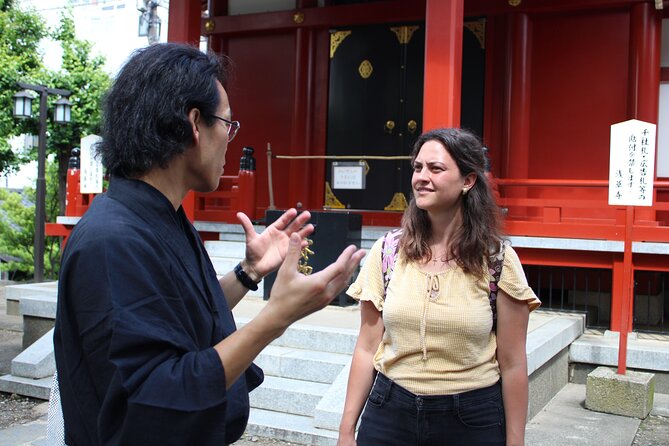
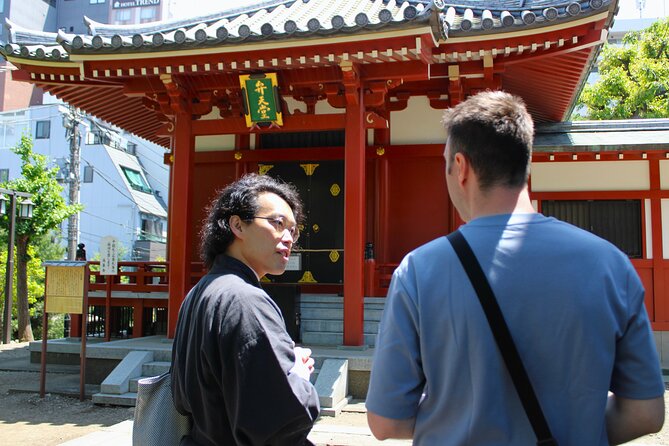
After Nakamise, the route shifts from the obvious main path to smaller places within the Senso-ji grounds. Bentendo is a compact temple associated with art and prosperity. You spend about five minutes here, so Ryo’s explanation is likely more important than the building’s size.
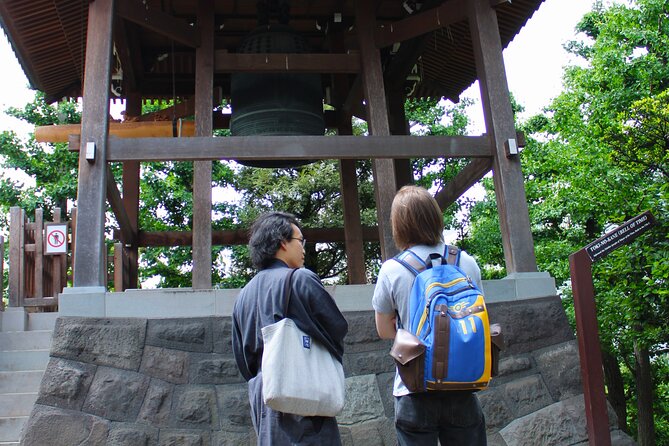
Next comes the Bell of Time. During the Edo period, the bell was regularly rung by a Senso-ji monk to tell people the time. This is the sort of detail that adds daily life to a historical site. Instead of seeing only old architecture, you begin to picture how the temple helped organize the neighborhood.
These stops are brief, but they show the tour’s purpose. It is not simply a march to the main hall. It uses small features to explain how Asakusa functioned as a religious and community center.
More walking routes in Tokyo:
- Tokyo Tsukiji Fish Market Food and Culture Walking Tour
★ 5.0 · 3,184 reviews - Tokyo: Imperial Palace and Shogun Historical Walking Tour
★ 5.0 · 2,251 reviews - Tokyo: Shinjuku Local Bar and Izakaya Guided Walking Tour
★ 4.9 · 1,794 reviews - Tokyo: Tsukiji Fish Market Food and Walking tour
★ 5.0 · 1,724 reviews
Nisombutsu and Nitenmon Gate
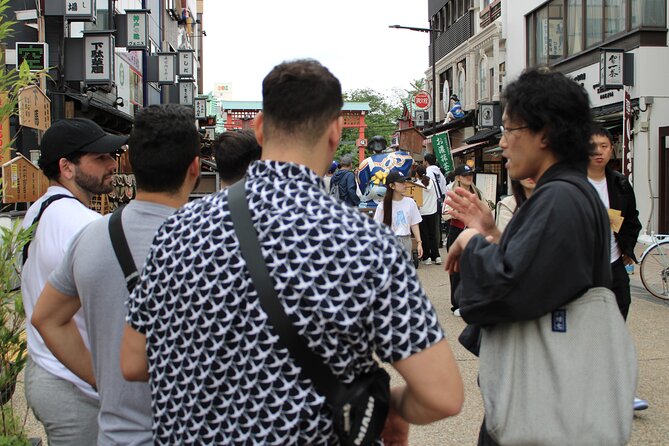
Nisombutsu offers a calmer pause. Here you see two bronze statues and four stone statues of Buddhist deities, constructed in the seventeenth century. Five minutes is scheduled for the stop, enough for a close look and a short explanation.
Nitenmon Gate is given more time, about 10 minutes. It is one of Japan’s National Cultural Properties and sits to the right of Senso-ji’s main hall. The gate was used as the shogun’s gate, according to the tour description, adding a strong link between the temple grounds and the political world of old Japan.
This is an important part of the route for anyone who wants more than a quick temple photograph. Ryo can explain how religious spaces, authority, and old Japanese society connect. You are also likely to have time for pictures, though the tour’s schedule means you should not expect a long stop at every structure.
Asakusa Shrine, Yogodo, and Awashimado
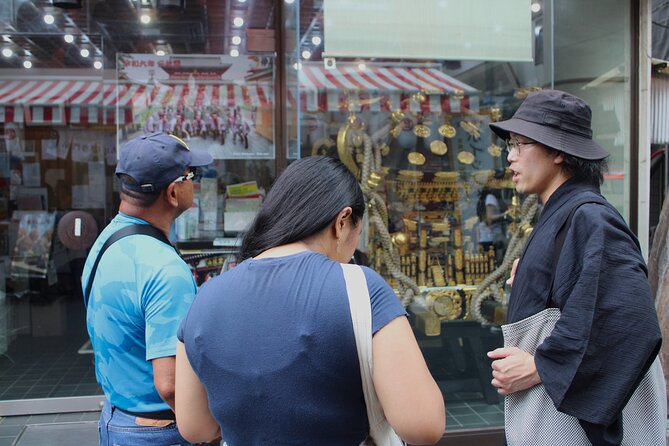
The walk next reaches Asakusa Shrine, a Shinto site connected to the origin of Senso-ji. Its three deities are closely tied to the temple’s beginnings, making this a useful place to understand the relationship between Shinto and Buddhism in Asakusa.
The shrine also has a garage for three large portable shrines used during local festivals. Even if you visit outside festival season, that detail helps show how religious life extends beyond the main buildings and into neighborhood events.
You spend around 10 minutes at Asakusa Shrine, followed by shorter visits to Senso-ji’s Yogodo and Awashimado. Yogodo receives about five minutes, while Awashimado receives about 10. These lesser-known spots help break up the standard Kaminarimon to main hall route.
If you have already spent hours studying temple architecture, the number of stops may feel demanding. If you are new to Japanese religious sites, the variety is useful. Ryo’s explanations help you tell a Buddhist temple from a Shinto shrine and notice details that otherwise blend together.
A sweet break at Asakusa Nishisando
At Asakusa Nishisando, the tour may stop at Kagetsudo for melon pan, a sweet Japanese bread. The itinerary allows about five minutes, so this is a quick taste rather than a full food tour.
Still, it is a welcome change of rhythm. Asakusa is not only temples and monuments. Its snack shops and shopping streets are part of the neighborhood’s appeal, and melon pan gives you something simple to try while walking.
The stop is optional in tone, so do not treat it as a guaranteed meal or a tasting program. If you want the full food experience, you may need to return later. But as a suggested snack, it is a useful recommendation from a guide who knows the area.
Hozomon and the main hall of Senso-ji
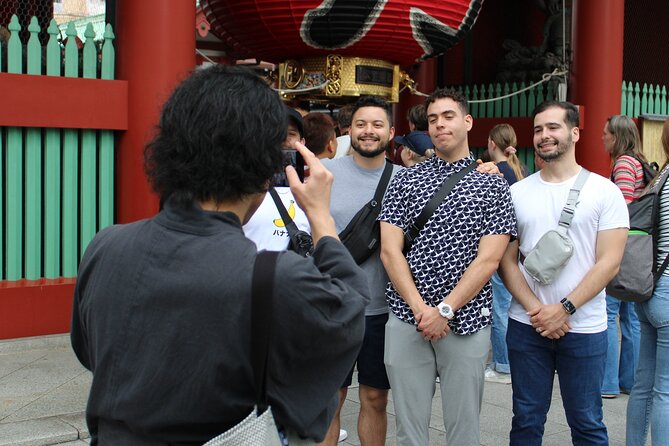
Hozomon is another major gate in front of the temple. A pair of guardian statues stands here, giving the entrance a strong sense of protection and ceremony. The planned stop is about five minutes.
The walk ends at the main hall of Senso-ji, where you spend about 10 minutes. Senso-ji is described as Tokyo’s oldest temple, with about 1,400 years of history, and it is dedicated to Kannon Bodhisattva.
This final stop is where the earlier details come together. After seeing Bentendo, the bell, statues, gates, and Asakusa Shrine, you have more context for the temple complex. Ryo can explain the story of Kannon and why the temple has remained important to people over many centuries.
The official end point is in front of Senso-ji’s main hall at 2-chōme-3-1 Asakusa. That is convenient for continuing your day. You can stay in the area, return to Nakamise, look for food, or explore more of Asakusa without needing to make your way back to the starting point.
What the 90-minute format gives you
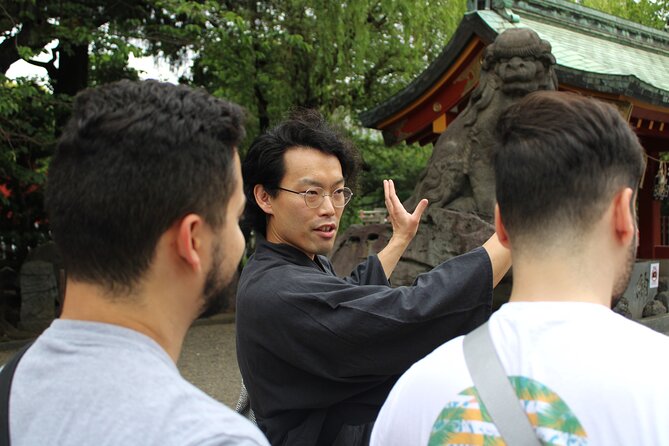
This is a concentrated introduction. The published route includes 12 stops, with time spread across viewpoints, gates, shrines, small temple sites, shopping streets, and the main hall. The actual walk is listed at about 90 minutes, while one description in the feedback refers to a two-hour experience. Plan for roughly 90 minutes, and allow extra time if you want to continue exploring afterward.
The format is best for seeing the shape of Asakusa quickly. You get the major landmarks, but you also hear about small details, including monuments and cultural practices that are easy to miss. You will not have much time for shopping, long food stops, or quiet personal reflection during the walk.
That tradeoff is reasonable at this price. You are paying $37.99 for a guide who brings structure and explanation to an area that can otherwise feel crowded and confusing. Since the stops have no separate admission charge, the main value is Ryo’s time, local interpretation, and ability to connect the sites.
Group size, language, and flexibility
The experience is promoted as a small-group walk capped at six people. The additional information gives a maximum of eight, so the safest expectation is a small group of up to eight rather than a private tour.
That size should still allow a more personal experience than a large coach excursion. You can ask about temple customs, Japanese culture, local shops, souvenirs, and details along the route. One-person and two-person bookings may also feel especially conversational, though you should not assume a private tour unless your booking confirms it.
Ryo’s English is described as very good, and the feedback repeatedly highlights his clear communication, humor, patience, and willingness to answer questions. The guide is also described as flexible with a minor schedule adjustment and able to adapt the tour to a visitor’s interests and needs.
Service animals are allowed, and most people can take part. The tour is near public transportation, but the provided details do not specify a station exit or exact walking distance from the station. Use the stated Asakusa Pier meeting point carefully when planning your arrival.
The best time to book
Morning is the strongest choice if you dislike heat and crowds. An 8 a.m. start has been arranged for some bookings, and the area is notably quieter then. Crowds begin building around 9 a.m., while many market stalls open at about 10 a.m.
You therefore have two reasonable strategies. Choose early for cooler air, clearer views, and a calmer walk through Senso-ji. Choose a later time if you want to see Nakamise and the surrounding market area with more shops open.
The early option may mean less shopping activity, but the tour itself is about seeing and understanding the district. You can always return to the market afterward, when the stalls are open. In warm weather, the early start is particularly useful.
Who will get the most from this walk
I would choose this tour if you want a friendly introduction to Asakusa and prefer a guide who talks with you instead of reciting facts. It fits first-time visitors, families, couples, and solo visitors who want context for the temple and shrine district.
It also suits teenagers and older children who may lose interest in a standard history talk. Ryo’s humor and conversational style can keep the route moving, while the short stops prevent the visit from becoming too heavy.
People with a strong interest in religious architecture may want more time at each site than this tour provides. The same is true for serious shoppers and food-focused visitors. You can still use the walk as an orientation, then explore independently afterward.
The tour may also work well for returning visitors. The route includes small monuments, local details, and less obvious corners, so someone who has already seen Kaminarimon and the main hall can still gain more from the district.
Price, cancellation, and practical planning
At $37.99 per person, this is a low-cost guided walk for Tokyo. The value is strongest when you consider how much interpretation is packed into a short route, particularly if you want help understanding Japanese temples, shrines, symbols, and local customs.
There are group discounts, and a mobile ticket is available. Confirmation arrives at booking. Free cancellation applies when you cancel at least 24 hours before the start time. Inside that 24-hour window, the payment is not refunded and changes are not accepted.
Wear shoes you can walk in and plan for an outdoor visit. The information says most people can participate, but it does not provide a detailed accessibility breakdown. If you have specific mobility needs, contact the provider before booking.
Should you book the Asakusa comedian walking tour?
Book it if you want history with personality, a small group, and a quick route through the temple district. Ryo’s mix of local experience, English conversation, comedy, and cultural explanation gives the walk a clear identity.
I would especially recommend an early start, then returning to Nakamise and the market after the tour. That plan gives you the quietest temple visit first and the livelier shopping scene later.
Skip it if you want a slow, private, highly specialized temple study or a dedicated food tour. For most visitors who want to understand Asakusa without spending much time or money, this is a practical and entertaining choice.
FAQ
How long is the Asakusa walking tour?
The tour lasts approximately 1 hour and 30 minutes. One provided description refers to a two-hour walk, so allow some extra time in case the pace or questions extend the visit.
Who is the guide?
The guide is Ryo, a stand-up comedian and former rickshaw driver in Asakusa. He provides information about Japanese history and culture while adding humor to the walk.
Where does the tour start?
The meeting point is Tokyo Cruise Asakusa Pier, 1-chōme-1-1 Hanakawado, Taito City, Tokyo 111-0033, Japan.
Where does the tour finish?
The tour ends in front of the main hall of Senso-ji Temple at 2-chōme-3-1 Asakusa, Taito City, Tokyo 111-0032, Japan.
How large is the group?
The experience is described as capped at six people in the highlights. The additional information lists a maximum of eight travelers, so the group may be as large as eight.
Is the tour offered in English?
The supplied information and feedback describe Ryo’s English as very good. The tour includes explanations and conversation in English.
Does the tour include temple admission fees?
The listed stops show free admission tickets. No separate entry fee is specified for the route.
Can I start the tour early?
An 8 a.m. start has been arranged for some bookings. The usual earliest time is described as 9 a.m., but Ryo may be able to start earlier when convenient.
Is food included?
Food is not listed as included. The tour may stop at Kagetsudo in Asakusa Nishisando so you can try melon pan.
What is the cancellation policy?
You receive a full refund if you cancel at least 24 hours before the local start time. Cancellations or changes made within 24 hours are not accepted and are not refunded.
New on our Tokyo list
- From Tokyo: Mount Fuji & Hakone Full Day Private Tour★ 4.9 · 25 reviews
- Tokyo Spectacular View Day-Cruise in 90 Minutes★ 5.0 · 25 reviews
- Real Tokyo Runner Club : Daikoku Car Meet Night Tour with JDM Car★ 5.0 · 25 reviews
- 2.5 Hour-Guided Cycle Tour in the Central Tokyo★ 5.0 · 25 reviews
- Tokyo: 2-Hour Night Bike Tour of the City’s Hidden Gems★ 4.9 · 25 reviews
- Ramen Making from Scratch +Akihabara Tour –Cooking Class★ 5.0 · 25 reviews
- [Self-Drive] Tokyo & Daikoku Custom Car Driving Tour★ 4.9 · 25 reviews
- Samurai themed Entertainment show in Shinjuku★ 4.5 · 25 reviews
Walking Tours, compared.
Tokyo Tsukiji Fish Market Food and Culture Walking Tour
Read our review →
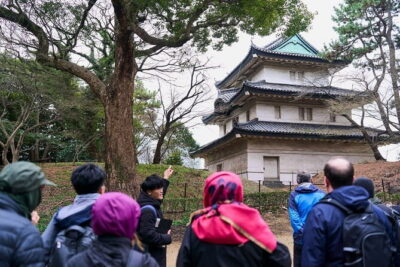
Imperial Palace and Shogun Historical Walking Tour
Read our review →
Shinjuku Local Bar and Izakaya Guided Walking Tour
Read our review →
Asakusa Walking Tour with Sensoji Temple Visit
Read our review →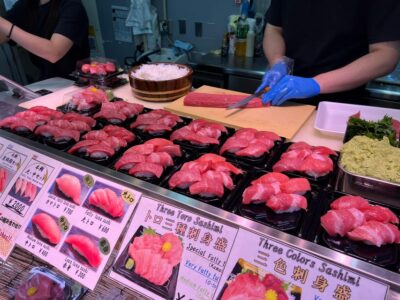
Tokyo Castle & Imperial PalaceーShogun Walking Tour
Read our review →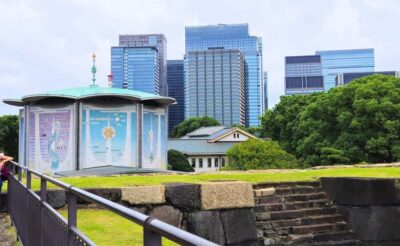
Browse the lists this tour appears in