
Reviewed · DESSERT TOURS
Tokyo: Hama-rikyu Gardens tour with Japanese Tea & Sweets
Hama-rikyu Gardens gives you a quiet look at Tokyo’s Edo-period past, right in the middle of the modern city. I like the way this tour explains the garden’s design instead of treating it as a photo stop, and I like that matcha and Japanese sweets are included in the price. With a maximum of four people, the walk can feel personal, and guide Nori has earned special praise for being helpful.
The main consideration is the cost: $85.84 per person is a serious price for a garden visit lasting about 90 minutes. The value depends on how much you want guided context and a small-group tea experience. The optional stops can extend the outing to roughly two and a half hours, but they are not the central part of the tour.
In This Review
- Key points to know before booking
- Why Hama-rikyu works so well for a short Tokyo tour
- Meeting at Otemon Bridge
- Reading the Karesansui dry garden
- Following the Kaiyushiki circular garden
- Matcha, sweets, and a quieter cultural moment
- Optional stop: Advertising Museum Tokyo
- Optional stop: Miyazaki’s giant clock
- Optional stop: Hibiya Shrine
- Is $85.84 a fair price?
- Who should book this experience?
- Cancellation and practical details
- Should you book the Hama-rikyu Gardens tea tour?
- FAQ
- How long does the Hama-rikyu Gardens tour last?
- What is included in the tour price?
- Is matcha included?
- How large is the tour group?
- Who guides the experience?
- Where does the tour begin?
- Where does the tour end?
- Are the additional stops required?
- Can I cancel for a full refund?
Key points to know before booking
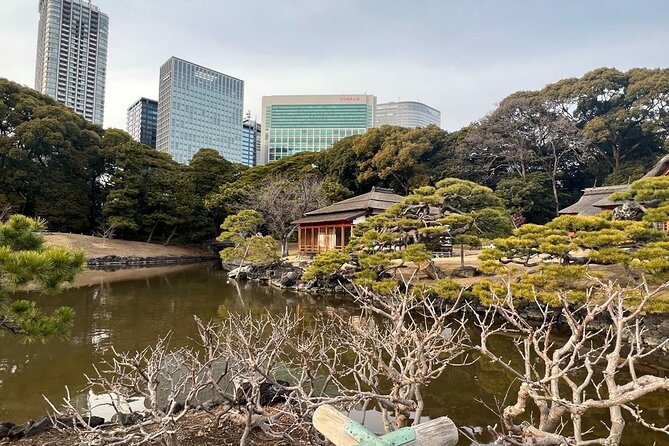
- Edo-period garden setting: Hama-rikyu was built as a daimyo garden during the years of the Tokugawa shogunate.
- Two distinct garden styles: You’ll learn about the Karesansui dry garden and the Kaiyushiki circular garden.
- Tea and sweets included: Matcha green tea and Japanese sweets are served in a tea room inside the gardens.
- Very small group: The tour accepts no more than four people, useful if you prefer questions and conversation.
- Optional cultural stops: You can add the Advertising Museum Tokyo, Miyazaki’s giant clock, and Hibiya Shrine.
- Easy onward transport: The tour ends at Shiodome Station, served by the Yurikamome and Toei Oedo lines.
Why Hama-rikyu works so well for a short Tokyo tour
Tokyo can make old Japan feel hard to find. Tall buildings, crowded crossings, and fast trains dominate most first visits. Hama-rikyu Gardens offer a useful change of pace without requiring a long trip outside the city.
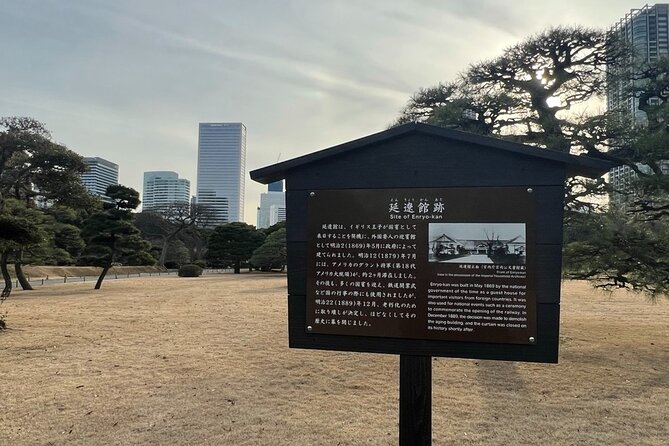
The garden is the largest of Tokyo’s daimyo gardens. Daimyo were powerful samurai-era lords who maintained large estates, including formal gardens. Here, the point is not simply to walk among plants and ponds. You’ll learn how the garden was planned, how its different areas relate to one another, and why Japanese garden design values controlled views and changing seasonal beauty.
I like this approach because it gives you a way to read what you see. Without explanation, a dry garden can look like gravel and arranged stones. A circular garden can look like a pleasant path around water. With a guide, those spaces become examples of different design ideas.
The tour is also a good fit for a traveler who wants a modest amount of culture in a compact block of time. The listed garden visit lasts about 90 minutes, while the full experience may run from 90 minutes to two and a half hours depending on the optional additions. That gives you room to fit it around other Tokyo plans.
A few more Tokyo bookings worth comparing
- Matcha Making Class in Tokyo with Authentic Japanese Sweets Set
★ 5.0 · 744 reviews - Tokyo: Matcha Making Experience with Mochi Sweets in Asakusa
★ 4.9 · 388 reviews - Make Traditional Nerikiri Sweets & Matcha experience in Shibuya
★ 5.0 · 130 reviews
Meeting at Otemon Bridge
The walk begins at Otemon Bridge, at the listed meeting point on 8 Chome-21 Ginza in Chuo City. The experience uses a mobile ticket, and confirmation arrives when you book. It is near public transportation, so you do not need to arrange private transport to reach the start.
Pay attention to the exact meeting instructions before setting out. Tokyo has many stations, exits, and similarly named places, and an early arrival gives you time to get your bearings without rushing. Comfortable walking shoes are recommended. That advice matters even on a short tour, since the garden portion is on foot and the optional stops add more walking.
The group size is capped at four people. That is one of the strongest practical features here. A guide can explain a garden more naturally when the group is small, and you have a better chance to ask about details that catch your eye. It also makes the tea portion feel less like a large scheduled presentation.
Guide Nori is specifically associated with the experience. Her helpful manner is an important part of the appeal, especially if you want more than a set speech. Still, guide availability can vary by date, so you should not assume every departure will be led by Nori unless the booking details confirm it.
Reading the Karesansui dry garden
One of the tour’s named highlights is the Karesansui, or dry garden. This style uses elements such as stones and gravel to suggest natural forms without relying on a traditional pond or stream.
The value of seeing it with a guide is that the arrangement becomes easier to understand. You can look closely at how the space is organized, then compare it with the wetter, more plant-filled areas of Hama-rikyu. The contrast helps you see that Japanese garden design is not one fixed look.
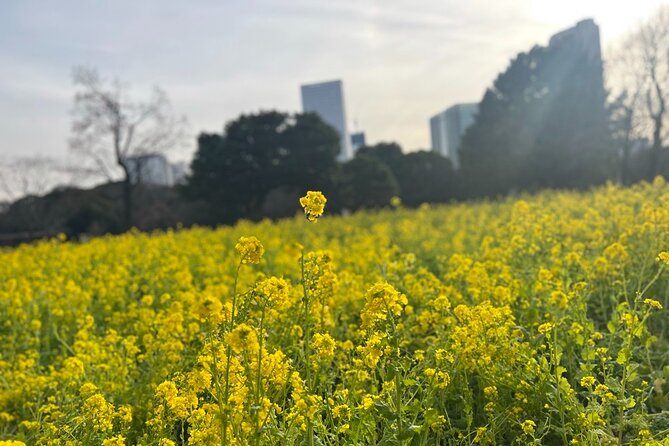
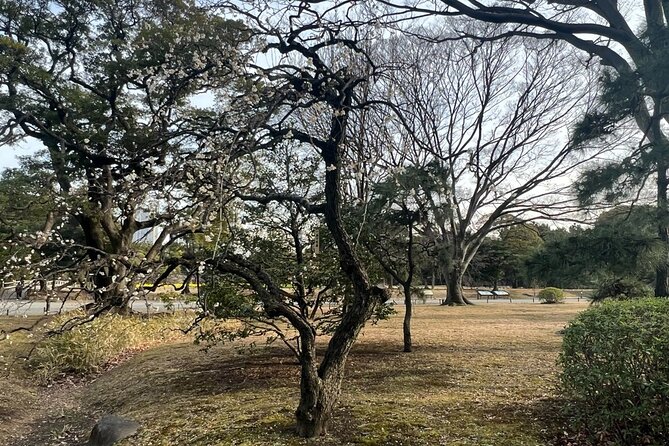
This is also a good place to slow down for photographs. The garden’s appearance changes through the seasons, so the exact colors and plant life will depend on when you visit. The tour does not promise a particular seasonal display, but it does encourage you to notice how plants and trees shape the view throughout the year.
Do not expect a huge list of stops or a rushed checklist. The garden visit is the heart of the activity. You are paying for interpretation, a measured walk, and tea, not for a full-day sightseeing circuit.
Following the Kaiyushiki circular garden
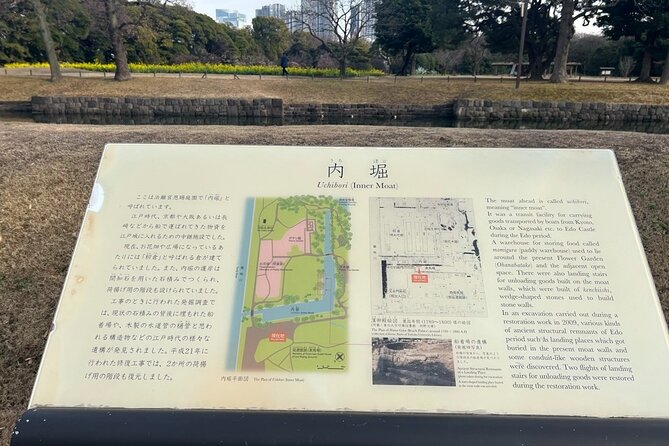
The second major design feature is the Kaiyushiki garden, a circular garden intended to be viewed while walking through it. Instead of presenting one fixed scene from a single viewpoint, this kind of garden reveals different sights as you move.
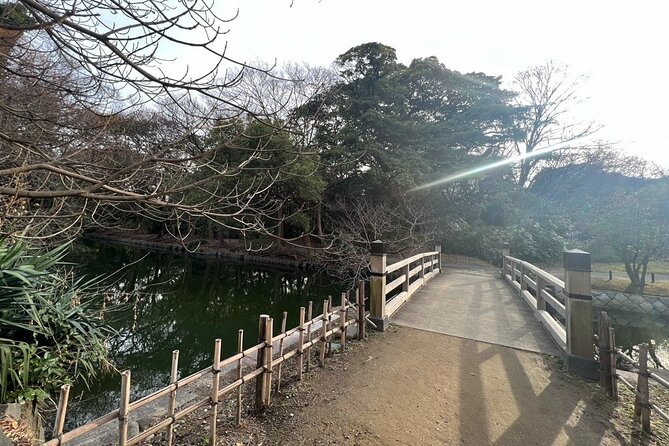
That makes the guide’s explanation especially useful. You can pay attention to how paths, water, trees, and open views work together. The tour helps connect the physical act of walking with the garden’s design purpose.
I like this part for visitors who want a little more substance than pretty scenery. A self-guided stroll can still be enjoyable, but the design may be easy to miss. Here, the historical background and explanation of the garden’s planning give you a clearer reason for each change in view.
The garden also gives you a chance to compare old and new Tokyo. Hama-rikyu’s formal spaces belong to the Edo period, while the city around it belongs to a very different age. That contrast is one of the most memorable features of the setting, even though the tour itself focuses on the garden and its culture.
Same corner of Tokyo, a completely different plan:
- Mt Fuji and Hakone 1-Day Bus Tour Return by Bullet Train
★ 5.0 · 26,383 reviews - 1-Day Tokyo Bus Tour
★ 5.0 · 14,250 reviews - Tokyo: TOKYO SKYTREE® Admission ticket
★ 4.5 · 11,192 reviews - Tokyo: teamLab Planets TOKYO Digital Art Museum Entry Ticket
★ 4.6 · 9,779 reviews
Matcha, sweets, and a quieter cultural moment
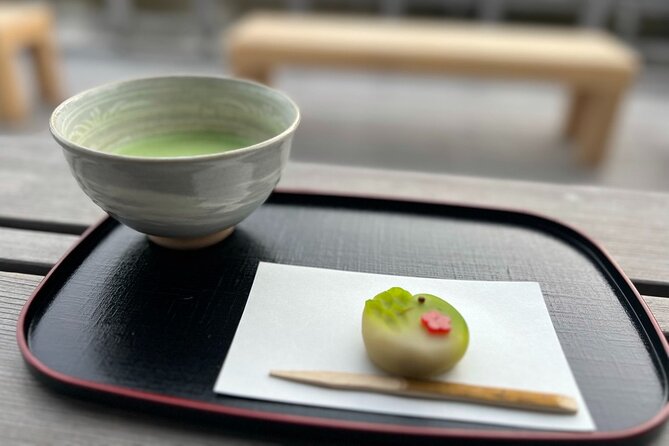
After the garden walk, you visit a tea ceremony room inside Hama-rikyu Gardens. Matcha green tea and Japanese sweets are included in the tour fee, so there is no separate charge for this part.
This is more than a refreshment break. Tea and sweets give the visit a cultural shape, with the garden providing the setting and the tea room offering a slower pause after walking. If you have never had matcha in a Japanese garden, this may be the part that makes the experience feel distinct from a standard park tour.
The information provided does not promise a full formal tea ceremony, so you should book it expecting a matcha experience rather than a long ceremonial performance. That distinction matters. If you want a detailed lesson on tea procedure, confirm what is included before booking. If you simply want to taste matcha and Japanese sweets in a historic garden setting, the arrangement is straightforward and appealing.
I also like the built-in value here. At $85.84, the tea and sweets help justify the price, though they do not make the tour inexpensive. You are paying for the guide, garden admission, small group, and tea experience together.
Optional stop: Advertising Museum Tokyo
The Advertising Museum Tokyo is listed as an optional stop and takes about 35 minutes. Admission is free.
The museum focuses on Japanese advertising, including how advertising has changed over time and how Japanese examples differ from those in other countries. This adds a modern cultural layer to the garden visit. After looking at Edo-period design, you can see how another form of Japanese visual communication developed in a much more recent setting.
This stop should appeal to you if you enjoy design, popular culture, or comparisons between Japan and other countries. It is less essential if your main interest is gardens and tea. Since it is optional, you can decide based on your energy and schedule rather than treating it as a required part of the experience.
The extra 35 minutes also helps explain why the total duration can reach two and a half hours. The core garden visit is shorter, but the added museum changes the pace and length.
Optional stop: Miyazaki’s giant clock
Another optional stop is the giant clock at Nippon Television. It is a copper, steampunk-style karakuri clock created by Hayao Miyazaki, the well-known Studio Ghibli animation director.
The listed visit lasts about 10 minutes, and admission is free. When the clock’s performance begins, lights come on and the moving mechanism operates with music. This is a quick stop, but it gives you a striking piece of modern Japanese design after the calm formality of Hama-rikyu.
You should treat this as a bonus rather than a reason to book the tour by itself. The stop is short, and the clock’s moving display depends on its timing. Still, if the schedule lines up, it adds a bit of playful Tokyo character without requiring another ticket.
Optional stop: Hibiya Shrine
The final optional stop is Hibiya Shrine, located in an office district. The shrine has a history of about 400 years and enshrines the god of agriculture and the god associated with driving away impurity.
The listed visit lasts 15 minutes, making it another compact addition. Its setting is useful: rather than finding a shrine in a remote or purely historic quarter, you see one surrounded by modern office buildings. That contrast helps you understand how older religious sites remain part of daily city life.
Like the museum and clock, Hibiya Shrine is not required for the main experience. It works best if you want a little more cultural variety after the garden. If you have a tight schedule, the garden and tea should take priority.
Is $85.84 a fair price?
At $85.84 per person, this is not a bargain garden entrance. A self-guided visit would cost less, and you could explore Hama-rikyu at your own pace. The question is what you want the money to buy.
You are getting a guided explanation of the garden’s history and design, admission to Hama-rikyu Gardens, matcha, Japanese sweets, and a group limited to four people. You may also receive the optional museum, clock, and shrine stops, all of which have free admission. The small group is the strongest value point because it gives the tour a more personal scale.
I would consider the price reasonable for a visitor who wants context, has limited time, and values a guide who can explain what the garden’s features mean. I would be less likely to recommend it to someone who enjoys wandering alone, has already studied Japanese garden design, or mainly wants photographs.
The fact that the tour is commonly booked well ahead of time, with an average of 49 days, suggests you should not wait until the last minute if your Tokyo dates are fixed. That does not guarantee every date will sell out, but it is a useful planning signal.
Who should book this experience?
I would point this tour toward first-time visitors who want a calm cultural activity between busier Tokyo sights. It also suits couples, solo visitors, or small families who like asking questions without joining a large group.
It is a good choice if you want:
- A clear introduction to Edo-period garden culture
- A short walking activity rather than a full-day excursion
- Matcha and Japanese sweets in a garden tea room
- A small group with no more than four people
- Optional modern and religious sights near the route
I would think twice if you dislike walking, want a formal tea ceremony, or need a fixed end time. The stated duration varies from 90 minutes to 150 minutes, especially if you include optional stops. The experience requires comfortable shoes and enough flexibility for the garden walk.
The tour is near public transportation and finishes at Shiodome Station. From there, you can use the Yurikamome or Toei Oedo line, which makes it practical to continue sightseeing after the tour.
Cancellation and practical details
You receive confirmation at booking, and the experience uses a mobile ticket. Most people can participate, according to the listed activity information, and the tour has a maximum of four participants.
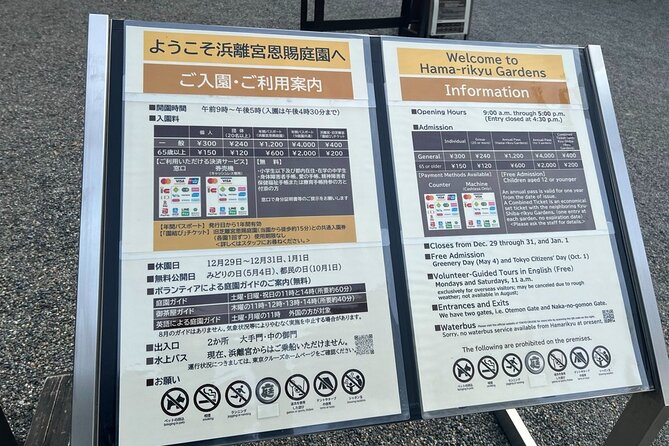
Free cancellation is available if you cancel at least 24 hours before the start time. Changes or cancellations made less than 24 hours before the start are not accepted for a refund. The activity also requires a minimum number of participants. If that minimum is not reached and the experience is canceled, you are offered another date or experience, or a full refund.
Should you book the Hama-rikyu Gardens tea tour?
Book it if you want Hama-rikyu Gardens to make sense, not just look attractive. The combination of Edo-period garden design, a small group, guide Nori’s helpful approach, and matcha with Japanese sweets gives the visit a clear purpose.
Skip it if you prefer independent sightseeing or feel $85.84 is too much for a short garden visit. The optional museum, giant clock, and shrine are useful extras, but they do not change the basic calculation.
For the right visitor, this is a thoughtful two-hour window into old and modern Tokyo, with tea at the end and a convenient station connection afterward.
FAQ
How long does the Hama-rikyu Gardens tour last?
The experience lasts approximately 1 hour 30 minutes to 2 hours 30 minutes. The main garden visit is listed as 1 hour 30 minutes, while optional stops can extend the total time.
What is included in the tour price?
The price includes admission to Hama-rikyu Gardens, the guided visit, matcha green tea, and Japanese sweets. Optional stops have free admission.
Is matcha included?
Yes. Matcha green tea and Japanese sweets are included in the tour fee and are served in a tea ceremony room inside the garden.
How large is the tour group?
The activity accepts a maximum of four participants.
Who guides the experience?
Guide Nori is associated with the tour. The available information does not guarantee that she leads every departure, so check the details for your selected date.
Where does the tour begin?
The tour begins at Otemon Bridge, at the listed meeting point on 8 Chome-21 Ginza, Chuo City, Tokyo.
Where does the tour end?
The tour ends at Shiodome Station. The station is served by the Yurikamome and Toei Oedo lines.
Are the additional stops required?
No. The Advertising Museum Tokyo, Hayao Miyazaki’s Nippon Television giant clock, and Hibiya Shrine are listed as optional stops.
Can I cancel for a full refund?
Yes, if you cancel at least 24 hours before the experience start time. Cancellations made less than 24 hours before the start are not refunded.
New on our Tokyo list
- Sumi-e Experience in a relaxing green tea shop in Tokyo★ 5.0 · 3 reviews
- Tokyo : Kamikaze Street Drift Ride★ 5.0 · 3 reviews
- Private Zen Meditation in English in Shinjuku, Tokyo★ 5.0 · 3 reviews
- Onsen Spa in Tokyo and Asakusa Bar Hopping with Local Guide★ 5.0 · 3 reviews
- Easy for everyone! Now you can play handmade mini shamisen and show off to everyone! Musical instruments, sweets and live music★ 5.0 · 3 reviews
- Tokyo: Private Tsukiji Street Food & Sake with Local Guide★ 5.0 · 3 reviews
- Mt Fuji Exploration Tour with Free Japanese Kusa Mochi from Tokyo★ 4.5 · 3 reviews
- Tokyo Tsukiji Fish Market Walking and Exploring Hidden Gems Tour★ 5.0 · 3 reviews
Dessert Tours, compared.

Matcha Making Class in Tokyo with Authentic Japanese Sweets Set
Read our review →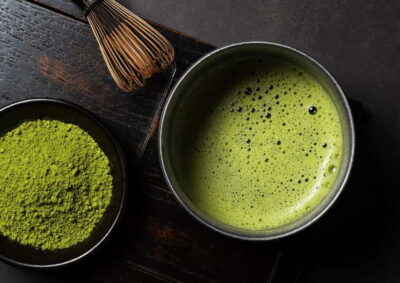
Matcha Making Experience with Mochi Sweets in Asakusa
Read our review →
Make Traditional Nerikiri Sweets & Matcha experience in Shibuya
Read our review →
Private Mochi Sweets Making class near Shibuya area
Read our review →
Japanese Traditional Sweets making and Tea Ceremony
Read our review →
Tokyo Local Food Tour: Noodles, Skewers, Dumplings, Sweets
Read our review →
Two Types of Japanese Sweets Making and Tea Ceremony
Read our review →
Mochi Matcha Gluten Free Japanese Sweets Class near Shibuya area
Read our review →Browse the lists this tour appears in