
Reviewed · JAPANESE COOKING CLASSES
TokyoSumoShow, ChickenHotPot, and Mochi-Pounding by Pro Wrestlers
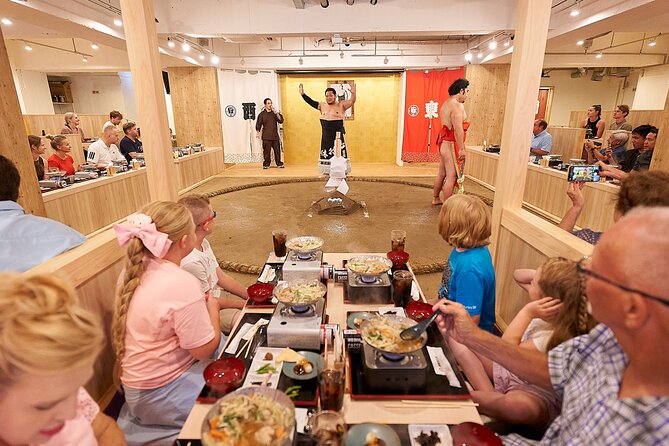
The best part of SUMOLAND is the chance to see former top-division wrestlers at close range, then watch them turn their sport into a lively, easy-to-follow show. You eat chicken chanko hot pot, learn basic sumo customs and techniques, pound mochi, and, if selected, face a real wrestler in the ring.
I like the mix of real athletic skill and family-friendly humor. I also like that the wrestlers do more than pose for photographs: they explain movements, demonstrate training, and perform short bouts. The main drawback is that this is an entertainment program, not a morning practice session or an official tournament. The food is part of the fun, but it receives more mixed praise than the wrestling.
In This Review
- Key points before you book
- Why this is more than a staged photo opportunity
- Chicken chanko hot pot starts the experience
- The ring entrance gives the show its first jolt
- Learn the basics without needing a rulebook
- Mochi pounding is the gentlest hands-on activity
- The sumo show mixes technique with comic timing
- The ring challenge is a highlight, with a catch
- Seating, timing, and practical details
- Is $106.12 a fair price?
- Who should book SUMOLAND?
- Should you book it?
- FAQ
- Where is SUMOLAND Tokyo Ryogoku located?
- How long does the SUMOLAND experience last?
- What food is included?
- Are drinks included?
- Can vegetarian or vegan meals be arranged?
- Are gluten-free or halal meals available?
- Can children participate?
- Can I choose my seat?
- Can I cancel for a refund?
Key points before you book
- Former professional wrestlers perform the show: The athletes include former top-division competitors, and the program is supervised by the 63rd Yokozuna.
- You get more than a performance: Audience members may try mochi pounding, sumo techniques, and a ring challenge.
- Chicken chanko hot pot is included: The meal is prepared in the style associated with sumo stables and supervised by the Isegahama stable.
- The format works well for children: Kids can take part in the mochi activity and sumo challenge, though participation may be limited.
- Seats are assigned by the venue: You cannot pick your exact seat. Standard seats require a separate reservation for every person, while box seats can hold up to six.
- Ryogoku Station is close: Look for the large sumo wrestler sign and flags at the first-floor venue.
Why this is more than a staged photo opportunity
SUMOLAND sits in Ryogoku, Tokyo’s sumo district, so the setting makes sense from the moment you arrive. The venue is on the first floor of Takashima Ryogoku Mansion, at 4-32-19 Ryogoku, Sumida City. It is a short walk from Ryogoku Station and marked by a large sumo sign and flags.
The location also makes this easy to pair with other Tokyo sights. You can build it into a day that includes Asakusa, Akihabara, Nihonbashi, or Tokyo Skytree. A nearby park or garden can fill the time if you arrive early.
Inside, the tone is deliberately welcoming rather than formal. You are not expected to understand sumo before you sit down. The program introduces the sport through demonstrations, simple explanations, video, humor, and audience participation.
That approach is useful if sumo feels mysterious to you. You will see how technique, balance, footwork, and force work together. You also get a better sense of the physical demands of the sport than you would from a quick photograph outside a tournament hall.
The 63rd Yokozuna supervises the experience, while the performers are former professional wrestlers. That gives the show a genuine sporting base, even though the format is designed for entertainment.
More cooking classes in Tokyo:
- Ramen & Gyoza Cooking Class in Tokyo with Local Supermarket Visit
★ 5.0 · 823 reviews - Tokyo: Easy Ramen Cooking Experience in Kabukicho, Shinjuku
★ 4.6 · 321 reviews - Ramen and Sushi Cooking Class with Sake Pairing Set in Tokyo
★ 5.0 · 291 reviews
Chicken chanko hot pot starts the experience
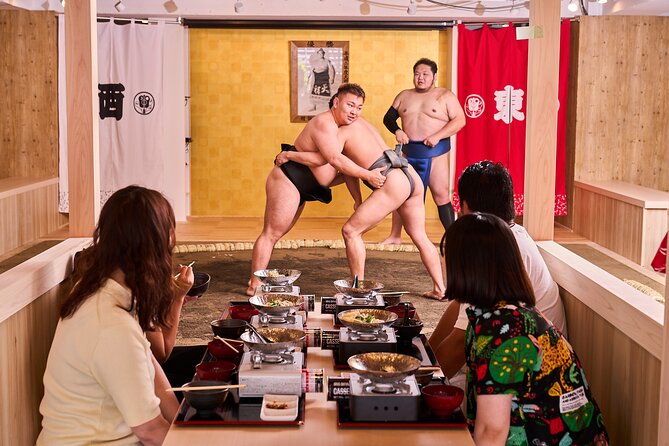
The meal is chicken chanko hot pot, a dish strongly associated with sumo wrestlers and their training stables. It is included in the admission price and is prepared under the supervision of the Isegahama stable.
The hot pot gives the opening part of the program a relaxed rhythm. You have something to eat while the next demonstration is prepared, rather than sitting through a long introduction with nothing happening. One particularly useful feature is that the food and demonstrations overlap in a sensible way, so the experience does not feel rushed.
The broth receives especially strong praise, and the dish is often described as hearty and healthy. At the same time, you should keep your expectations in check. Some people consider the meal excellent, while others find it merely fine. The wrestling and interaction are the main reasons to book, with dinner serving as a pleasant extra.
Alcoholic drinks and bottled water are not included. Vegetarian and vegan meals can be arranged if you request them at least two days ahead. Gluten-free and halal meals are not available, although you may bring your own food.
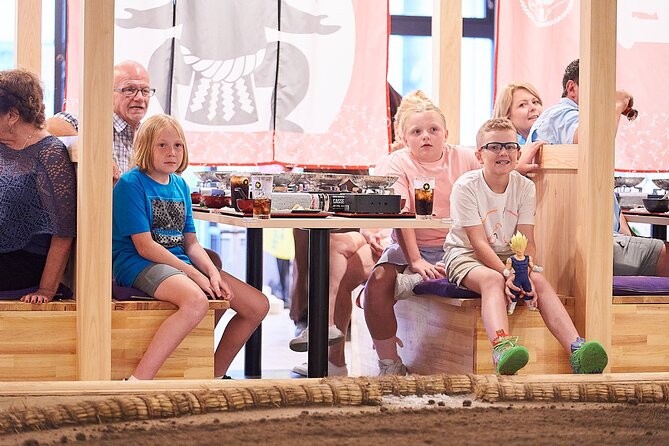
If you are booking for a family, check the seating rules carefully. In standard seats, it is considered unsafe to hold a child on your lap, so you should reserve a place for every person. Box seats can accommodate up to six people and allow a child to sit on a lap.
The ring entrance gives the show its first jolt
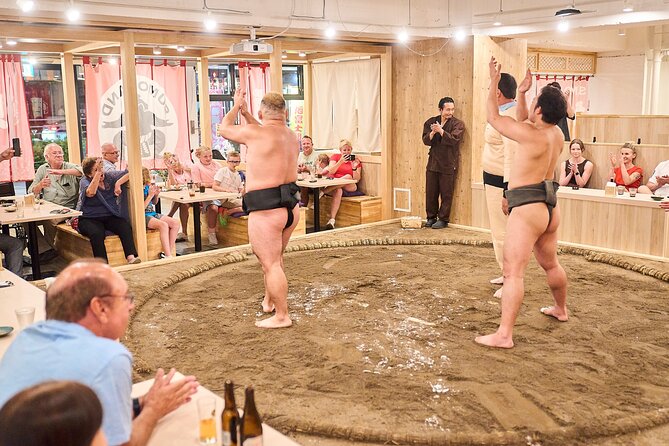
The formal program begins with a ring entrance ceremony. Former top-division wrestlers make a powerful entrance, bringing the visual drama of sumo to a small setting.
This is not a quiet cultural lecture. The performers use presence, movement, and showmanship to get the room involved. You will see why the ring entrance matters in sumo, where ceremony and discipline are part of the sport rather than decoration added afterward.
The close seating helps here. The wrestlers are near the tables, and the scale makes their size and movement easy to appreciate. You are not watching tiny figures from a distant upper tier. Even people who know little about sumo can follow the action.
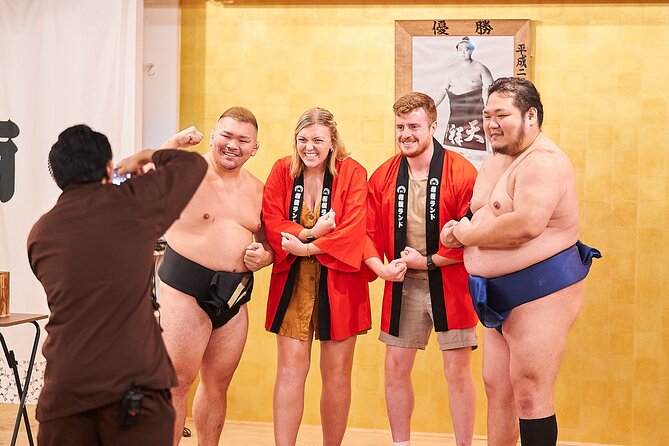
Photography is a major part of the experience. The program includes a photo session with the wrestlers, and the staff make a clear effort to give families and groups memorable pictures.
Learn the basics without needing a rulebook
The educational section covers sumo terms, customs, techniques, and the demands of practice. The English presentation is designed for an international audience, with Japanese words, translations, and chances to repeat the terms.
That language practice may sound simple, but it helps the show stick in your mind. The presenters explain movements and strategies in an accessible way, then demonstrate them with plenty of personality.
The strongest educational moments come when the wrestlers show how a technique works instead of merely describing it. You see the difference between pushing, pulling, shifting weight, and using an opponent’s balance against them.
One limitation is that the explanations may not satisfy a serious sumo fan. The program gives you the basics, but it does not appear to offer a full lesson on tournament rules, rankings, or the complete history of the sport. If you want detailed commentary, you may wish for more narration during the video sections between acts.
For a first introduction, though, the level is about right. You leave with enough context to make an official tournament more enjoyable later.
A few more Tokyo bookings worth comparing
- Mt Fuji and Hakone 1-Day Bus Tour Return by Bullet Train
★ 5.0 · 26,383 reviews - 1-Day Tokyo Bus Tour
★ 5.0 · 14,250 reviews - Tokyo: TOKYO SKYTREE® Admission ticket
★ 4.5 · 11,192 reviews - Tokyo: teamLab Planets TOKYO Digital Art Museum Entry Ticket
★ 4.6 · 9,779 reviews
Mochi pounding is the gentlest hands-on activity
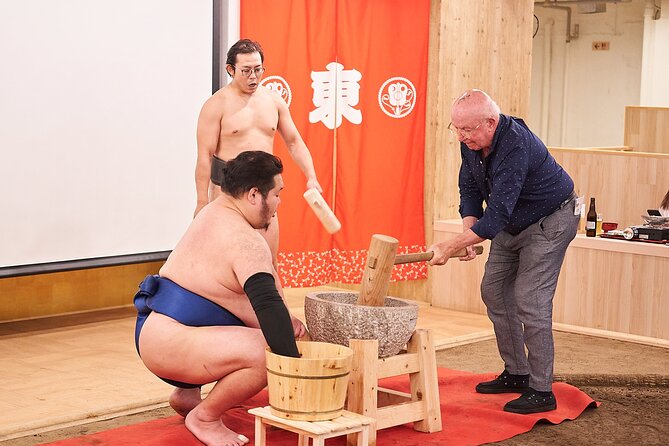
The mochi-pounding challenge brings a traditional Japanese food activity into the show. The wrestlers demonstrate the process, then invite participants to try it.
Children are welcome, and this is likely to be one of the easiest activities for younger family members to join. It is also a good change of pace between the more physical sumo demonstrations.
The mochi itself is served as part of the food experience, and it receives particularly warm praise. The activity is fun partly because the wrestlers guide and encourage participants, keeping the tone playful rather than intimidating.
Participation can be limited if many people want a turn. The venue may allow only one person per group or decide participation by lottery. You should treat it as a possible bonus, not a guaranteed individual activity.
Souvenir items may change with the season. The included souvenir is part of the package, but the exact item is not fixed.
The sumo show mixes technique with comic timing
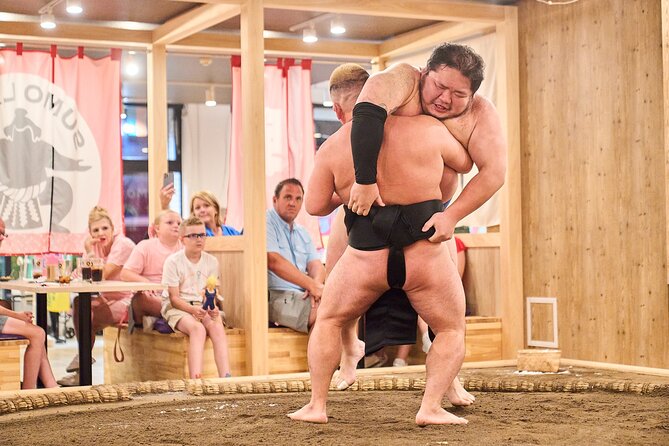
The main show presents demonstrations, training movements, and bouts by the former wrestlers. You get to see the contrast between controlled practice and full-force competition.
The athletes are not simply demonstrating strength. Their work shows timing, balance, foot placement, and the way a wrestler responds to an opponent’s movement. That is where the program earns its price. The show makes a sport that can seem repetitive from a distance feel active and understandable.
The humor matters, especially for families. The wrestlers interact with the audience and make the demonstrations entertaining even when you do not know every rule. Their personalities help soften the formality of the sport.
The bouts near the end are more impressive than a novelty wrestling act. Former athletes bring real skill and physical power to the ring, even though the presentation is made for a general audience. You should not confuse these matches with official tournament contests, but they offer a credible glimpse of the sport’s force.
The show is usually not rushed. The food, explanations, demonstrations, and participation fit together over roughly 90 minutes to two hours.
The ring challenge is a highlight, with a catch
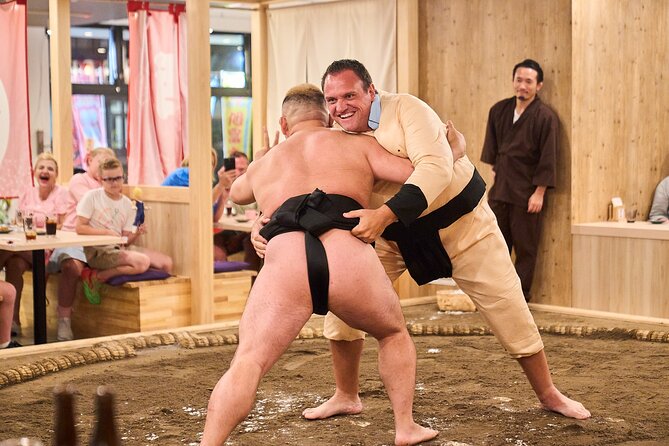
The audience challenge lets selected participants step into the ring and take on a real sumo wrestler. Children can take part, which makes this especially appealing for families with school-age children and teenagers.
The value here is not the chance of winning. It is the physical comparison. Standing opposite a trained wrestler, even briefly, gives you a much clearer sense of the sport’s strength and balance than watching from a seat.
The audience also enjoys watching other people try. The staff and wrestlers turn each attempt into part of the show, so you remain involved even if your name is not called.
As with mochi pounding, participation may be limited when many people want to join. It may be restricted to one person per group or handled through a lottery. The safest plan is to book the experience for the performance itself, not solely for a chance to enter the ring.
Seating, timing, and practical details
Your seat is assigned by the venue, so you cannot choose the exact location. The standard seating rule about children on laps is important, especially for families trying to save money by booking fewer places.
Box seats offer more flexibility. They can hold up to six people, and a child may sit on an adult’s lap there. If you are traveling with a larger family or want everyone together, compare the seating options before paying.
The venue is close to public transportation, and the sign and flags make it easier to find. The mobile ticket format is convenient for a day of sightseeing, but confirmation is issued within 48 hours of booking and remains subject to availability.
Plan to arrive a few minutes early. The show begins on time, and arriving late could mean missing the opening entrance ceremony.
The experience is suitable for most people. It combines seated dining with short activities, but the ring challenge and mochi pounding require physical participation. If you have concerns about taking part, you can still watch the demonstrations and enjoy the meal.
Is $106.12 a fair price?
At $106.12 per person, SUMOLAND is not a cheap meal or a simple cultural demonstration. The price makes more sense when you count the full package: admission, chicken chanko hot pot, a performance by former professional wrestlers, instruction, audience activities, photographs, and a souvenir.
I see the strongest value for first-time visitors to Japan, families, and anyone who wants a low-pressure introduction to sumo without arranging a tournament ticket. The experience also saves you from trying to work out the rules alone while sitting in a large arena.
The value is weaker if your main goal is an official, traditional sumo event. This is clearly a tourist attraction, and the show uses humor, audience participation, and staged demonstrations. That is not a flaw, but it is a different product.
Food also affects the calculation. If you expect a standout dinner, the meal may not fully justify the cost on its own. If you see the hot pot as part of a two-hour cultural show, the price is easier to defend.
The experience receives a 4.9 rating and is recommended by 98 percent of the people who rated it. Those figures fit the overall picture: the performances, staff, close contact, and interactive format are the major strengths, while the meal and depth of historical explanation are the areas where expectations should stay moderate.
Who should book SUMOLAND?
I would point families toward this first. Children can pound mochi, learn simple sumo movements, enter the ring if selected, and take photographs with the wrestlers. Teenagers are also likely to enjoy the physical demonstrations more than a long museum explanation.
It works well for adults too, especially if you want something different from temples, shopping, and observation decks. The friendly staff and English support make it less demanding than attending a tournament without prior knowledge.
Sumo fans should book only if they understand the format. You will see former professionals and legitimate athletic demonstrations, but you will not see an official tournament, morning practice, or a fully traditional ceremony.
Vegetarians and vegans can request suitable meals at least two days ahead. If you need gluten-free or halal food, the venue cannot provide it, though you may bring your own.
Cancellation is free up to 24 hours before the start time. Inside that window, the price is not refunded and changes are not accepted.
Should you book it?
Book SUMOLAND if you want an entertaining, approachable sumo experience with food and a real chance to participate. Its best features are the close view of former professionals, the lively staff, the clear English explanations, and the way the program keeps both children and adults busy.
Skip it if you want the quiet ritual of morning practice, the full atmosphere of an official tournament, or a destination meal built around refined cuisine. For most first-time Tokyo visitors, especially families, the combination of wrestling, hot pot, mochi, and photographs creates a memorable two-hour stop in Ryogoku.
FAQ
Where is SUMOLAND Tokyo Ryogoku located?
It is on the first floor of Takashima Ryogoku Mansion at 4-32-19 Ryogoku, Sumida City, Tokyo 130-0026, Japan. The venue is a short walk from Ryogoku Station and is marked by a large sumo wrestler sign and flags.
How long does the SUMOLAND experience last?
The experience lasts approximately 90 minutes to two hours.
What food is included?
Chicken chanko hot pot is included. It is specially prepared by sumo wrestlers and supervised by the Isegahama stable.
Are drinks included?
Alcoholic beverages and bottled water are not included.
Can vegetarian or vegan meals be arranged?
Yes. Vegetarian and vegan meals are available if requested at least two days in advance.
Are gluten-free or halal meals available?
No. Gluten-free and halal meals are not available, but you may bring your own food.
Can children participate?
Yes. Children are welcome to try mochi pounding and the sumo challenge. If many people want to participate, the venue may limit participation to one person per group or use a lottery.
Can I choose my seat?
No. Seat locations are assigned by the venue. Box seats can hold up to six people and allow a child to sit on an adult’s lap. In standard seats, you should reserve a place for every person because holding a child on your lap is considered unsafe.
Can I cancel for a refund?
Yes, if you cancel at least 24 hours before the experience start time. Cancellations within 24 hours are not refunded, and changes made within that period are not accepted.
New on our Tokyo list
- From Tokyo: Mount Fuji & Hakone Full Day Private Tour★ 4.9 · 25 reviews
- Tokyo Spectacular View Day-Cruise in 90 Minutes★ 5.0 · 25 reviews
- Real Tokyo Runner Club : Daikoku Car Meet Night Tour with JDM Car★ 5.0 · 25 reviews
- 2.5 Hour-Guided Cycle Tour in the Central Tokyo★ 5.0 · 25 reviews
- Ramen Making from Scratch +Akihabara Tour –Cooking Class★ 5.0 · 25 reviews
- [Self-Drive] Tokyo & Daikoku Custom Car Driving Tour★ 4.9 · 25 reviews
- Tokyo: 2-Hour Night Bike Tour of the City’s Hidden Gems★ 4.9 · 25 reviews
- Buddha, Bamboo & Zen – Bespoke Kamakura Private Walking Tours★ 5.0 · 25 reviews
Japanese Cooking Classes, compared.
Ramen & Gyoza Cooking Class in Tokyo with Local Supermarket Visit
Read our review →
Easy Ramen Cooking Experience in Kabukicho, Shinjuku
Read our review →
Ramen and Sushi Cooking Class with Sake Pairing Set in Tokyo
Read our review →
Tokyo Washoku 4-hour Cooking Class: From Market to Table
Read our review →
Professional Ramen & Gyoza with Ramen Chef in a restaurant!
Read our review →
Small-Group Wagyu Beef and 7 Japanese Dishes Tokyo Cooking Class
Read our review →
Private Home Cooking in Yanaka – Local Flavors in a Warm Setting
Read our review →Browse the lists this tour appears in