
Reviewed · SUMO EXPERIENCES
Sumo Training Watching Experience in Tokyo
Real sumo training is not a stage act. Inside a working Tokyo stable, you sit close to the wrestlers as they stretch, strengthen their bodies, repeat basic movements, and crash into one another during serious match-style practice. The sound and heat are far more immediate than they are from a seat in the Kokugikan arena.
I like two things here: the small group, capped at eight, and the clear live explanations from NicoTour Japan guide Alisa, supported by original diagrams. You also have a chance to take photos with wrestlers after practice. The main drawback is the strict etiquette: you sit on the floor, stay quiet, cannot eat or drink, and must arrive on time.
In This Review
- Key points to know before you book
- Why a sumo stable feels different from the arena
- The walk from Ryogoku to the stable
- What happens at 7:45
- What changes if you arrive at 8:20
- Etiquette inside the sacred training space
- Floor seating and the question of comfort
- The small group and live commentary
- Photos after practice
- Is the $84.70 price fair?
- Who should choose this Tokyo experience?
- Booking, timing, and cancellation details
- Should you book the Sumo Training Watching Experience?
- FAQ
- Where does the sumo training experience begin?
- How long does the experience last?
- What happens if I arrive at 8:20?
- Can I take photos?
- Can I eat or drink inside the stable?
- Do I need to remain quiet?
- Is the experience suitable for children?
- Can I cancel for a refund?
Key points to know before you book
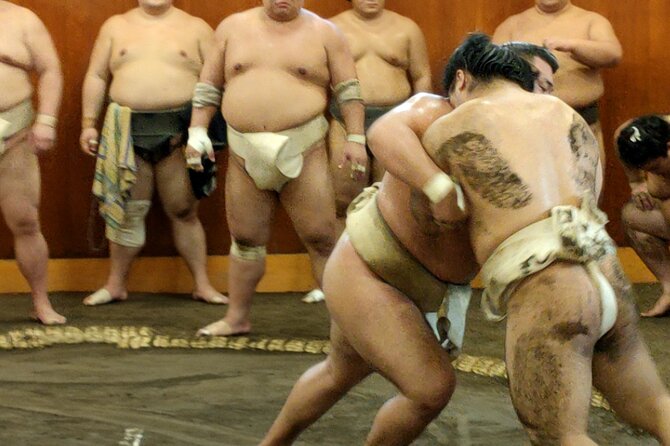
- Watch real wrestlers in a working stable: This is a genuine morning practice, not a costumed performance or comedy show.
- Arrive early for the full program: The 7:45 arrival includes stretching, strength work, basic training, and match-style practice.
- A later arrival means less time: Guests arriving at 8:20 generally begin with basic training, with only 30 to 90 minutes inside.
- Expect floor seating: You sit directly on cushions in the Japanese style, which can be hard on sore knees, backs, or during pregnancy.
- Silence is part of the experience: Phones must be on silent, and talking is generally not allowed during practice.
- Photos may happen after training: You can take pictures, and wrestler photos may be possible, but they are not guaranteed.
Why a sumo stable feels different from the arena
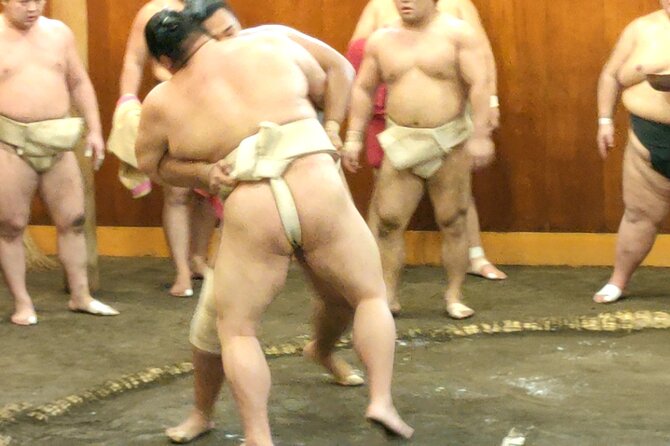
A major tournament gives you the broad spectacle of sumo: the formal ceremonies, the packed crowd, and the long day of bouts. A stable visit gives you something more focused. You watch wrestlers repeat the same movements at close range, often just a short distance away, without the distance and noise of a large stadium.
The setting matters. A sumo stable is a place where wrestlers live and train under a strict routine. This is also a sacred space, not a tourist theater. Your behavior is part of the visit, so the quiet can feel unusual at first. Once practice begins, the slap of bodies and the force of each charge fill the room.
The activity is especially useful if you are curious about how sumo athletes prepare between tournaments. You are not simply watching a series of matches. You see the physical work behind them, from stretching and strength exercises to basic drills and full-contact practice.
Alisa adds live commentary while you watch. The original diagrams help explain what is happening, which is useful if you know little about sumo technique or rank. The experience does not depend on you already understanding the sport.
More sumo mornings:
- Tokyo: Sumo Show Experience with Chicken Hot Pot and a Photo
★ 4.8 · 6,678 reviews - Tokyo: Sumo Show and Dining Experience
★ 4.8 · 2,742 reviews - the SUMO show
★ 5.0 · 1,960 reviews
The walk from Ryogoku to the stable
You meet near Ryogoku Station at 1-chome 4-29 Yokoami in Sumida City. From there, the stable is reached on foot. The stated walk is about 10 minutes, though practical directions indicate roughly 7 to 15 minutes depending on the exact meeting point and pace.
This detail deserves attention. The meeting point is not the same as entering the JR station, and the stable is not right beside the Kokugikan. If you arrive expecting to walk straight from the famous sumo arena, you could lose valuable time.
I would arrive early enough to find the meeting point without rushing. The group leaves on time and cannot wait for late arrivals. That rule is not a minor scheduling note. Missing the walk or the opening part of practice can shorten your visit considerably.
The activity ends back at the meeting point. The full booking is listed at about 2 hours 20 minutes, but the time inside the stable depends on your arrival slot and the day’s practice. Plan your morning around the stated meeting time, not only the advertised total duration.
What happens at 7:45
The earliest arrival time gives you the fullest version of the program. You can expect four parts:
- stretching and strength training
- basic sumo training
- match-style training
- photo time
The first section shows the work that prepares the wrestlers for harder practice. Stretching may look simple, but it helps you see that sumo begins with body control and flexibility, not only force. Strength training gives the session a steady rhythm before the more dramatic collisions begin.
Basic training follows. This is a good point to listen to Alisa’s explanations and watch for repeated movements. With the guide’s diagrams, you can follow the purpose of the drills instead of seeing only a blur of bodies and noise.
Match-style training is usually the part most people anticipate. Wrestlers face one another and push, drive, and attempt to force an advantage. It is not presented for your entertainment, so the mood stays serious. You may find the lack of showmanship refreshing, but it also means you need to respect the quiet and let the action speak for itself.
The practice lasts about 60 to 120 minutes. The exact length can vary, so do not treat the end time as fixed to the minute. Photo time may extend beyond the basic schedule, a point worth remembering if you have a train reservation or another morning tour.
What changes if you arrive at 8:20
The later arrival is not simply a relaxed alternative. Guests who arrive at 8:20 generally begin with the basic training section, rather than seeing the opening stretches and strength exercises.
That can reduce the time inside to about 30 to 90 minutes. You may still see the key training, but you lose part of the sequence that shows how the session builds. If you are paying for the full experience and care about seeing the stable’s complete routine, choose the earlier arrival.
The later option may suit a tightly planned morning, but the schedule is less forgiving than a standard sightseeing stop. You cannot expect the group to pause while you arrive, and you cannot count on seeing every stage of practice.
A few more Tokyo bookings worth comparing
- Mt Fuji and Hakone 1-Day Bus Tour Return by Bullet Train
★ 5.0 · 26,383 reviews - 1-Day Tokyo Bus Tour
★ 5.0 · 14,250 reviews - Tokyo: TOKYO SKYTREE® Admission ticket
★ 4.5 · 11,192 reviews - Tokyo: teamLab Planets TOKYO Digital Art Museum Entry Ticket
★ 4.6 · 9,779 reviews
Etiquette inside the sacred training space
The rules are firm because this is a working religious and sporting setting, not a public theater. You should treat the stable as you would a place of worship or a private training room.
You cannot eat or drink inside. Keep your phone on silent, and use a silent camera if you take pictures. The basic expectation is that you do not talk during the tour. Alisa provides explanations, but the session itself is not a back-and-forth conversation.
Wear modest clothing and avoid revealing outfits. If you ignore the rules, you may be asked to step outside temporarily. That could mean missing the training you came to see.
Do not attend if you have a cold or another infectious illness on the day. The wrestlers train in close quarters, and canceling is the responsible choice. The cancellation terms allow a full refund when you cancel at least 24 hours before the start time, but late cancellations are not refunded.
Floor seating and the question of comfort
You sit directly on cushions on the floor, in the Japanese style. There are no regular chairs, and this is one of the most important practical details for deciding if the activity suits you.
If you have bad knees or a sore back, sitting through 60 to 120 minutes may be uncomfortable. The same caution applies to pregnant women. You should also think carefully about children. The minimum age is six, but even children over eight who cannot sit still are not allowed to participate.
This is not a good pick for a family hoping for a loose, casual morning. Children who can remain quiet and still may manage well, but the rules leave little room for fidgeting, snacks, or constant questions.
For adults who are comfortable on the floor and willing to follow the rules, the seating places you close to the action. You are not looking through a stadium crowd or watching tiny figures from a distant seat.
The small group and live commentary
The maximum group size is eight. That is a strong feature for this kind of visit. A large group would make a quiet stable feel crowded and could make it harder to follow the guide’s explanations.
Alisa’s role is practical. She explains what you are seeing as the training moves from one stage to the next and uses diagrams to make the techniques easier to understand. This matters most if your knowledge of sumo begins and ends with the tournament ring.
The commentary also gives the session context. Without it, you might notice the force of a collision but miss the reason for a particular drill or movement. With it, you have a better chance of connecting the training to the matches you may see later in Japan.
The guide’s job is not to turn the practice into a performance. The wrestlers remain focused on training, while you receive enough explanation to understand the scene without interrupting it.
Photos after practice
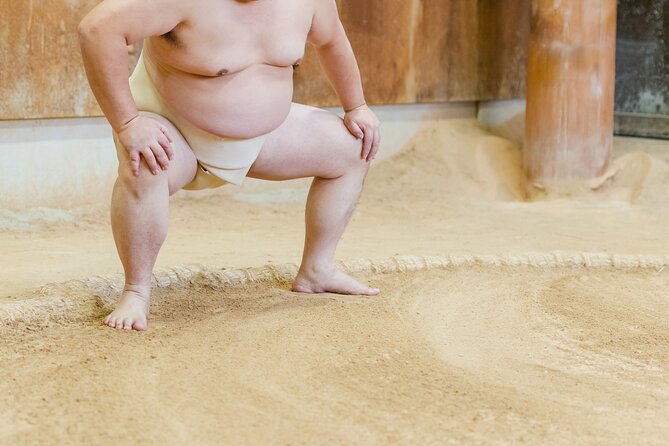
Photography is allowed, but it must be quiet and discreet. Install or select a silent camera setting before you enter. A phone that makes a shutter sound could break the stable’s rules.
After training, you might be able to take a photo with wrestlers. This is a pleasant extra, but it is not the central promise of the experience and should not be treated as guaranteed. The wrestlers’ training schedule and the stable’s rules come first.
Allow extra time if photos take place. The advertised end time may not include every picture, so avoid scheduling something immediately afterward. You should also follow any instructions about where to stand and when to take your turn.
Is the $84.70 price fair?
At $84.70 per person, this is not a cheap way to fill two hours in Tokyo. The price makes more sense when you consider what you are buying: access to a place that is difficult for independent visitors to enter, a small group, live interpretation, and a close view of real training.
Sumo matches are held only at certain times of year, and other training camps can limit access to wrestlers in Tokyo. Even Japanese visitors may not find it easy to visit a stable on their own. For someone who wants an inside look at sumo rather than a quick photo outside the Kokugikan, that access has real value.
The value is weaker if you want a flexible sightseeing stop. You must arrive at a fixed time, follow strict conduct rules, sit on the floor, and accept that practice length and photo opportunities can vary. You are paying for a rare setting, not a polished stage show with guaranteed entertainment.
I would consider it good value for a sumo fan, a first-time visitor eager to understand Japan’s national sport, or anyone who has already seen a tournament and wants to know how wrestlers train. It is less suitable if you dislike quiet observation or have trouble sitting on the floor.
Who should choose this Tokyo experience?
You should book this if you want:
- a close look at real sumo training
- a small group rather than a crowded attraction
- explanations that help you understand the movements
- a morning activity tied closely to Japanese culture
- the chance of a wrestler photo after practice
You may want to skip it if you need chairs, snacks, flexible arrival times, or a lively guide-led show. It is also a poor fit for anyone who may be ill on the day or for children unable to sit still and remain quiet.
The activity suits curious adults especially well. You do not need to be a sumo expert, but you do need to approach the stable with patience and respect. The reward is not a long list of sights. It is the chance to observe a working tradition at close range.
Booking, timing, and cancellation details
Confirmation is sent within 48 hours of booking, subject to availability. The activity uses a mobile ticket, and it is booked around 77 days ahead on average, so leaving this until the last few days may not work.
Date requests are not accepted. Training schedules, tournaments, and other camps affect when a stable can receive visitors, so you need to select from the dates offered rather than ask for a custom morning.
You can cancel for a full refund up to 24 hours before the local start time. Cancellations or changes made inside that 24-hour window are not accepted, and the payment is not refunded.
Should you book the Sumo Training Watching Experience?
I would book it if sumo is a real interest, not just a box to tick. The close view of serious training, the eight-person limit, and Alisa’s diagrams give you more than a quick cultural photo stop. You leave with a clearer sense of the discipline behind the tournament.
Before paying, make three checks. Can you reach the meeting point early? Can you sit quietly on a floor cushion for up to two hours? Can you accept that photos with wrestlers are possible but not promised?
If the answer is yes, this is one of Tokyo’s more unusual morning activities. If you need comfort and flexibility, watch a tournament at the Kokugikan instead. The stable visit asks more of you, but it also gives you a closer look at the daily work behind Japan’s most distinctive sport.
FAQ
Where does the sumo training experience begin?
You meet near Ryogoku Station at 1-chome 4-29 Yokoami, Sumida City, Tokyo 130-0015, Japan. The group then walks to the sumo stable.
How long does the experience last?
The overall activity lasts about 2 hours 20 minutes. Training inside the stable generally lasts 60 to 120 minutes for the early arrival, or 30 to 90 minutes for guests arriving at 8:20.
What happens if I arrive at 8:20?
Guests arriving at 8:20 generally begin with the basic training section. They usually do not see the earlier stretching and strength training.
Can I take photos?
Yes, photography is allowed, but your phone must be silent. You should use a silent camera setting. You might also be able to take a photo with wrestlers after training.
Can I eat or drink inside the stable?
No. Eating and drinking are not allowed inside the stable.
Do I need to remain quiet?
Yes. The tour generally does not include talking during practice, and your cell phone must be set to silent mode.
Is the experience suitable for children?
Children must be at least six years old. Children over eight who cannot sit still are not allowed to participate.
Can I cancel for a refund?
You can receive a full refund if you cancel at least 24 hours before the experience start time. Cancellations and changes made less than 24 hours before the start time are not accepted.
New on our Tokyo list
- Sumi-e Experience in a relaxing green tea shop in Tokyo★ 5.0 · 3 reviews
- Tokyo : Kamikaze Street Drift Ride★ 5.0 · 3 reviews
- Private Zen Meditation in English in Shinjuku, Tokyo★ 5.0 · 3 reviews
- Onsen Spa in Tokyo and Asakusa Bar Hopping with Local Guide★ 5.0 · 3 reviews
- Easy for everyone! Now you can play handmade mini shamisen and show off to everyone! Musical instruments, sweets and live music★ 5.0 · 3 reviews
- Tokyo: Private Tsukiji Street Food & Sake with Local Guide★ 5.0 · 3 reviews
- Mt Fuji Exploration Tour with Free Japanese Kusa Mochi from Tokyo★ 4.5 · 3 reviews
- Tokyo Tsukiji Fish Market Walking and Exploring Hidden Gems Tour★ 5.0 · 3 reviews
Sumo Experiences, compared.
Sumo Show Experience with Chicken Hot Pot and a Photo
Read our review →
Tokyo Shinjuku Sumo Show & Experience with Photo
Read our review →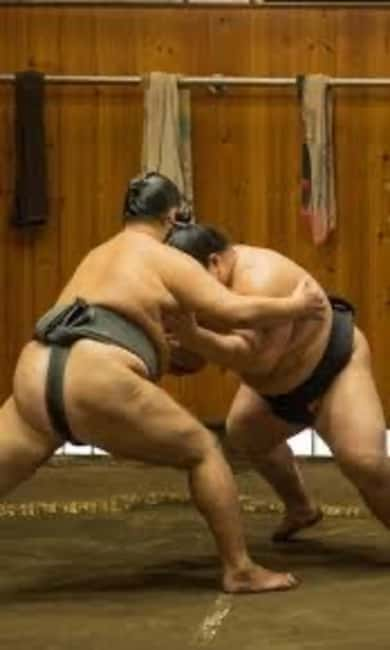

Authentic Sumo Experience in Tokyo: Enter the Sanctuary
Read our review →
Luxury Sumo Show Experience & Japanese cuisine & Drink
Read our review →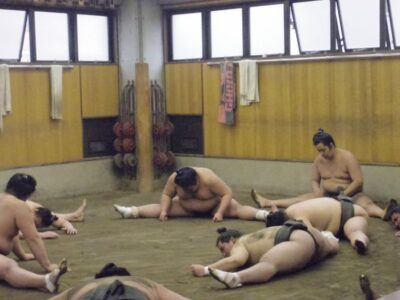
Browse the lists this tour appears in