
Reviewed · WORKSHOPS
Tokyo: 1.5-Hour Edo Kiriko Glass Cutting Workshop in Sumida
Edo Kiriko is not painted glass. Its color and pattern come from cutting into layered glass with a wheel, revealing the clear layer beneath. In this 90-minute Sumida workshop, you watch the craft being done in a working studio, then try it yourself with help from the staff.
I like the chance to choose your own piece from a stock that changes each day. I also like the small group size, limited to four people, and the practice session with test glass before you touch your final piece. The main consideration is that the work takes focus and a steady hand. Beginners get freedom, but some may want more step-by-step supervision.
In This Review
- Key points
- Why Edo Kiriko Makes a Good Tokyo Souvenir
- Entering the Sumida Glass-Cutting Studio
- Practicing Before You Cut Your Own Glass
- Choosing a Daily Changing Glass
- Cutting a Personal Edo Kiriko Design
- What You Take Home
- The Edo Kiriko Shop After the Lesson
- Who Will Enjoy This Workshop Most
- Is $122 a Fair Price?
- Practical Advice Before You Go
- My Verdict: Book It for the Making, Not Just the Glass
- FAQ
- How long does the Edo Kiriko workshop last?
- Where does the workshop take place?
- What languages are available?
- What will adults make?
- What will elementary school children make?
- What is the minimum age?
- Can a companion watch without making a piece?
- How many people are in each group?
- Is the workshop wheelchair accessible?
- Can I cancel for a refund?
Key points
- Watch working Edo Kiriko craftsmen use traditional glass-cutting tools in an active Sumida studio.
- Practice before committing to your chosen glass, which takes the pressure off first-timers.
- Choose a one-of-a-kind piece from a daily changing selection of glasses and containers.
- Make a useful keepsake: adults and middle school students cut drinking glasses, while elementary school children decorate lidded containers.
- Learn with English support from a guide who translates the Japanese-speaking artisan’s instructions.
- Shop after the workshop for classic Edo Kiriko designs and modern collaborations, including Starbucks pieces.
Why Edo Kiriko Makes a Good Tokyo Souvenir
Tokyo offers plenty of souvenirs that are easy to pack but quickly forgotten. A piece of Edo Kiriko gives you a different sort of memory. You do not simply select it from a shelf. You help cut its pattern, and the small irregularities can remind you that a person made it.
The craft is tied to Tokyo’s old name, Edo, and Sumida is a fitting place to encounter it. This is not a museum display with the work safely behind glass. You enter a functioning studio where craftsmen are actively cutting glass. You can watch the concentration involved before trying the tools yourself.
That matters because Edo Kiriko can look simple from a distance. A glass may show neat lines, stars, or geometric shapes, but each cut requires control. Once you understand that the pattern is carved into the surface, the high price of finely made Edo Kiriko makes more sense.
At $122 per person, this is not a cheap craft activity. The price pays for a guided lesson, materials, staff support, a finished piece, and access to a real studio rather than a basic souvenir-making table. I see the strongest value for people who want a hands-on cultural activity and a keepsake with a story attached.
A few more Tokyo bookings worth comparing
- Sushi Making Tokyo Roll and Authentic Japanese Sushi Class
★ 5.0 · 3,971 reviews - Tokyo: Roll and Authentic Sushi Making Class in Asakusa
★ 4.9 · 1,957 reviews - Tokyo Shinjuku Chopsticks Making Class
★ 5.0 · 1,763 reviews
Entering the Sumida Glass-Cutting Studio
The workshop takes place indoors in Sumida Ward, with no hotel pickup or drop-off included. You will need to make your own way there, so allow time for transportation and arrival before the 90-minute session begins.
The group is limited to four participants. That is a useful size for this kind of work. Glass cutting needs attention, and a crowded class could make it harder to see the demonstration or ask for help. A small group also gives you room to compare designs and work without feeling rushed by a large class.
Photography is allowed in designated areas. Follow the staff’s directions around the active workspaces, since this is a working studio with tools and glass in use.
The first part is observation. Japanese-speaking craftsmen demonstrate the traditional cutting process while an English-speaking guide provides support and translation. The arrangement works well for understanding both the physical method and the reason behind each step.
The guide can also help with practical matters, including photographs. If you want a record of your visit, ask at a suitable point rather than interrupting the cutting demonstration.
Practicing Before You Cut Your Own Glass
The practice session is one of the best features of the workshop. You use the tools on test glasses first, so you can get a feel for the pressure, movement, and focus required before choosing your final piece.
This is important because the process is not quite like drawing with a pencil. You guide the glass against a cutting wheel, and your hand needs to stay controlled. The work requires dexterity and concentration, but the atmosphere is relaxed. Mistakes during practice are part of getting comfortable with the technique.
I would treat this stage as a real lesson, not a formality. Pay attention to how the artisan positions the glass and how the guide explains the motion. If you are unsure, ask for another demonstration before moving on.
The instruction is friendly and forgiving, though it may not be tightly managed at every moment. You get room to experiment, which suits creative people. If you prefer constant correction, you may need to ask for more direct guidance. Beginners should speak up early rather than quietly guessing.
Choosing a Daily Changing Glass
After practice, you select the piece you will decorate. The available stock changes each day, and every item is described as unique. That makes the choice more personal, but it also means you cannot count on seeing a particular shape or color.
Adults and middle school students work on drinking glasses. Elementary school children make designs on lidded containers under supervision. The different projects give younger participants a suitable option while letting older participants create something they can use at home.
Take your time when choosing. Look at the shape, color, and area available for cutting. A piece with a simple surface may be easier for a beginner to manage, while a more complex shape could require extra care. The staff can help you understand the options available that day.
The choice also affects the finished result. Edo Kiriko’s appeal comes partly from the contrast between the colored outer glass and the clear cuts underneath. Your design will look different depending on the glass you select and where you place the cuts.
Same corner of Tokyo, a completely different plan:
- Mt Fuji and Hakone 1-Day Bus Tour Return by Bullet Train
★ 5.0 · 26,383 reviews - 1-Day Tokyo Bus Tour
★ 5.0 · 14,250 reviews - Tokyo: TOKYO SKYTREE® Admission ticket
★ 4.5 · 11,192 reviews - Tokyo: teamLab Planets TOKYO Digital Art Museum Entry Ticket
★ 4.6 · 9,779 reviews
Cutting a Personal Edo Kiriko Design
Once you have chosen your piece, you cut your own pattern with staff guidance. The aim is not to reproduce a master artisan’s work in a few minutes. You are learning the feel of the craft and creating a personal design within the time available.
Expect to work slowly. A clean line takes care, and a pattern can change as you go. The relaxed setting helps here. You are not being graded, and the activity is designed for first-timers.
The freedom is part of the fun, but it also creates the workshop’s main limitation. Some people enjoy choosing their own approach. Others may wish for a fixed design template or closer supervision. You can make the session suit you by asking the guide for suggestions and checking your progress as you work.
The English support is useful for safety instructions and technique. The artisan speaks Japanese, while the guide translates and helps make the process clear. You should be able to follow along even without Japanese, provided you listen closely and ask questions when needed.
Do not expect a large finished design with the detail of a professional piece. The real reward is understanding the physical skill involved and leaving with something you helped make. Your glass may show a beginner’s hand, which is exactly what gives it its travel story.
What You Take Home
Adults and middle school students take home a drinking glass, while elementary school children take home a decorated lidded container. These are practical keepsakes rather than disposable craft projects.
The finished piece gives you a useful reminder of Tokyo. It can also start a conversation at home because you can explain where it came from and how you made the pattern. Pack it with care when transporting it after the session, since glass needs sensible handling.
The activity description does not specify whether the piece is handed over immediately or requires additional finishing time. Ask the studio staff about collection and packing arrangements during the workshop.
The Edo Kiriko Shop After the Lesson
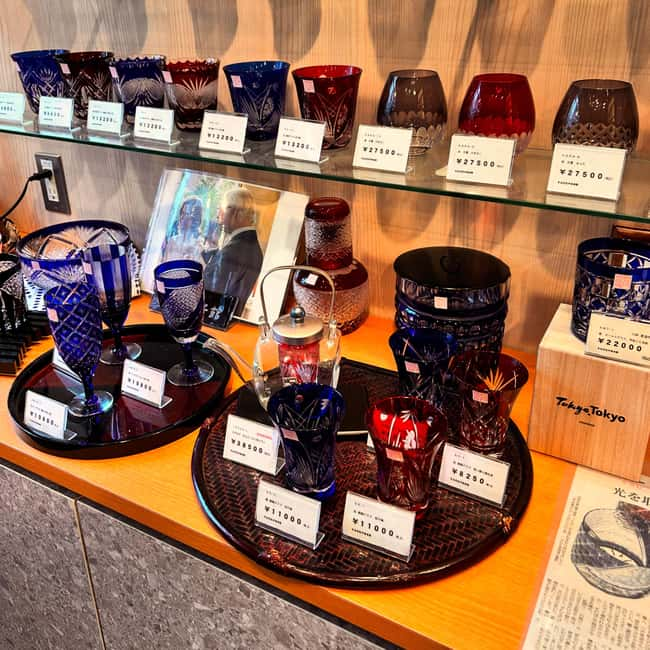
After cutting your own piece, you can browse the on-site Edo Kiriko shop. This is a good chance to see what trained craftsmen can do with more time and precision.
The displays include traditional designs as well as newer products and brand collaborations. Starbucks items are specifically featured, showing how the craft has moved beyond strictly formal tableware while keeping its distinctive cut-glass look.
I would use the shop visit as a comparison exercise. Look at the depth and regularity of the cuts in the finished merchandise, then compare them with your own work. This helps you see the difference between a guided introduction and professional production without taking anything away from your handmade piece.
Shop purchases are not included in the activity price. You can browse without buying, so there is no need to budget for an extra item unless something catches your eye.
Who Will Enjoy This Workshop Most
This experience suits adults, couples, solo visitors, friends, and families with older children. It works especially well for anyone who prefers making something to simply looking at traditional crafts.
The activity is suitable from the fourth grade of elementary school with an adult companion. The information also says it is not suitable for children under nine, so families should follow the age guidance rather than relying only on a child’s interest.
Adults must accompany children. A companion may observe, but cannot cut glass unless booked as a participant. That distinction matters for family planning, since everyone who wants to make a piece needs a place in the small group.
The workshop is wheelchair accessible. It is also entirely indoors, which makes it a practical choice when you want a cultural activity without spending the session outside.
It may be less suitable for very young children, anyone who dislikes careful handwork, or people hoping for a fast and effortless souvenir. The craft rewards patience. You will need to concentrate and accept that your final pattern may not look perfectly even.
Is $122 a Fair Price?
The price is $122 per person. That puts the activity in the premium range for a 90-minute workshop, so the value depends on what you want from your time in Tokyo.
If you only want a glass, buying one from a shop could be cheaper or easier. If you want to understand the process, work in a real studio, receive English support, practice with tools, and make your own piece, the price has a stronger case.
The group size helps justify the cost. Four participants allow for personal attention without turning the session into a mass class. Materials, tool use, a guided demonstration, and the finished glass or container are also part of the package.
I would book it for a special morning or afternoon in Tokyo, not as a casual add-on you squeeze between distant sightseeing stops. The activity lasts 90 minutes, but you also need time to reach Sumida and browse the shop afterward.
Free cancellation is available up to 24 hours before the activity for a full refund. You can also reserve now and pay later, which helps if your Tokyo plans are still shifting. These policies add some flexibility, though they do not change the basic question: you should book because you want the craft lesson, not just because you need an inexpensive souvenir.
Practical Advice Before You Go
Wear clothes that allow you to work comfortably at a studio table. The supplied information does not state a dress code, but you will want freedom of movement while handling glass and tools.
Listen carefully during the safety demonstration. This is a craft activity involving professional equipment, and the practice session is there to help you understand the tools before you work on your selected piece.
Use the practice glass to test your comfort level. Try not to rush toward the final item simply because the first cuts feel exciting. Ask the guide to explain a movement again if you are uncertain.
If you have a child in the group, plan to stay involved. Elementary school children need supervision, and adults accompanying children must remain with them. Younger participants also work on lidded containers rather than drinking glasses.
Photography is permitted only in designated areas. Take a few pictures, but keep your attention on the demonstration and your own work. The cutting process is the part you cannot recreate later from a souvenir photograph.
English and Japanese are available. The Japanese-speaking artisan works with an English-speaking guide, so you can follow the main explanations without knowing Japanese. The translation also gives you a useful bridge into a craft that might otherwise be difficult to understand through observation alone.
My Verdict: Book It for the Making, Not Just the Glass
I recommend the Edo Kiriko workshop if you want a small, focused cultural activity with a physical result. The chance to watch craftsmen at work, practice first, select a changing piece of glass, and cut your own design gives the visit more meaning than a standard shop stop.
The strongest points are the four-person group, the relaxed practice session, and the English support. The main weakness is the price, along with the fact that some beginners may want more active supervision than the free-form approach provides.
Book it if you enjoy careful handwork and want a souvenir you helped create. Skip it if you need a low-cost activity, dislike concentrating on fine movements, or are traveling with children younger than the stated age range. For the right visitor, this is a memorable way to understand why Edo Kiriko pieces command such respect and cost.
FAQ
How long does the Edo Kiriko workshop last?
The workshop lasts 1.5 hours, or 90 minutes.
Where does the workshop take place?
It takes place in an Edo Kiriko glass studio in Sumida Ward, Tokyo, on Honshu.
What languages are available?
The activity offers Japanese and English. An English-speaking guide supports the explanations from the Japanese-speaking artisan.
What will adults make?
Adults and middle school students cut their own drinking glasses.
What will elementary school children make?
Elementary school children decorate lidded containers with supervision.
What is the minimum age?
The activity is suitable from the fourth grade of elementary school with an adult companion. It is listed as not suitable for children under nine.
Can a companion watch without making a piece?
Yes. Companions may observe, but they may not cut glass unless they participate in the workshop.
How many people are in each group?
The workshop is limited to four participants.
Is the workshop wheelchair accessible?
Yes, the activity is wheelchair accessible.
Can I cancel for a refund?
You can cancel up to 24 hours in advance for a full refund. Reserve now and pay later is also available.
New on our Tokyo list
- Sumi-e Experience in a relaxing green tea shop in Tokyo★ 5.0 · 3 reviews
- Tokyo : Kamikaze Street Drift Ride★ 5.0 · 3 reviews
- Private Zen Meditation in English in Shinjuku, Tokyo★ 5.0 · 3 reviews
- Onsen Spa in Tokyo and Asakusa Bar Hopping with Local Guide★ 5.0 · 3 reviews
- Easy for everyone! Now you can play handmade mini shamisen and show off to everyone! Musical instruments, sweets and live music★ 5.0 · 3 reviews
- Tokyo: Private Tsukiji Street Food & Sake with Local Guide★ 5.0 · 3 reviews
- Mt Fuji Exploration Tour with Free Japanese Kusa Mochi from Tokyo★ 4.5 · 3 reviews
- Tokyo Tsukiji Fish Market Walking and Exploring Hidden Gems Tour★ 5.0 · 3 reviews
Workshops, compared.
Sushi Making Tokyo Roll and Authentic Japanese Sushi Class
Read our review →
Roll and Authentic Sushi Making Class in Asakusa
Read our review →
Sushi Making Class in a Happi Coat near a Famous Spot
Read our review →
Tokyo Sushi Making Class in Tsukiji with Professional Chef
Read our review →
Ramen & Gyoza Cooking Class in Tokyo with Local Supermarket Visit
Read our review →
Matcha Making Class in Tokyo with Authentic Japanese Sweets Set
Read our review →Browse the lists this tour appears in