
Reviewed · WORKSHOPS
Tokyo: Traditional foot-kneaded Udon noodles class
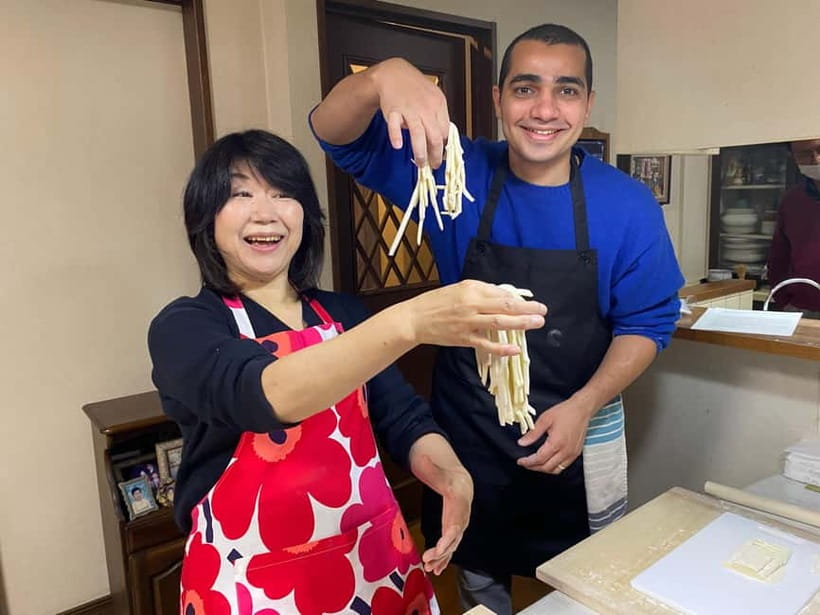
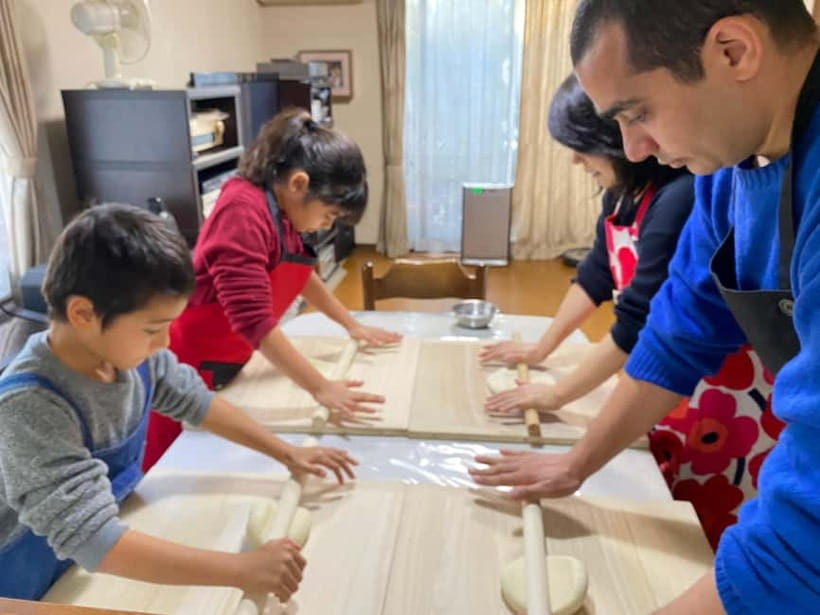
The unusual part comes first: you knead udon dough with your feet. In Izumi’s ordinary home kitchen in Musashino, each person works a dough ball, rolls it with a long pin, and cuts it into thick noodles with a proper udon knife. It is playful, but you also learn a real local food tradition tied to four centuries of wheat farming.
I like the small four-person limit, which gives you hands-on time instead of a quick demonstration. I also like the full meal: you make dashi, cook a hot pork dipping soup, eat it with cold noodles, and finish with matcha and wagashi. The main consideration is the location. You must reach Higashimurayama Station on your own, and the public transport fare is not included.
In This Review
- Key points to know before booking
- Why foot-kneaded udon is worth your time
- Inside Izumi’s Musashino kitchen
- Making the dough, then stepping on it
- Rolling and cutting your own noodles
- Learning dashi, the foundation of the soup
- The reward: Musashino udon with pork dipping soup
- Matcha and wagashi after lunch
- Getting to the house in west Tokyo
- Is $70 a fair price?
- Who should book this class?
- Booking details that matter
- Should you book the Musashino udon class?
- FAQ
- How long does the udon-making class last?
- Where does the activity take place?
- How do I get to the venue?
- Is transportation to Higashimurayama Station included?
- How many people can join the class?
- Is the class available in English?
- Can I book a vegetarian or vegan lesson?
- What food is included?
- What happens if I need to cancel?
Key points to know before booking
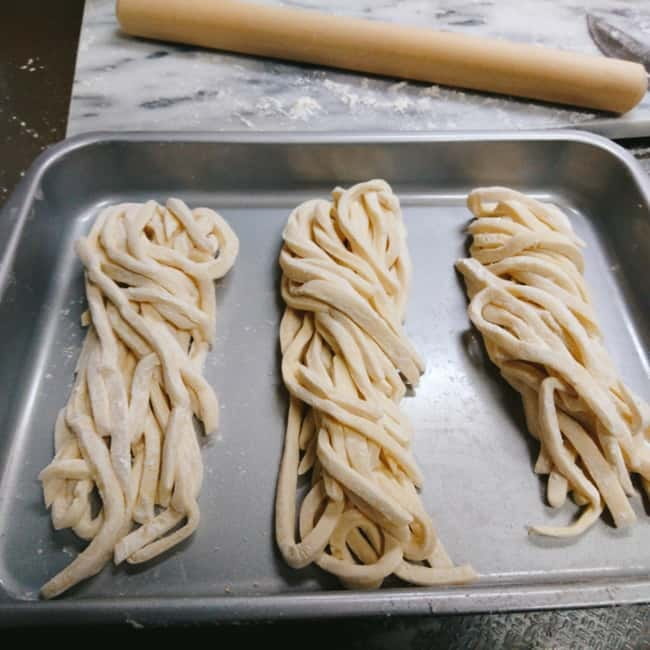
- Foot-kneaded Musashino udon: You make and knead your own dough before rolling and cutting it by hand.
- A real home kitchen: The class takes place in Izumi’s house in the green suburb of Musashino, west of central Tokyo.
- Dashi from basic ingredients: You learn how this essential Japanese stock becomes the base for the dipping soup.
- A complete meal, not just a lesson: Fresh cold udon is served with hot pork soup, giving you a useful contrast in texture and temperature.
- Casual tea at the end: Matcha and wagashi provide a quiet finish after the lively noodle work.
- Vegetarian and vegan options: These are available when arranged in advance, and allergies should also be reported ahead of time.
Why foot-kneaded udon is worth your time
Tokyo offers plenty of polished food tours. This is a different sort of experience. You are not simply watching a chef prepare a familiar dish. You are handling flour, feeling the dough change, and making the noodles that will become your lunch.
Foot-kneading sounds odd until you understand the practical reason. Udon dough needs firm, even pressure. The feet provide that pressure while the dough is protected, so the method is both traditional and amusing. You will likely laugh at the first step, but the work quickly becomes focused.
Each person gets to make their own udon. That matters in a small class because you can see the connection between your effort and the final bowl. If your noodles are uneven, that is part of the lesson, not a problem to hide behind a cooking demonstration.
The class also gives you local context. Musashino, west of central Tokyo, was historically a wheat-growing area, and udon has been made locally for about 400 years. That background helps explain why this is not just a novelty activity borrowed from a television show. It belongs to the area.
A few more Tokyo bookings worth comparing
- Sushi Making Tokyo Roll and Authentic Japanese Sushi Class
★ 5.0 · 3,971 reviews - Tokyo: Roll and Authentic Sushi Making Class in Asakusa
★ 4.9 · 1,957 reviews - Tokyo Shinjuku Chopsticks Making Class
★ 5.0 · 1,763 reviews
Inside Izumi’s Musashino kitchen
The setting is an ordinary Japanese home rather than a large cooking school. That makes the class feel personal and gives you a look at how a food lesson can fit into everyday domestic life.
Izumi leads the session in English and Japanese. Her teaching style is patient and relaxed, with room for questions and conversation. You can also expect personal stories about udon, family, and the local community, details that make the food easier to remember after you leave.
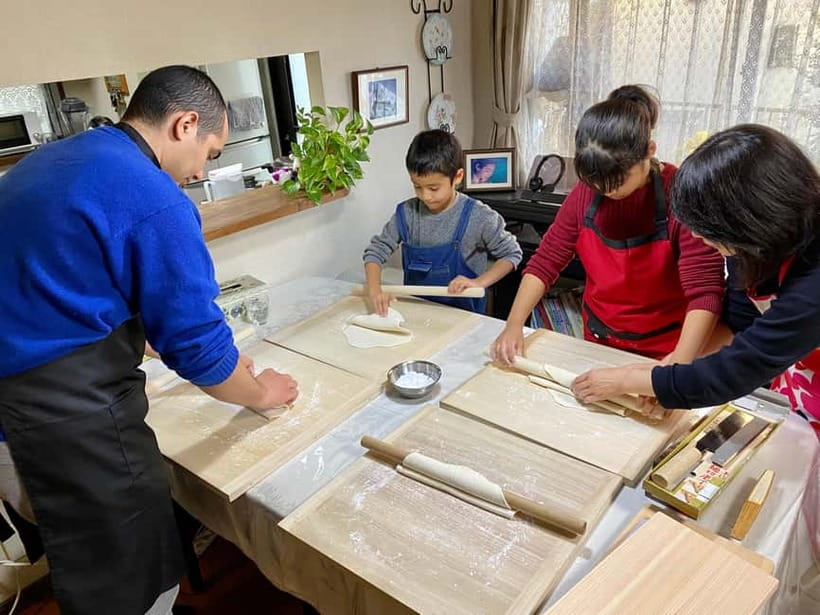
The small group size is one of the strongest practical features. With no more than four participants, you should have space at the work surface and a real chance to use the equipment. In a larger class, the foot-kneading and knife work would become a turn-taking exercise. Here, the point is your own hands-on meal.
The class supplies the ingredients, kitchen equipment, and an apron. Recipes are included, so you can try to recreate the dish later. You should still let Izumi know about allergies or foods you cannot eat before the class begins.
Making the dough, then stepping on it
The first stage is making udon dough. You will work with flour and other ingredients, then prepare the dough for kneading. The exact feel is important: udon dough should become firm and elastic rather than soft like cake batter.
Then comes the memorable part. The dough is covered and pressed under your feet. This is not a race, and you do not need special cooking skill. Follow Izumi’s instructions and let your weight do the work.
The activity has a nice balance of silliness and purpose. You may arrive expecting a photo opportunity, but you soon see why the dough needs repeated pressure. The process is also a good icebreaker if you are sharing the class with other people.
This is the part most likely to suit families, couples, and first-time cooking students. You do not need to know how to make noodles before arriving. The lesson is built around learning by doing.
Rolling and cutting your own noodles
After kneading, you will work with the traditional tools: a large wooden kneading board, a long rolling pin, and a large bowl. The rolling pin helps turn the dough into a broad sheet.
Rolling udon evenly takes more care than it first appears. Too thick, and the noodles can feel heavy. Too thin, and you lose the satisfying chew that makes udon distinctive. Izumi guides you through the process, but you still get the pleasure, and occasional unevenness, of doing it yourself.
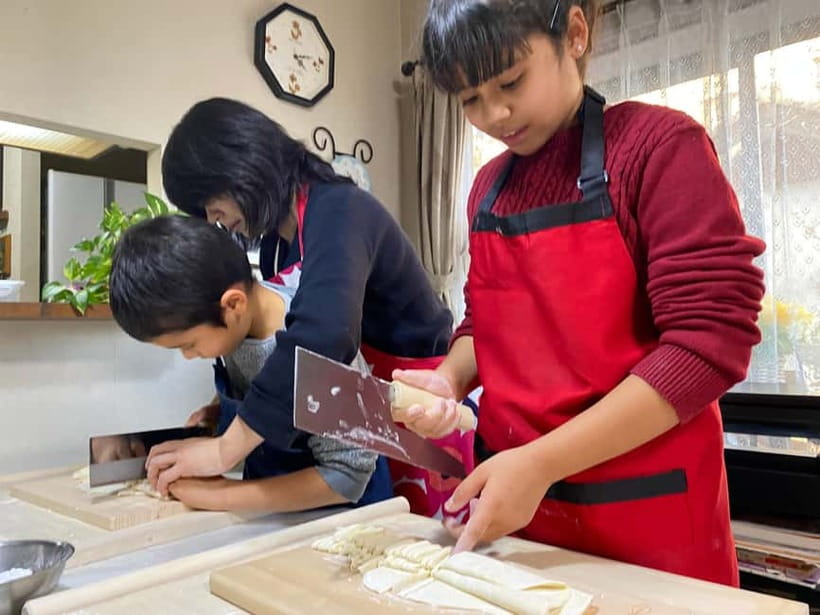
You then fold or handle the dough for cutting and use a special udon knife to create the noodles. This is another useful lesson in texture. Udon should be substantial, and the cut affects how it cooks and how it holds the dipping soup.
The homemade result is not meant to look factory-perfect. That is part of the appeal. You leave with a clearer idea of how much care goes into a food that can look very simple in a restaurant bowl.
Same corner of Tokyo, a completely different plan:
- Mt Fuji and Hakone 1-Day Bus Tour Return by Bullet Train
★ 5.0 · 26,383 reviews - 1-Day Tokyo Bus Tour
★ 5.0 · 14,250 reviews - Tokyo: TOKYO SKYTREE® Admission ticket
★ 4.5 · 11,192 reviews - Tokyo: teamLab Planets TOKYO Digital Art Museum Entry Ticket
★ 4.6 · 9,779 reviews
Learning dashi, the foundation of the soup
The noodle lesson is only half the cooking. You also learn to prepare dashi, a basic Japanese stock used in many soups and sauces.
This is a valuable addition because dashi is one of the building blocks of Japanese cooking. Instead of treating the dipping sauce as a mystery, the class shows you how the stock is prepared before it becomes part of the meal.
With the dashi, you make a hot pork soup commonly served as a dip for Musashino udon. The soup gives the meal its savory depth, while the freshly made noodles provide a cool, firm contrast.
That hot and cold combination is the reason the meal feels more distinctive than a standard bowl of udon. You dip the cold noodles into the rich soup rather than mixing everything into one broth. It lets you notice both parts separately.
If you are vegetarian or vegan, request the appropriate lesson in advance. Do not wait until you arrive, since the soup and stock require planning around ingredients.
The reward: Musashino udon with pork dipping soup
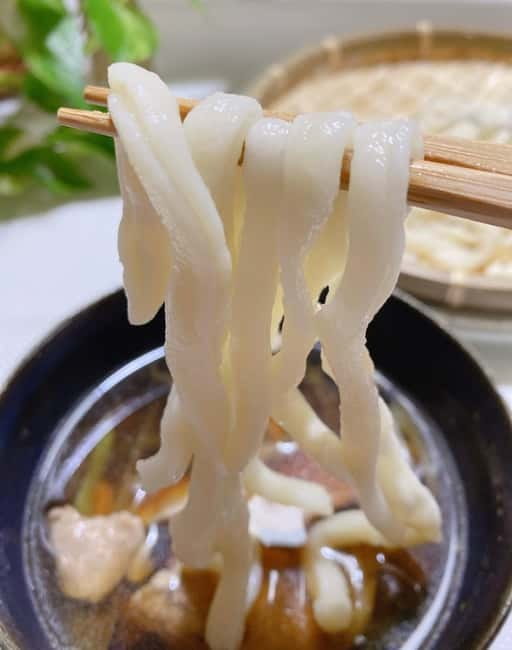
After the preparation, you sit down to eat the noodles you made. This is the moment when the activity becomes a meal rather than a craft project.
The fresh udon should have a firm, chewy texture, and the hot pork soup adds a stronger flavor than a plain noodle broth. The contrast is simple but effective: cool noodles, hot dipping soup, and the satisfaction of knowing you made both the main component and its accompaniment.
I like that the meal reflects the local style rather than trying to cover every Japanese dish in one afternoon. You get one regional preparation and learn it properly. That focus is more useful than a rushed class that includes sushi, tempura, miso soup, and dessert without giving you time to understand any of them.
The meal is also a good point to ask questions. You can discuss the dough, the stock, and how the recipe might change at home. Recipes are provided, though your access to the same ingredients will depend on where you live.
Matcha and wagashi after lunch
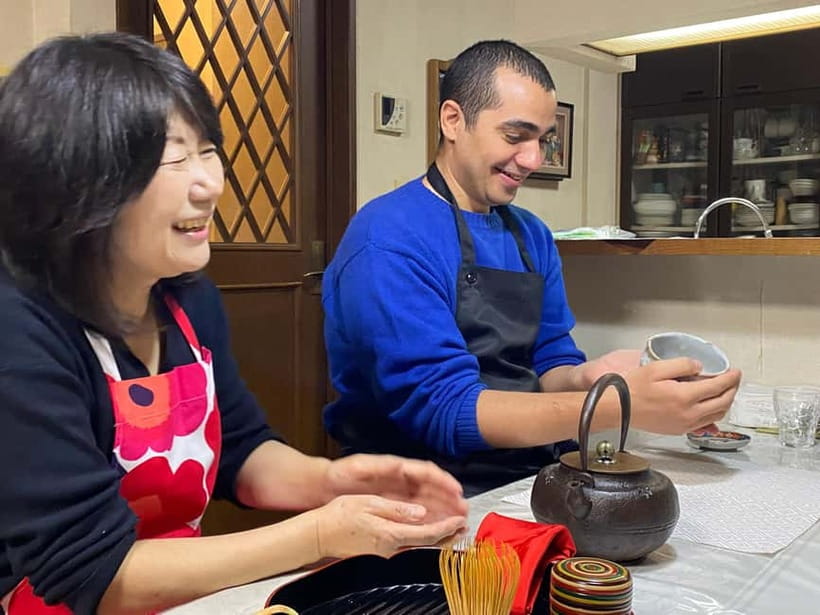
The final part is a casual Japanese tea ceremony. This is not presented as a highly formal tea-school performance. Instead, you relax with matcha and wagashi, traditional Japanese sweets.
The timing works well. After the noisy, physical work of kneading and cutting, tea gives the class a calmer finish. Wagashi adds a small sweet course and helps balance the savory meal.
If you have never had matcha, expect a stronger, more earthy taste than ordinary steeped green tea. The wagashi offers a contrasting sweetness. You do not need prior tea ceremony experience, and the casual format keeps this from feeling intimidating.
This ending also gives you time to talk with Izumi. Her storytelling is an important part of the class, and the tea table is a natural place for local history and personal anecdotes.
Getting to the house in west Tokyo
You are responsible for reaching Higashimurayama Station. The public transportation cost to the station is not included in the $70 price.
Once you arrive at the meeting point, the host gives you a ride to the venue. This is useful because the class takes place in Izumi’s home, not at a prominent tourist site that you can easily identify from a train station.
Allow enough time to reach the station without rushing. The activity lasts 150 minutes, and a late arrival could cut into the dough work, which is the part you came to do.
The west Tokyo setting is a feature for some people and a drawback for others. If your itinerary is built around Asakusa, Shibuya, or Tokyo Station, this requires a separate trip. If you have already seen the city center and want a quieter local neighborhood, Musashino gives the day a different rhythm.
Is $70 a fair price?
At $70 per person, this class is not the cheapest way to eat udon in Tokyo. You can buy a bowl for far less. The value comes from the combination of instruction, equipment, a full meal, tea, a recipe, and direct time with a local host.
The four-person limit strengthens the value. You are paying for a personal cooking session rather than a large commercial demonstration. The ingredients and kitchenware are included, as is an apron and the ride from Higashimurayama Station to the house.
I would see this as good value if you want an activity with a meal built in. It is less compelling if your main goal is simply to sample noodles or save money on lunch.
The class also suits a special afternoon during a longer Tokyo visit. It is long enough to feel substantial at 2.5 hours, but short enough to fit alongside other plans if you allow time for transport.
Who should book this class?
I would recommend it most strongly to:
- First-time cooking students who want clear, active instruction
- Families and couples looking for a funny shared activity
- Food-focused visitors interested in regional Japanese dishes
- People who prefer small groups and personal conversation
- Vegetarians and vegans who arrange their menu in advance
- Anyone who has already seen central Tokyo and wants time in a quieter suburb
It may be less suitable if you dislike touching dough, standing during food preparation, or participating in unusual cooking methods. The foot-kneading is the heart of the class, not an optional side show.
You should also think about the trip to west Tokyo. The host pickup helps once you reach Higashimurayama Station, but you still need to pay for and organize your own journey there.
Booking details that matter
The class runs for 150 minutes, and available start times depend on the date you choose. Instruction is offered in English and Japanese.
Free cancellation is available up to 24 hours before the activity for a full refund. You can also reserve now and pay later, which is useful if your Tokyo schedule is still shifting.
Tell Izumi about allergies or restricted foods in advance. Vegetarian and vegan udon lessons are offered as options, but the request should be made before the cooking day.
The experience provider is Izusha’s WASHOKU Kitchen. The meeting arrangement is simple: make your way to Higashimurayama Station, then meet the host for the ride to the home kitchen.
Should you book the Musashino udon class?
Book it if you want a personal food experience with a strong sense of place. The best parts are the foot-kneading, the small group, and the complete progression from flour to dashi, dipping soup, udon, matcha, and wagashi.
The class is especially worthwhile for people who value stories and conversation as much as cooking technique. Izumi’s warm teaching style, personal storytelling, and lively atmosphere help turn a simple noodle lesson into a memorable afternoon.
Skip it if you only want a quick meal in central Tokyo or if the trip to Higashimurayama feels inconvenient. For everyone else, $70 buys far more than lunch: you get a local tradition, a practical recipe, and the rare chance to make an entire udon meal with your feet and your own hands.
FAQ
How long does the udon-making class last?
The experience lasts 150 minutes, or 2.5 hours.
Where does the activity take place?
The class takes place in the instructor Izumi’s home in Musashino, a green suburb in west Tokyo.
How do I get to the venue?
You must reach Higashimurayama Station using public transportation. The host then gives you a ride from the station to the venue.
Is transportation to Higashimurayama Station included?
No. The public transportation cost to Higashimurayama Station is not included.
How many people can join the class?
The group is limited to four participants.
Is the class available in English?
Yes. The instructor offers the class in English and Japanese.
Can I book a vegetarian or vegan lesson?
Yes. Vegetarian and vegan udon lessons are available as options, but you should request one in advance.
What food is included?
You make Musashino udon, dashi, and a pork dipping soup, then enjoy matcha tea and wagashi, a traditional Japanese sweet.
What happens if I need to cancel?
You can cancel up to 24 hours in advance for a full refund. The activity also offers a reserve-now, pay-later option.
New on our Tokyo list
- Tokyo : Kamikaze Street Drift Ride★ 5.0 · 3 reviews
- Private Zen Meditation in English in Shinjuku, Tokyo★ 5.0 · 3 reviews
- Sumi-e Experience in a relaxing green tea shop in Tokyo★ 5.0 · 3 reviews
- Onsen Spa in Tokyo and Asakusa Bar Hopping with Local Guide★ 5.0 · 3 reviews
- Easy for everyone! Now you can play handmade mini shamisen and show off to everyone! Musical instruments, sweets and live music★ 5.0 · 3 reviews
- Tokyo: Private Tsukiji Street Food & Sake with Local Guide★ 5.0 · 3 reviews
- Mt Fuji Exploration Tour with Free Japanese Kusa Mochi from Tokyo★ 4.5 · 3 reviews
- Tokyo Tsukiji Fish Market Walking and Exploring Hidden Gems Tour★ 5.0 · 3 reviews
Workshops, compared.
Sushi Making Tokyo Roll and Authentic Japanese Sushi Class
Read our review →
Roll and Authentic Sushi Making Class in Asakusa
Read our review →
Sushi Making Class in a Happi Coat near a Famous Spot
Read our review →
Tokyo Sushi Making Class in Tsukiji with Professional Chef
Read our review →
Ramen & Gyoza Cooking Class in Tokyo with Local Supermarket Visit
Read our review →
Matcha Making Class in Tokyo with Authentic Japanese Sweets Set
Read our review →Browse the lists this tour appears in