
Reviewed · TEMPLE & SHRINE TOURS
Tokyo Asakusa Temple & Shrine Walking Tour with Local Guide
Asakusa is where old Tokyo feels easiest to read. This walk links the Sumida River, Kaminarimon’s giant red lantern, Nakamise’s snack stalls, Sensoji Temple, and Asakusa Shrine in one tidy route. The guide also explains the small rituals that are easy to miss when you explore alone, from hand cleansing to fortune slips.
I like the eight-person limit, which should make it easier to hear the guide and ask questions. I also like the practical route: you get famous sights, local customs, and a little orientation for $19.82. The main drawback is the short two-hour schedule. You will see the essentials, but you will not have much time for shopping, lingering, or a long look at every building.
In This Review
- Key points to know before you book
- Why this short Asakusa walk works
- Starting beside the Sumida River at Azumabashi Bridge
- Kaminarimon and the giant red lantern
- Nakamise Shopping Street, snacks, and useful browsing
- Hozomon Gate and the approach to Sensoji
- Sensoji Temple, Tokyo’s major Buddhist landmark
- Asakusa Shrine and the meeting of Shinto and Buddhism
- Temizu, prayer, and omikuji without guesswork
- The small group and the guide make the difference
- Who should book this $19.82 experience
- Booking, cancellation, and final practical notes
- Should you book the Asakusa Temple and Shrine Walking Tour?
- FAQ
- How long does the Asakusa walking tour last?
- How much does the tour cost?
- How large is the tour group?
- Where does the tour begin?
- Where does the tour end?
- Which major sights are included?
- Are temple and shrine rituals included?
- Are admission tickets included?
- Can I cancel for a full refund?
Key points to know before you book
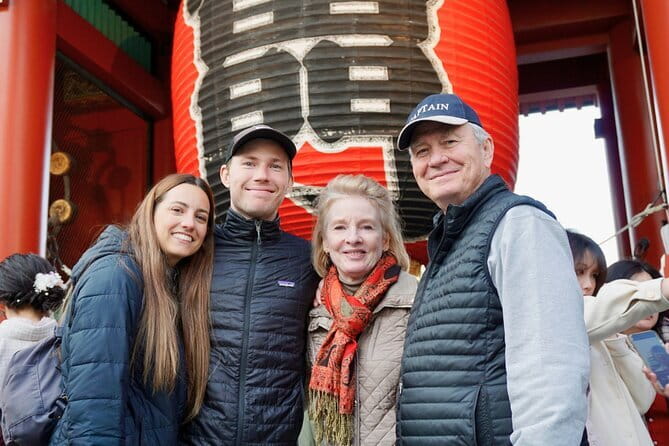
- The route covers Asakusa’s main landmarks: Azumabashi Bridge, Kaminarimon, Nakamise Shopping Street, Hozomon Gate, Sensoji Temple, and Asakusa Shrine.
- The group is capped at eight people: That is a useful size for a walking tour through busy temple grounds.
- Rituals are part of the experience: You can learn about temizu hand cleansing, prayer, and omikuji fortune-telling.
- The price is modest: At $19.82 per person, the tour offers orientation and cultural explanation without an admission fee.
- The guide handles navigation: You do not need to plan the route or decode every shrine and temple custom alone.
- The walk begins and ends near Azumabashi Bridge: The meeting point is Burger King Asakusa Azumabashi.
Why this short Asakusa walk works
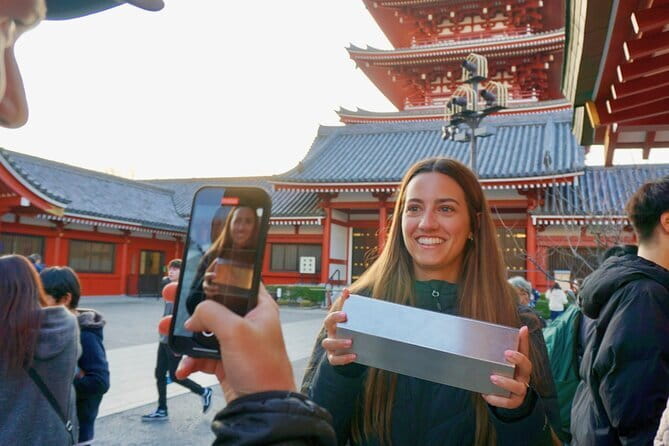
Asakusa can look simple on a map, yet its sights spread across a busy mix of riverfront streets, temple approaches, gates, shops, and courtyards. A first visit can easily become a photo stop at Kaminarimon followed by a quick dash through Nakamise. This tour gives you a clear order and a person to explain what you are seeing.
The emphasis is not just on taking pictures. You learn the difference between Buddhist and Shinto spaces, how to approach a place of worship, and what to do with an omikuji fortune slip. Those details give the famous sights more meaning without asking you to study Japanese religion before your visit.
The tour is listed at $19.82 per person, with admission tickets free. That makes the price reasonable if you want a compact introduction rather than a full-day cultural program. You are paying mainly for the guide’s route planning, explanations, and help with customs.
The value depends on your style. If you already know Sensoji well, you may prefer to wander on your own and spend the money on snacks or souvenirs. If this is your first time in Asakusa, the cost is easier to justify because you can cover the key sights without stopping every few minutes to check a map.
More temples and shrines near Tokyo:
- Tokyo: Meiji Shrine, Asakusa, Skytree Bus Tour and Cruise
★ 4.7 · 1,986 reviews - Tokyo: Asakusa Walking Tour with Sensoji Temple Visit
★ 4.8 · 1,583 reviews - Nikko: Kegon Falls, Lake Chuzenji & Toshogu Temple
★ 4.6 · 1,577 reviews
Starting beside the Sumida River at Azumabashi Bridge
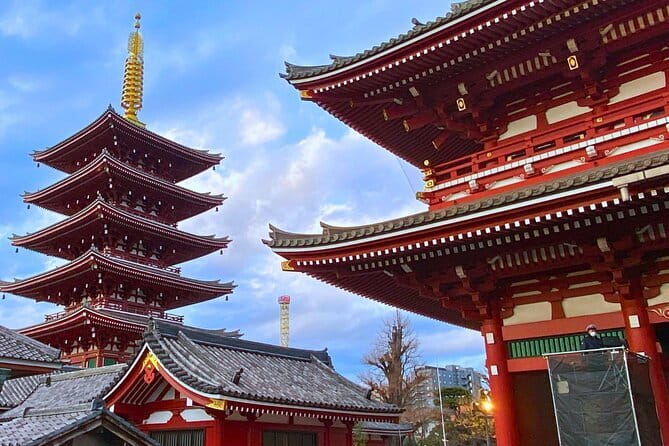
The walk begins at Burger King Asakusa Azumabashi, near Azumabashi Bridge in Taito City. The bridge gives you an early look at the Sumida River and Tokyo’s modern skyline, while the guide sets the scene for Asakusa and its place in old Tokyo.
This opening stop is useful because it puts the historic district in a wider frame. You are not starting inside the temple crowd with no idea where you are. Instead, you get a quick sense of the river, the surrounding city, and Asakusa’s role as a gateway into one of Tokyo’s best-known old districts.
The meeting address is written as Burger King Asakusa Azumabashi, Japan, 111-0034 Tokyo, Taito City, Kaminarimon, 2-chome 20-6, Cross Building Royal Palace. Check the exact map position before you leave your hotel, since meeting near a familiar restaurant is helpful only if you arrive at the correct branch.
Kaminarimon and the giant red lantern
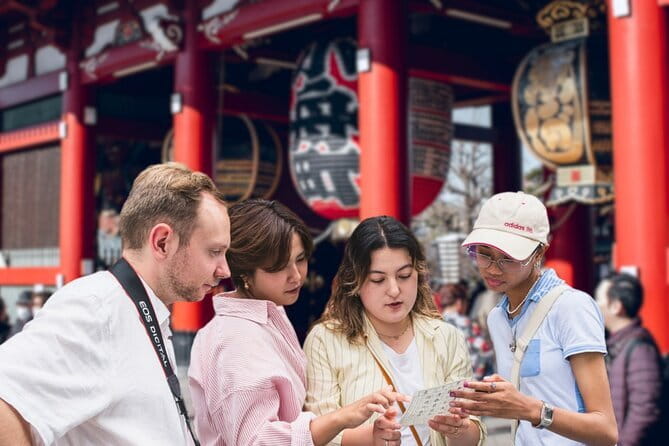
From the river area, the route takes you toward Kaminarimon, or Thunder Gate. This is the dramatic entrance most people associate with Sensoji. Its huge red lantern weighs about 700 kilograms, making it more than a colorful photo prop.
The guide explains the gate’s name, its place in Japanese culture, and the repeated rebuilding caused by fires. That context matters. Asakusa’s major structures have not simply survived unchanged for centuries. Many have been repaired or reconstructed, and the guide can help you understand that ongoing process.
Kaminarimon is also where the tour’s navigation help earns its keep. The gate draws crowds, and people often pause in the middle of the approach for photos. A small group and a guide can help you keep moving while still giving you time to look up at the lantern and the gate’s figures.
Do not expect a quiet introduction. This is one of Asakusa’s busiest points. The tradeoff is clear: you get an instantly recognizable landmark, but you share it with plenty of other people.
Nakamise Shopping Street, snacks, and useful browsing
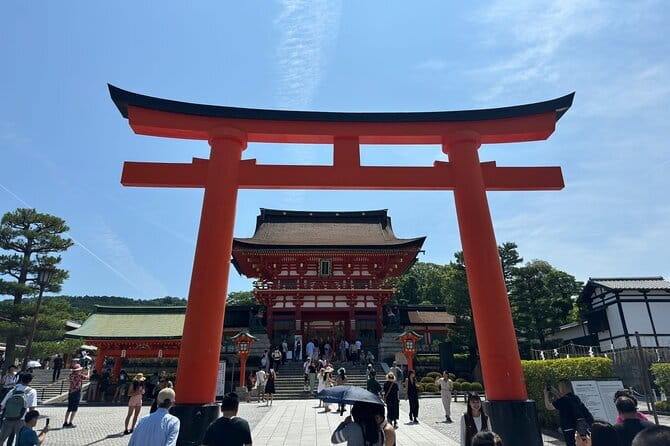
Beyond Kaminarimon, Nakamise Shopping Street leads toward Sensoji. The street is lined with shops selling traditional crafts, souvenirs, and local snacks. Your guide explains its connection with visits to the temple and helps turn a row of storefronts into part of the area’s story.
This is one of the most practical parts of the walk. You can identify foods and small items that might otherwise be hard to understand, and you can note what you want to buy after the tour. Since personal purchases are not included, bring a little extra money if you want snacks or souvenirs.
The timing is the limitation. A two-hour tour cannot give you a leisurely shopping session and still cover the temple grounds. Treat Nakamise as a guided pass with a chance to spot things for later, not as your main shopping outing.
I would save serious browsing for after the walk. The tour ends back at the meeting point, so you can return to the shopping area independently if something catches your eye. That arrangement keeps the group moving and lets you choose how much time to spend in the shops.
More Asakusa visits:
- Tokyo: Japanese Dance Cabaret Theater Asakusa-Kaguwa Ticket
★ 4.8 · 2,270 reviews - Tokyo: Roll and Authentic Sushi Making Class in Asakusa
★ 4.9 · 1,957 reviews - Tokyo Asakusa Rickshaw Tour
★ 5.0 · 1,375 reviews - Tokyo Panoramic 1 Day: Meiji Shrine, Asakusa, Odaiba and SKYTREE®
★ 4.5 · 1,222 reviews
Hozomon Gate and the approach to Sensoji
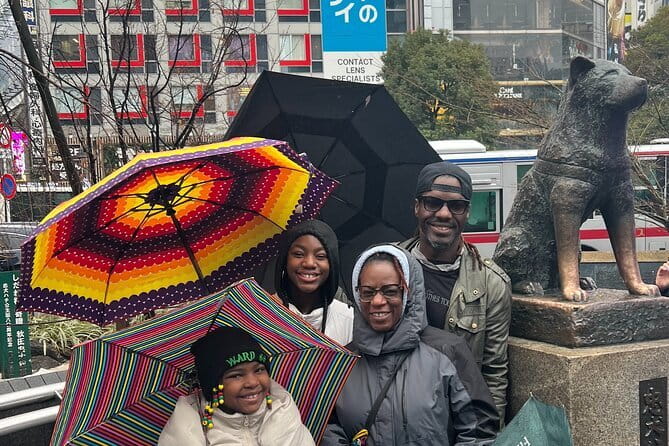
The next major landmark is Hozomon Gate, an impressive entrance that protects the temple grounds. The guide points out its architectural features and symbolism, giving you a better way to look at the structure than simply calling it another large gate.
The approach to Sensoji is part of the experience. Gates mark changes in space, and the sequence from Kaminarimon through Nakamise and Hozomon gradually moves you from a commercial street into the temple precinct. The guide’s explanations help you notice that change.
Sensoji is Tokyo’s oldest and most famous Buddhist temple. Its popularity is both its strength and its weakness. You get one of the city’s essential sights, but the grounds can feel crowded, especially around the best-known viewpoints.
A guide cannot remove the crowds, but can make them less frustrating. You know where you are going, what you are looking at, and why the gates and approach matter. That is better than spending your limited time searching for the next landmark.
Sensoji Temple, Tokyo’s major Buddhist landmark
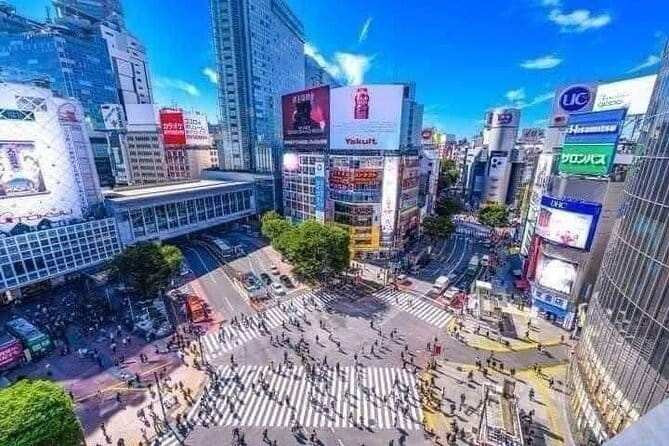
Sensoji is the centerpiece of the walk. The guide explains the temple’s history, cultural importance, and notable architecture. You get the broad story rather than a long academic lecture, which suits a two-hour introduction.
The temple is especially valuable for first-time visitors because it gives you a clear example of how a major Buddhist site functions in daily public life. You can observe the layout, the entrance rituals, and the way people approach the temple for prayer.
Admission is free, so you do not need to budget for a ticket here. The cost of the tour covers the guided experience, not entry to a paid attraction. That distinction makes the price easier to assess: the guide is adding interpretation rather than selling access.
The itinerary information repeats Sensoji several times, but the useful point is simple: expect Sensoji to receive the most attention. The exact balance between explanation and walking may depend on the guide and crowd conditions. If you want an unusually long photography stop or a detailed study of every building, this short tour may feel brisk.
Asakusa Shrine and the meeting of Shinto and Buddhism
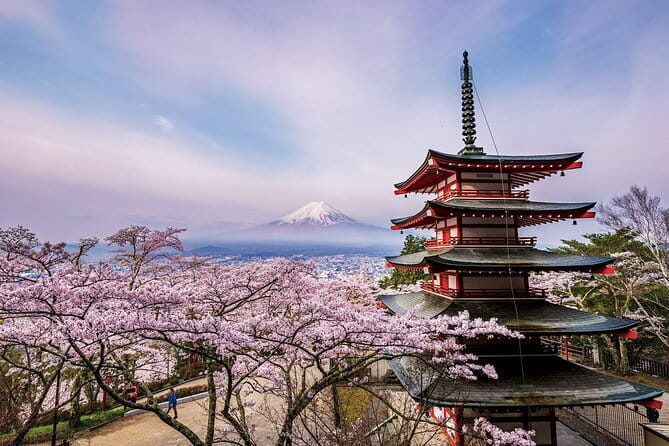
The walk also includes Asakusa Shrine, giving you a chance to compare a Shinto shrine with the nearby Buddhist temple. That pairing is one of the best reasons to choose this route. You are not seeing two unrelated monuments. You are learning how different religious traditions share the same historic district.
The guide explains the cultural blending of Shinto and Buddhism, as well as the rituals connected with each setting. This is where a little instruction helps. Temple and shrine customs can look unfamiliar, and it is easy to copy what others do without knowing why.
You can take part in basic practices such as temizu cleansing and prayer. These hands-on moments make the walk more memorable, but they should be approached with care and attention. Follow the guide’s instructions and watch the people around you rather than treating the ritual as a performance.
The listing does not provide a detailed minute-by-minute schedule for Asakusa Shrine, so do not assume you will receive a long, separate lecture there. Think of it as an important part of the route’s comparison between Buddhist and Shinto traditions.
Temizu, prayer, and omikuji without guesswork
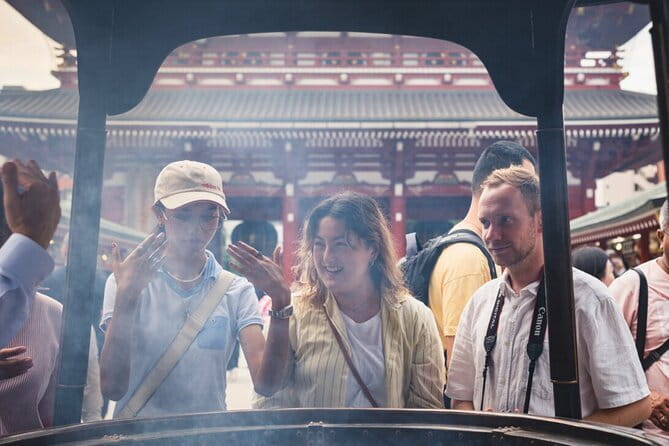
The tour includes explanations of three customs that many first-time visitors find confusing: cleansing, prayer, and omikuji fortune-telling.
Temizu is the hand cleansing ritual performed before approaching a sacred place. The guide shows you the proper process, so you do not have to rely on a hurried imitation of the person ahead of you.
Prayer also differs depending on the setting. A guide can explain the basic approach and help you avoid treating the temple or shrine like a stage set. You still have room to observe quietly and decide how much participation feels right for you.
Omikuji are fortune-telling slips. You can learn how they work and what to do with the result. The information provided does not say that an omikuji purchase is included, so plan on paying separately if you choose to draw one.
These small lessons may be the tour’s best value. A photograph of Sensoji is easy to get. Understanding what you are doing at a temple or shrine is harder to pick up in a few minutes alone.
The small group and the guide make the difference
The maximum group size is eight people. That is small enough for a guide to keep the group together and explain things without shouting across a large crowd. It also gives you a better chance to ask a quick question about a ritual, building, or shop.
The guide is described as a local guide, though one review recounts a very knowledgeable young man from the United Kingdom who was spending a gap year in Japan. That detail is worth keeping in mind. Guide quality depends on the individual person, not just the label attached to the tour.
The same account describes him managing the group well amid the busy streets. That is a useful strength for this route. Asakusa is easy to reach, but the temple approach and shopping street can be confusing when crowded. A calm guide who keeps the walk organized adds real value.
You should still expect some variation. The tour provider is Sunrise Adventure, but no guide’s name is supplied, so you cannot request a particular person based on the available information. The experience is likely to be strongest for you if you value clear explanations and a simple route more than a specialist lecture.
Who should book this $19.82 experience
I would recommend this walk to a first-time Tokyo visitor who wants a quick, affordable introduction to Asakusa. It suits you if you want the main sights arranged in a sensible order and would like help with temple and shrine etiquette.
It is also a good fit for solo visitors or couples who prefer a small group to a large coach tour. The maximum of eight keeps the experience personal without making it private-tour expensive.
Families and older visitors may appreciate the two-hour length, since it offers a focused look at the district without taking up half a day. The activity notes say most people can participate, but the walk is still on foot, so you should be comfortable walking between several nearby sights.
I would be less likely to choose it if you want free time for shopping, a food-focused tour, or a long visit inside one temple. The route is designed as an overview. You can always stay in Asakusa afterward and explore at your own speed.
The tour has a 4.9 rating from 52 reviews and is recommended by 98 percent of buyers. Those figures suggest a strong record, while the specific account of the UK guide also points to an important practical quality: good group management in crowded streets.
Booking, cancellation, and final practical notes
You receive a mobile ticket, and confirmation is provided at booking. The area is near public transportation, which makes the meeting point practical for a Tokyo sightseeing day.
The tour starts and ends at the same meeting point. That is useful if you want to continue shopping or eating nearby, though the provided information does not include a restaurant plan or food tasting.
Free cancellation is available if you cancel at least 24 hours before the experience start time. Cancellations or changes made inside that window are not accepted for a refund, and the cut-off uses local Tokyo time.
Should you book the Asakusa Temple and Shrine Walking Tour?
Book it if you want a low-cost two-hour orientation with the landmarks and rituals handled for you. The combination of Sensoji, Asakusa Shrine, Kaminarimon, Nakamise, and temizu or omikuji guidance gives you more than a simple photo walk.
Skip it if you already know Asakusa or want to set your own pace. The short schedule leaves little room for extended shopping and quiet exploration.
For most first visits, the $19.82 price is fair. You get a small group, a planned route, free entry to the main sites, and help understanding customs that are easy to miss. Arrive ready to walk, keep your shopping for afterward, and use the guide’s explanations to see Asakusa as more than Tokyo’s famous red gate.
FAQ
How long does the Asakusa walking tour last?
The tour lasts approximately two hours.
How much does the tour cost?
The listed price is $19.82 per person.
How large is the tour group?
The activity has a maximum of eight travelers.
Where does the tour begin?
It begins at Burger King Asakusa Azumabashi, in Taito City, Tokyo, near Azumabashi Bridge.
Where does the tour end?
The activity ends back at the meeting point.
Which major sights are included?
The walk includes Azumabashi Bridge, Kaminarimon, Nakamise Shopping Street, Hozomon Gate, Sensoji Temple, and Asakusa Shrine.
Are temple and shrine rituals included?
Yes. The guide explains and includes hands-on cultural practices such as temizu cleansing, prayer, and omikuji fortune-telling.
Are admission tickets included?
The guided walk includes the listed temple and shrine visits, and the admission information states that the ticket cost is free. Personal purchases are not included.
Can I cancel for a full refund?
Yes, if you cancel at least 24 hours before the experience start time. Cancellations or changes made less than 24 hours before the start time are not accepted for a refund.
More Walking Tours in Tokyo
- Tokyo Tsukiji Fish Market Food and Culture Walking Tour
★ 5.0 · 3,184 reviews - Tokyo: Imperial Palace and Shogun Historical Walking Tour
★ 5.0 · 2,251 reviews - Tokyo: Shinjuku Local Bar and Izakaya Guided Walking Tour
★ 4.9 · 1,794 reviews - Tokyo: Tsukiji Fish Market Food and Walking tour
★ 5.0 · 1,724 reviews
New on our Tokyo list
- From Tokyo: Mount Fuji & Hakone Full Day Private Tour★ 4.9 · 25 reviews
- Tokyo Spectacular View Day-Cruise in 90 Minutes★ 5.0 · 25 reviews
- 2.5 Hour-Guided Cycle Tour in the Central Tokyo★ 5.0 · 25 reviews
- Real Tokyo Runner Club : Daikoku Car Meet Night Tour with JDM Car★ 5.0 · 25 reviews
- Ramen Making from Scratch +Akihabara Tour –Cooking Class★ 5.0 · 25 reviews
- [Self-Drive] Tokyo & Daikoku Custom Car Driving Tour★ 4.9 · 25 reviews
- Tokyo: 2-Hour Night Bike Tour of the City’s Hidden Gems★ 4.9 · 25 reviews
- Samurai themed Entertainment show in Shinjuku★ 4.5 · 25 reviews
Temple & Shrine Tours, compared.
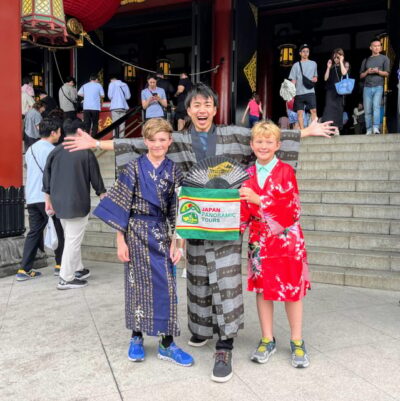
Meiji Shrine, Asakusa, Skytree Bus Tour and Cruise
Read our review →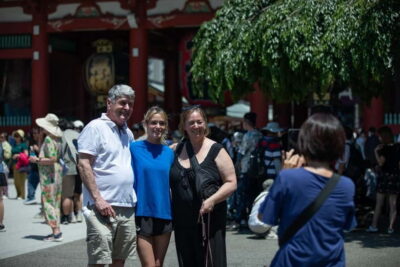
Asakusa Walking Tour with Sensoji Temple Visit
Read our review →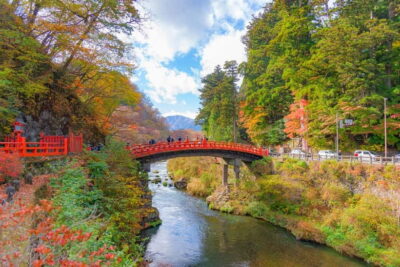
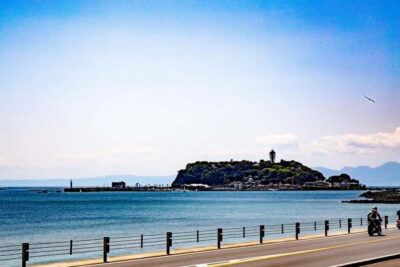
Kamakura & Enoshima Day Trip including Temple Tickets
Read our review →
Nikko Toshogu Shrine and Kegon Waterfall Tour
Read our review →
Tokyo Panoramic 1 Day: Meiji Shrine, Asakusa, Odaiba and SKYTREE®
Read our review →
Mt. Fuji Heritage Tour: Traditional Villages, Lakes & Shrine
Read our review →Browse the lists this tour appears in