
Reviewed · YANAKA & OLD TOKYO WALKS
Half-Day Local Tokyo Tour in Adachi Market and Shibamata
Adachi Fish Market gives you a side of Tokyo that most first-time visitors miss. Instead of heading to the famous Tsukiji area, you start among working seafood stalls, then take a local train to Shibamata, a nostalgic town of old-style shops, temple carvings, and quiet streets. The market is the hook, but Shibamata gives the morning its shape.
I like the small maximum of eight people, which leaves room for questions and makes a market visit far easier than joining a large group. I also like the contrast between enormous tuna, fresh sashimi, and seafood trade at Adachi, followed by sweets, soba shops, Buddhist art, and Japanese-Western architecture in Shibamata.
The main thing to consider is the early start and fixed route. You must reach Senjuohashi Station by 8:00 a.m., food and drinks are not included, and the tour ends at Shibamata Station rather than returning you to your hotel.
In This Review
- Key details before you book
- Why Adachi Market is worth the early start
- The train ride from Senjuohashi to Shibamata
- Shibamata, a slower version of old Tokyo
- Walking Taishakuten-Sando for 200 meters
- Shibamata Taishakuten and its carved walls
- Yamamototei, where Japanese and Western styles meet
- How the guides shape the morning
- What the $91.96 price really covers
- Who should book this Tokyo tour
- Practical details that affect your decision
- Should you book Adachi Market and Shibamata?
- FAQ
- How long does the Adachi Market and Shibamata tour last?
- What time does the tour start?
- Where does the tour begin?
- Where does the tour end?
- Is train fare included?
- Are food and drinks included?
- What is the group size?
- Can I cancel for a full refund?
Key details before you book
- Tokyo’s less-touristed seafood market: Adachi is Tokyo’s only specialized marine-products market, with a more local working feel than the city’s best-known market districts.
- A sharp change of scene: The tour moves from seafood stalls to Shibamata’s 200-meter Taishakuten-Sando, lined with traditional shops and old Tokyo character.
- A guide-led cultural walk: Guides including Kaori, Mutsuko, Megumi, Masayo, Yumi, Mana, Yoshimi, and Fumiko have led this experience.
- Small group, capped at eight: A booking requires at least two people, and the small size suits questions and personal explanation.
- Temple art is a major stop: Shibamata Taishakuten is known for tightly placed wood carvings showing the Lotus Sutra story.
- The $91.96 price includes useful basics: Your guide, local taxes, small-group walk, entrance to Yamamototei, and one-way rail fare are covered.
Why Adachi Market is worth the early start
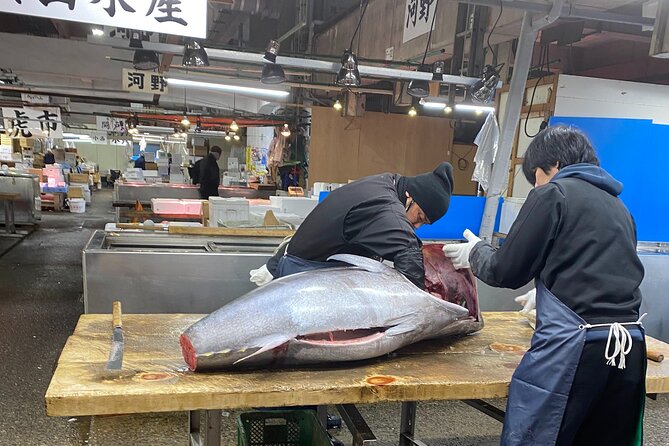
The tour begins at Central Market Adachi Shijo, commonly called Adachi Fish Market. It is described as Tokyo’s only specialized marine-products market, and that alone makes it different from a general food market or a shopping street aimed mainly at sightseers.
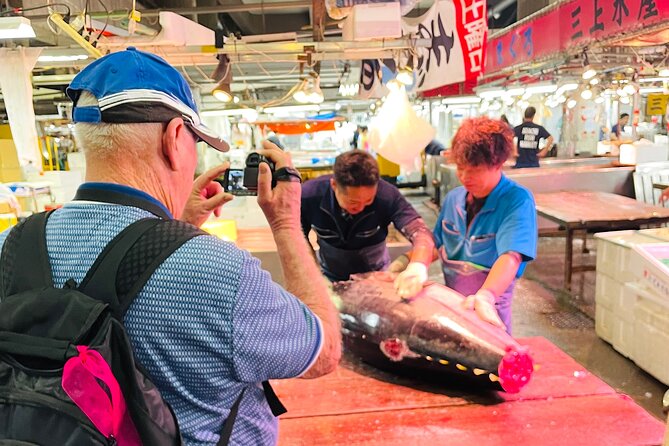
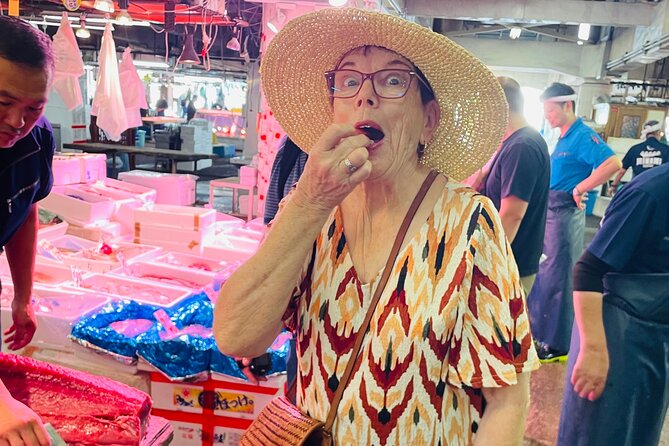
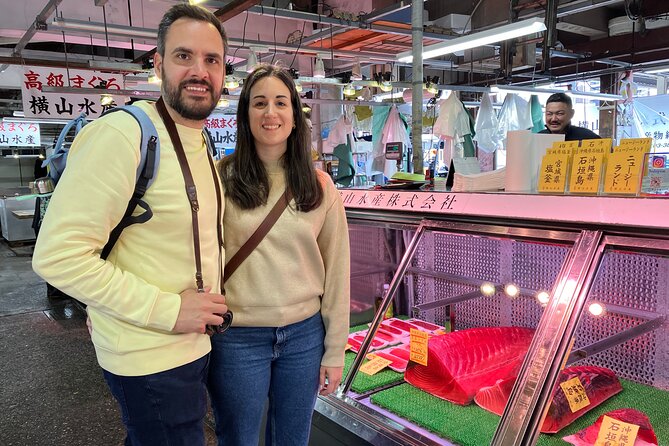
You spend about an hour here. The purpose is not simply to look at seafood. Your guide helps explain what you are seeing, how the market operates, and why the products matter in Japanese food culture. You can expect stalls with fresh sashimi and sushi ingredients, along with large fish and a broad range of marine products.
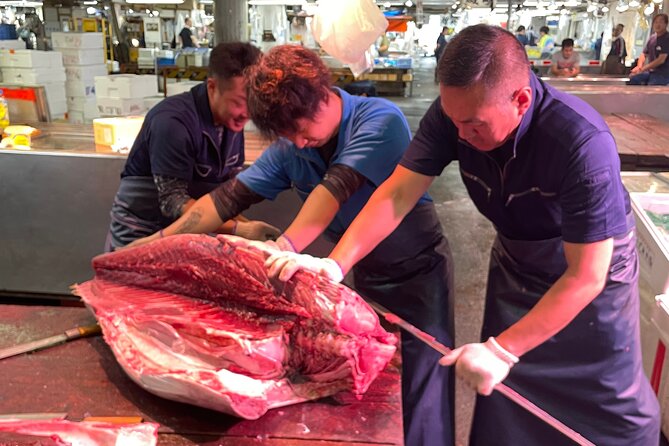
One particularly memorable detail from the tour experience is the sight of enormous tuna. That sort of scale can be hard to understand from a restaurant menu. At the market, you see the size and handling of the fish before it becomes a polished meal.
This is also where having a guide pays off. Fish markets can be visually busy but hard to read on your own. Labels may be unfamiliar, stall activity may move quickly, and it is not always obvious what you are allowed to touch, photograph, or buy. A guide can give the scene context and help you notice details that might otherwise pass by.
Do not expect a long restaurant meal to be part of this hour. Food and drinks are excluded, and the information supplied does not promise tastings or a market breakfast. If eating is important to you, plan to ask your guide what is available or budget separately.
The market is likely to appeal most to people interested in Japanese food, daily commerce, and working neighborhoods. If you only want famous sights and polished shopping streets, it may feel less immediately rewarding. If you enjoy seeing where food culture begins, this is the strongest part of the morning.
More old-Tokyo backstreet walks:
- The Old Quarter of Tokyo – Yanaka Walking Tour
★ 4.5 · 590 reviews - Yanaka Walking Tour: Historic and Traditional District of Tokyo
★ 5.0 · 530 reviews - Tokyo: Old Quarter Yanaka Walking Tour
★ 4.8 · 406 reviews
The train ride from Senjuohashi to Shibamata
The tour includes one-way rail fare from Senjuohashi Station to Shibamata Station. That is a small but useful inclusion. You do not have to work out the fare during the transition, and the train ride connects two parts of Tokyo that feel quite different.
You meet at Senjuohashi Station in Adachi City at 8:00 a.m. The tour does not include hotel pickup, so you need to make your own way there. Private transport by taxi, car, or bus can be arranged for an additional fee, but it is not part of the standard price.
The train transfer also helps the tour feel like a real neighborhood outing rather than a sealed sightseeing package. You begin in a market district, then cross toward northeastern Tokyo and finish in Katsushika at Shibamata Station.
The exact train duration is not provided, so do not build a tight connection immediately after the advertised 4.5-hour finish. The tour ends at Shibamata Station, and you will need to make your own onward plans from there.
Shibamata, a slower version of old Tokyo
Shibamata sits beside the Edogawa River in northeastern Tokyo. The town is known for its old-style atmosphere, and the change from Adachi is part of the appeal.
The visit to Shibamata itself is listed at about 30 minutes before the more focused stops begin. That gives you time to get your bearings and notice the town’s scale. This is not a giant monument complex. It is a place of streets, shopfronts, temple grounds, and local character.
Shibamata is also linked with the fictional character Futen No Tora, known as Mr. Tora, from the long-running Otoko wa Tsuraiyo film series. The bronze statue stands just outside Shibamata Station, where the tour spends about five minutes.
The statue is a brief stop, but it gives the town a useful cultural key. For Japanese audiences, Tora is strongly tied to Shibamata. Even if you have never seen the films, your guide can explain why the character matters and how the town became associated with him.
This is one of the places where a local guide adds more than directions. Several guides associated with the experience, including Masayo and Yumi, have been praised for explaining customs and local culture in clear, accessible language. Kaori has also been noted for careful presentations and language that was easy to understand.
Walking Taishakuten-Sando for 200 meters
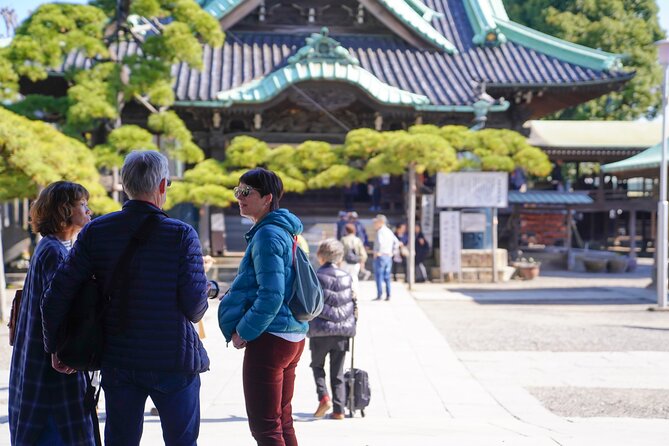
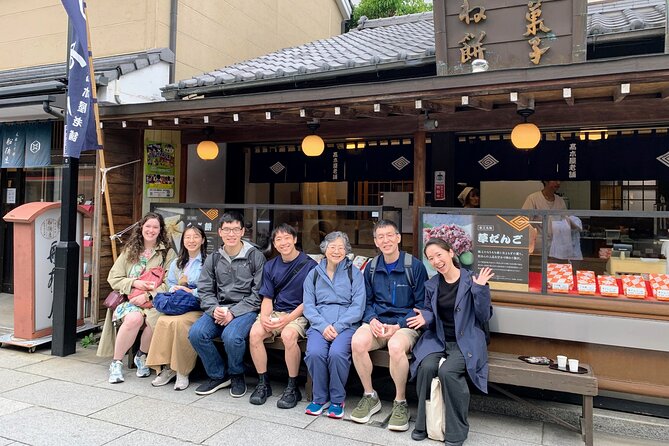
From Shibamata Station, the tour follows Taishakuten-Sando for roughly 200 meters toward the temple. It is a short walk, but it carries much of the town’s personality.
The street has Japanese sweets shops, soba restaurants, and other traditional businesses. You may find it tempting to stop at every storefront, but the tour schedule allows about 20 minutes here. That is enough to look, listen, and understand the street, though not enough for a leisurely meal at several shops.
This is a good place to ask about local sweets or noodle traditions. Since food is not included, any purchase is your responsibility. That gives you freedom to choose rather than paying for a standard meal that may not suit you, but it also means the $91.96 price is not an all-in food tour.
The street works best as a link between the station and temple. It is not a huge shopping district, and anyone expecting a full morning of retail browsing may find the time short. The reward is the sense of moving through a lived-in town with a clear connection to the temple ahead.
A few more Tokyo bookings worth comparing
- Tokyo Tsukiji Fish Market Food and Culture Walking Tour
★ 5.0 · 3,184 reviews - Tokyo: Tsukiji Fish Market Food and Walking tour
★ 5.0 · 1,724 reviews - Tokyo: Tsukiji Fish Market Guided Walking Tour
★ 4.9 · 1,397 reviews - Tsukiji Fish Market Guided Tour and Sushi Making with Pro Chef
★ 5.0 · 775 reviews
Shibamata Taishakuten and its carved walls
Shibamata Taishakuten, also called Taishakuten Daikyoji Temple, receives about 40 minutes. This is the cultural center of the tour and the place where a guide’s explanation becomes especially useful.
The temple is known for intricate wood carvings installed around the main hall. The carvings depict scenes connected with the Lotus Sutra story. Their placement and detail make the building worth careful attention, not just a quick photograph from the front.
You should give yourself time to look closely. The appeal is in the precision of the carving and the way the images cover the structure. A guide can explain what you are looking at and help connect the artwork with Buddhist ideas and temple practice.
The temple grounds also include a garden associated with ikebana, the Japanese art of flower arranging. The supplied details describe the garden as stunning, though the visit remains fairly short. Forty minutes is enough for a guided introduction, but it may feel brief if you like to study every carving or linger in gardens.
Entrance fees for the main tour stops are generally presented as included, with Yamamototei specifically listed as included. The temple stop itself is shown without a separate admission charge. As always with a timed group walk, follow your guide’s schedule rather than assuming you can stay longer.
Yamamototei, where Japanese and Western styles meet
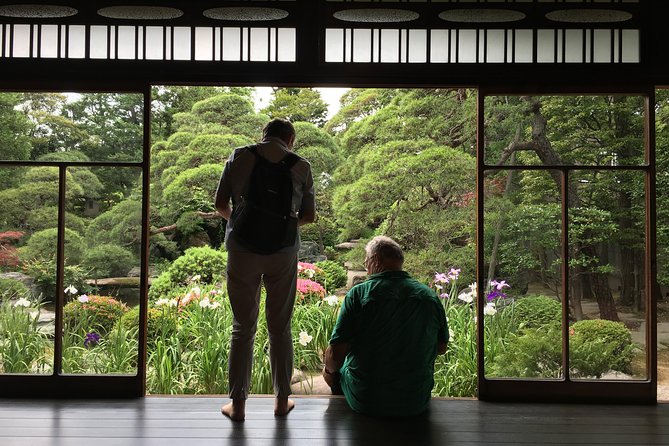
The final major stop is Yamamototei, visited for about 30 minutes. This two-story building combines Japanese and Western architectural elements in a restrained way. It is not simply a traditional house, nor is it a European-style building placed in Japan. Its interest comes from the mixture.
The Nagayamon, or gatehouse, is highlighted for its unusual Western-style details. This gives you another useful contrast after the temple. At Taishakuten, the focus is religious carving and Buddhist art. At Yamamototei, you look at how architectural tastes and building traditions were brought together.
The visit adds variety to the morning. Without it, the route would be mainly market, shopping street, and temple. Yamamototei shows a different aspect of Japanese design and helps explain why Shibamata is valued as more than a single temple stop.
The building is included in the tour price, which improves the value of the package. You receive a guided look at a site you might easily overlook if exploring Shibamata alone.
How the guides shape the morning
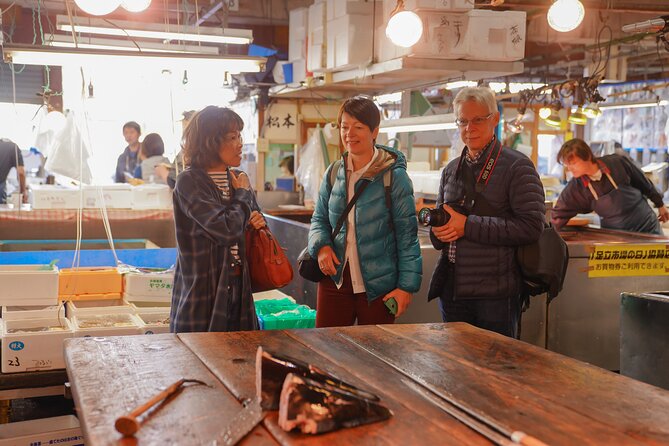
This is a guide-dependent experience. The market, temple, and old street are all accessible without a tour, but their meaning is harder to grasp without someone explaining what you are seeing.
The guide team connected with this tour includes names such as Kaori, Mutsuko, Megumi, Masayo, Yumi, Mana, Yoshimi, and Fumiko. Their strengths described in the supplied material include clear English, friendly conversation, explanations of customs, and willingness to answer questions.
That matters most at the market. A good guide helps you understand the difference between simply seeing seafood and understanding the role of a specialized marine-products market in Tokyo. It also matters at the temple, where carved panels can look beautiful but remain mysterious without context.
The small group limit of eight is a real advantage. One group of six found that every family member could take part, and a private English-speaking version has also been available. The standard experience still requires at least two people per booking, so it is not designed as a solo booking with guaranteed departure.
There is no promise that you will receive a particular guide. You can, however, expect a professional guide as part of the package. If clear communication is especially important to you, mention that when booking and confirm the language arrangements.
What the $91.96 price really covers
At $91.96 per person, this is not the cheapest way to walk through Shibamata. You are paying for a 4.5-hour guided experience, not simply admission to a temple.
The price includes:
- A professional guide
- Local taxes
- A small-group walking tour
- One-way train fare from Senjuohashi Station to Shibamata Station
- Admission to Yamamototei
Food and drinks are not included. Hotel pickup and drop-off are not included either. Private transportation is available for an extra fee, so the standard price works best if you are comfortable reaching the meeting point independently and ending at Shibamata Station.
I see the value in the combination. You get a market that can be difficult to interpret alone, rail travel between two districts, cultural explanation at a temple, and entry to Yamamototei. The price is easier to justify for first-time visitors who want a local guide and would not feel confident planning the route themselves.
You may find it less worthwhile if you speak Japanese, already know Tokyo’s rail system well, and prefer to set your own pace. In that case, the main benefit is the guide’s access to context and local explanation, not transportation.
The tour is regularly booked well ahead, with an average booking lead time of about 64 days. That does not guarantee that every date sells out, but it is a useful sign that you should not leave this one until the final morning of your trip.
Who should book this Tokyo tour
I would choose this tour if you have already seen Tokyo’s central districts or want to avoid the city’s most familiar sights. It suits anyone curious about food, neighborhood life, Buddhist art, traditional architecture, and the quieter edges of the capital.
It is especially good for:
- First-time visitors who want a guided introduction to lesser-known Tokyo
- Food-minded people interested in seafood markets
- Families who prefer a short half-day outing
- Adults who enjoy history, architecture, and local customs
- People who want a small group rather than a coach tour
- Repeat visitors looking for districts outside the standard central route
You should think twice if you dislike early starts, do not want to use public transportation, or need a tour that returns to your hotel. The morning includes several walks and a train transfer, and the end point is different from the start.
The experience is also not built around a long sit-down meal. You can buy food or drinks separately, but the core product is a guided walk with cultural explanation.
Practical details that affect your decision
The meeting point is Senjuohashi Station in Adachi City, Tokyo. Start time is 8:00 a.m., so check your route carefully and allow time to find the correct station exit or meeting area.
The experience lasts approximately 4 hours and 30 minutes. It ends at Shibamata Station, 4 Chome-8 Shibamata, Katsushika City. Since the tour does not include a return transfer, Shibamata can also be a useful place to continue exploring on your own after the guide finishes.
Instant confirmation is advertised, though the additional booking information says confirmation is received within 48 hours and remains subject to availability. A mobile ticket is available, and group discounts may apply.
Most people can participate, according to the supplied information. No special accessibility details are provided, so if you have mobility concerns, ask the operator before booking. The route includes walking through a market, along a traditional street, around temple grounds, and through a building.
Cancellation is flexible up to 24 hours before the start time, with a full refund. Cancellations or changes made less than 24 hours before the tour are not accepted for a refund.
Should you book Adachi Market and Shibamata?
Book it if you want Tokyo with fewer famous-name sights and more local texture. The best pairing is the contrast: enormous tuna and seafood stalls in Adachi, then a quiet old town, Mr. Tora’s statue, Taishakuten’s carved walls, and Yamamototei’s mixed architecture.
The price makes sense when you value a guide who can explain customs and answer questions, especially in the market and temple. Skip it if you want free time, a full food tasting, hotel transport, or a flexible private route.
For the right person, this is a smart half-day choice. It shows you a Tokyo that does not need neon signs or major landmarks to hold your attention.
FAQ
How long does the Adachi Market and Shibamata tour last?
The tour lasts approximately 4 hours and 30 minutes.
What time does the tour start?
The tour starts at 8:00 a.m.
Where does the tour begin?
It begins at Senjuohashi Station in Adachi City, Tokyo.
Where does the tour end?
It ends at Shibamata Station in Katsushika City, Tokyo.
Is train fare included?
Yes. One-way rail fare from Senjuohashi Station to Shibamata Station is included.
Are food and drinks included?
No. Food and drinks are not included in the tour price.
What is the group size?
The tour requires a minimum of two people per booking and allows a maximum of eight people.
Can I cancel for a full refund?
Yes. You can cancel at least 24 hours before the local start time for a full refund. Cancellations or changes made less than 24 hours before the start time are not accepted.
More Half-Day in Tokyo
- Half-day Tokyo Afternoon Tour by Hato Bus
★ 4.0 · 269 reviews - Tokyo: A Half-Day Trip Bus Tour in the Morning
★ 4.6 · 236 reviews - Half-day Tokyo Morning Tour by Hato Bus
★ 4.0 · 220 reviews - Tokyo Private Half-Day Tour with a Local – Secrets & Highlights
★ 5.0 · 53 reviews
More Shopping Tours in Tokyo
- Tokyo: Tsukiji Fish Market Food and Culture Walking Tour
★ 4.7 · 757 reviews - Tsukiji Fish Market: Street Food & Culture Walking Tour
★ 5.0 · 669 reviews - Tsukiji Fish Market Small-Group Food Walking Tour
★ 5.0 · 621 reviews - Tokyo: Tsukiji Fish Market Sushi Making Class with Pro Chef
★ 4.9 · 506 reviews
New on our Tokyo list
- Sumi-e Experience in a relaxing green tea shop in Tokyo★ 5.0 · 3 reviews
- Tokyo : Kamikaze Street Drift Ride★ 5.0 · 3 reviews
- Private Zen Meditation in English in Shinjuku, Tokyo★ 5.0 · 3 reviews
- Onsen Spa in Tokyo and Asakusa Bar Hopping with Local Guide★ 5.0 · 3 reviews
- Easy for everyone! Now you can play handmade mini shamisen and show off to everyone! Musical instruments, sweets and live music★ 5.0 · 3 reviews
- Tokyo: Private Tsukiji Street Food & Sake with Local Guide★ 5.0 · 3 reviews
- Mt Fuji Exploration Tour with Free Japanese Kusa Mochi from Tokyo★ 4.5 · 3 reviews
- Tokyo Tsukiji Fish Market Walking and Exploring Hidden Gems Tour★ 5.0 · 3 reviews
Yanaka & Old Tokyo Walks, compared.
Yanaka Walking Tour: Historic and Traditional District of Tokyo
Read our review →

Small Town in the Big City: Tasting Tokyo’s Kichijoji
Read our review →
Stroll in Old traditional culture towns~Yanaka & Nezu
Read our review →
Yanaka Historical Walking Tour in Tokyo’s Old Town
Read our review →
Private Home Cooking in Yanaka – Local Flavors in a Warm Setting
Read our review →
Browse the lists this tour appears in