
Reviewed · JAPANESE COOKING CLASSES
Asakusa Classic Ramen & Crispy Gyoza Cooking Class
The best part of this Asakusa cooking class is that it tackles two Japanese comfort-food classics in three hours. Masa and Junko guide you through shoyu ramen and handmade gyoza, then you eat a full bowl of ramen and roughly eight dumplings made during the lesson. I like the small maximum of eight people, and I like that you leave with recipes rather than just a pleasant memory. The only catch is that ramen made from scratch has many steps, so you assemble the finished bowl more than you cook every part of the broth yourself.
I also like the clean, real kitchen setting near Kappabashi, Tokyo’s famous chef-supply district, and the warm teaching style. Masa explains the food, cooking methods, and cultural background in clear English, while Junko helps with the preparation and takes photos. Knife work is part of the class, so families with young children should consider their children’s comfort and ability before booking.
In This Review
- Key points at a glance
- Starting at Chagohan Tokyo in Asakusa
- Learning the base of shoyu ramen
- Folding gyoza by hand
- Masa and Junko’s teaching style
- Eating the finished ramen and gyoza
- What the $167.81 price includes
- Who should book this cooking class
- Practical planning for your Tokyo day
- Should you book Asakusa Classic Ramen and Crispy Gyoza?
- FAQ
- Where does the ramen and gyoza class take place?
- How long is the cooking class?
- What dishes will I prepare?
- Are aprons and cooking tools provided?
- What is the maximum group size?
- Are vegetarian or vegan options available?
- What happens if the class is canceled?
Key points at a glance
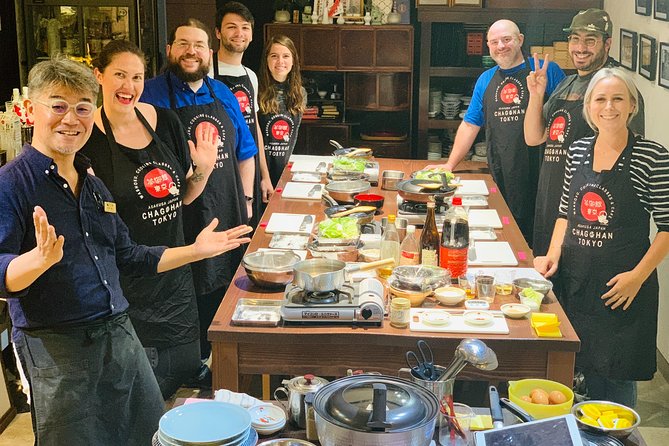
- Two dishes in one class: Prepare ramen components and fold crispy gyoza during the same three-hour session.
- Masa and Junko teach together: Masa leads the explanations and demonstrations, while Junko helps with the cooking and photographs.
- A real kitchen near Kappabashi: The class takes place at Chagohan Tokyo in Nishiasakusa, close to Tokyo’s chef-supply area.
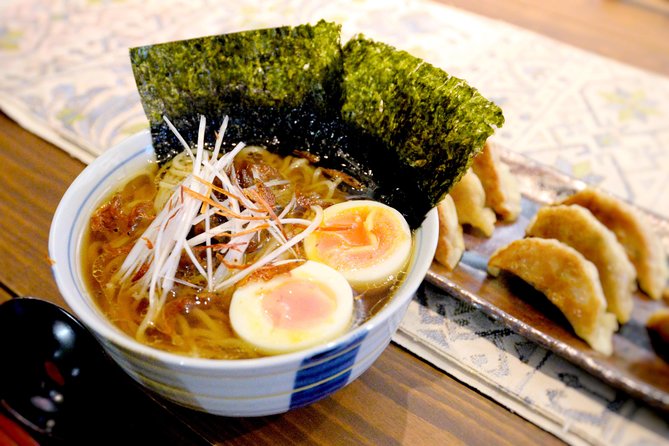
- A meal you actually make: Finish with a photogenic bowl of chicken shoyu ramen and about eight gyoza per person.
- Useful take-home material: Aprons, utensils, ingredients, and digital recipes are included.
- Small and personal: The maximum group size is eight, with vegetarian and vegan choices available if requested ahead of time.
Starting at Chagohan Tokyo in Asakusa
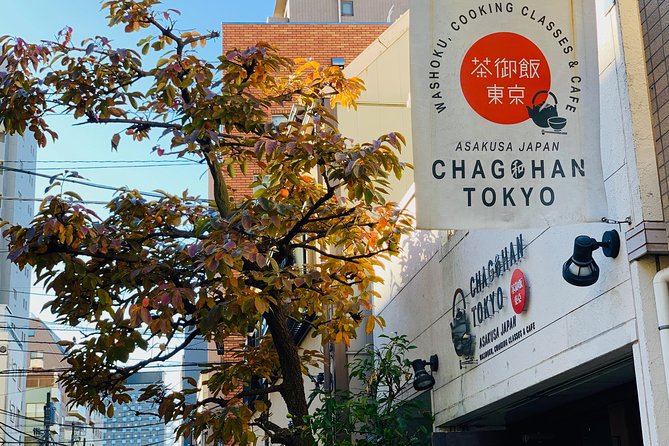
The class meets at 茶御飯東京 Chagohan Tokyo, at 2-17-13 Nishiasakusa, Taito City, Tokyo 111-0035. It begins at 10 a.m. for the morning session or 3 p.m. for the afternoon session, and finishes back at the same location. The listed duration is about three hours, though the timing can shift slightly depending on the pace of the cooking.
The setting matters. This is a proper kitchen rather than a lesson held in someone’s private living room. That gives the class a more organized, practical feel, especially when several people are chopping, mixing, folding, and assembling food at once. The address is near public transportation and in the Kappabashi area, where Tokyo’s shops sell knives, pans, dishes, restaurant signs, and other cooking equipment.
You do not need to arrive with special gear. An apron and utensils are provided, and the ingredients are supplied. Wear clothes you can move comfortably in, but you can come as you are without packing a cooking kit.
The group limit of eight keeps the lesson personal. That is especially useful for first-time cooks who need to see a technique more than once or want to ask questions without holding up a large class. The class also suits couples, families with older children, friends, and small work groups.
More ramen stops:
- Eat and Drink Like a Local: Tokyo Ueno Food Tour-Taverns&Ramen
★ 5.0 · 957 reviews - Ramen & Gyoza Cooking Class in Tokyo with Local Supermarket Visit
★ 5.0 · 823 reviews - Tokyo: Ramen Tasting Tour with 6 Mini Bowls of Ramen
★ 4.9 · 432 reviews
Learning the base of shoyu ramen
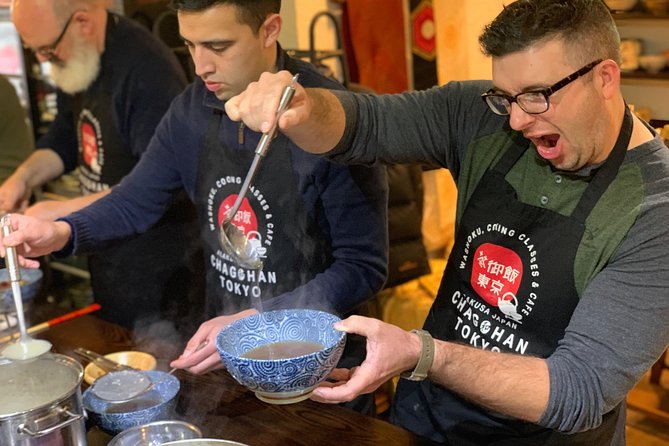
The ramen portion begins with an explanation of the broth and base. This is important because ramen is not one single recipe. Its flavor comes from several parts working together, including the broth, seasoning base, noodles, toppings, and finishing touches.
Masa explains the ingredients and the reasoning behind the preparation. You learn how a flavorful bowl is built, rather than simply dropping noodles into a pot and adding a ready-made soup packet. The class uses natural ingredients and does not use MSG or artificial additives.
That does not mean you personally perform every long cooking step from start to finish. One practical limitation is that the broth takes time and involves many stages. The chef carries out much of the lengthy stock preparation while explaining what is happening, and you later assemble the bowl. If your main goal is to spend three hours simmering a stock from the first ingredient to the last, this class will not quite deliver that.
For most people, this is a sensible trade-off. A fully scratch-made ramen broth needs far more time than a short class allows, while the teaching still shows you how the components fit together. You receive a detailed recipe afterward, so you can try the longer version at home.
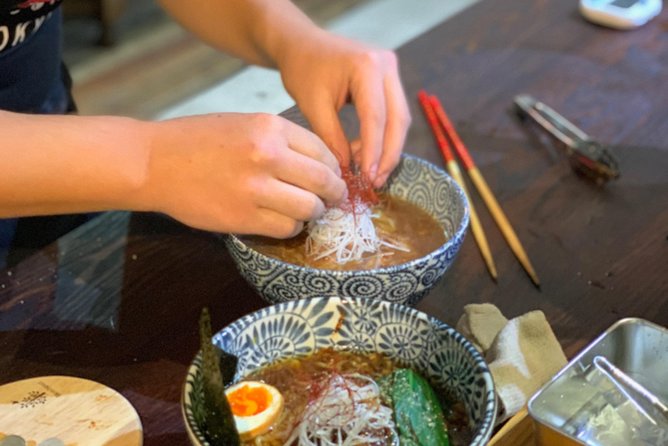
The lesson also covers ramen toppings and the final arrangement of the bowl. You learn that presentation is part of the experience. Once the noodles, broth, and toppings come together, you create a bowl that looks as good as it tastes. The finished ramen is chicken-based shoyu ramen, a style with a savory soy-seasoned character.
Folding gyoza by hand
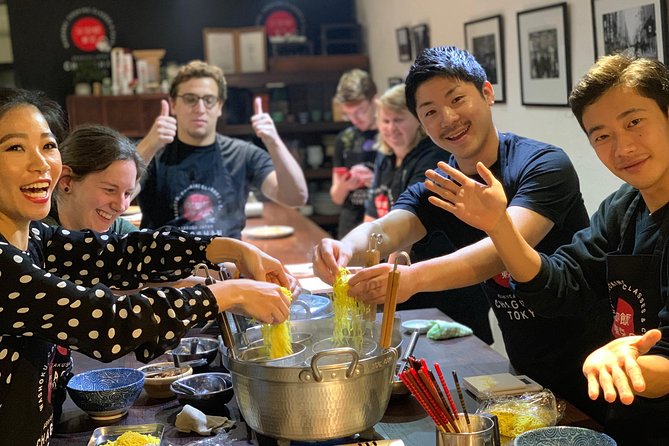
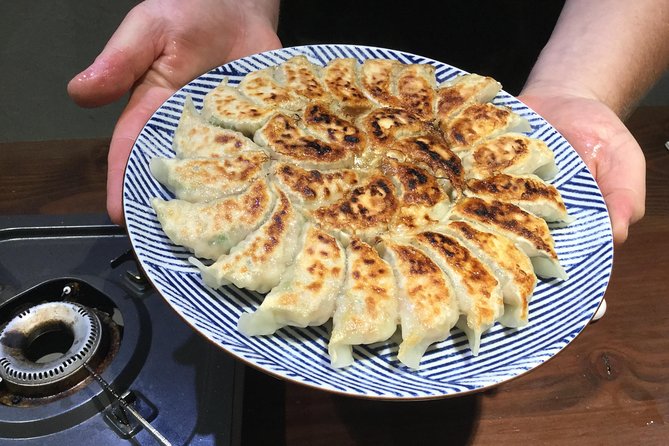
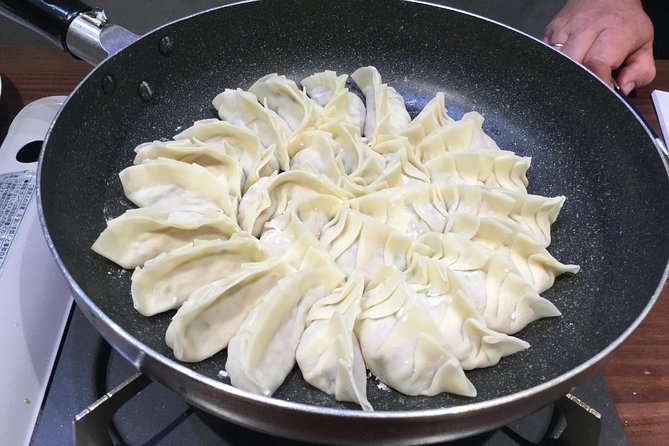
The gyoza segment is the most hands-on part of the class. You help prepare the filling, cut vegetables using Japanese kitchen techniques, and fold the dumplings by hand. The instructors demonstrate the process clearly, then give you time to repeat it yourself.
Gyoza can look simple until you try to seal one neatly. The class breaks the task into manageable steps, making it suitable for beginners while still giving more experienced cooks room to ask about technique. You work toward dumplings that are juicy inside and crisp underneath.
The cooking method is part of the lesson. You learn how to get the outside crunchy without losing the moist filling. That practical detail is one reason the class has value beyond the meal itself. Gyoza are realistic to make at home, unlike some elaborate Japanese dishes that require specialist tools or hard-to-find ingredients.
Knife work is involved when preparing the vegetables. Families should keep that in mind, especially with younger children. Older children and teens can take part, but the class is not simply a demonstration where everyone watches from a distance.
At the end, you eat about eight gyoza along with your ramen. That is enough food to make the class function as a proper meal, not just a tasting. You also get the satisfaction of seeing a dumpling you folded yourself come out crisp in the pan.
Masa and Junko’s teaching style
Masa leads the instruction and speaks English well, which makes the class accessible to international visitors. His teaching covers both technique and context, including the place of ramen in Japanese food culture and the ingredients used in the dishes.
His manner is described as clear, relaxed, and humorous. That matters in a cooking class because small mistakes are part of the process. You need an instructor who can correct a fold or chopping motion without making beginners feel clumsy.
Junko works alongside him and helps keep the session moving. She also takes photos and videos during the class, giving you a record of the experience without requiring you to stop cooking and reach for your phone. This is a thoughtful touch, especially when both hands are covered in dumpling filling or busy at the cutting board.
The couple’s teamwork is one of the strongest parts of the class. Masa handles the main explanations, while Junko provides support and attention around the kitchen. The result is a lesson that feels organized without becoming stiff.
The class also works well for people with different cooking levels. Complete beginners can follow the demonstrations step by step, while confident home cooks can ask about broth, folding, seasoning, or preparation methods. You are not expected to arrive with Japanese cooking experience.
More cooking classes in Tokyo:
- Tokyo: Easy Ramen Cooking Experience in Kabukicho, Shinjuku
★ 4.6 · 321 reviews - Ramen and Sushi Cooking Class with Sake Pairing Set in Tokyo
★ 5.0 · 291 reviews - Tokyo: Wagyu and 7 Japanese Dishes Cooking Class
★ 4.9 · 273 reviews - Tokyo Washoku 4-hour Cooking Class: From Market to Table
★ 5.0 · 253 reviews
Eating the finished ramen and gyoza
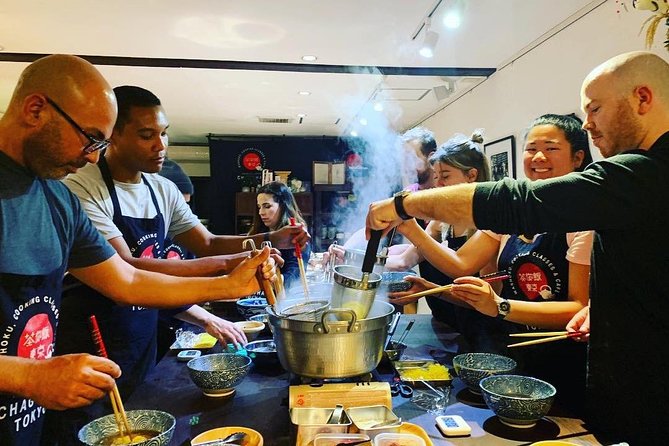
The final meal is the payoff. You assemble a bowl of ramen, add the prepared toppings, and sit down to eat it with the gyoza. The presentation is designed to be photogenic, so you have a chance to photograph the finished bowl before digging in.
The meal is substantial. A full bowl of chicken ramen plus roughly eight gyoza is more than a small sample, so avoid scheduling a large lunch immediately afterward. The class starts at 10 a.m. or 3 p.m., making the morning session a late breakfast or early lunch and the afternoon session an early dinner.
The food also gives you a useful point of comparison for future ramen meals in Japan. After learning about broth, seasoning, toppings, and texture, you may pay closer attention to how a restaurant bowl is put together. That is one of the better reasons to take a cooking class while visiting Tokyo: it changes how you eat during the rest of the trip.
The recipes make the meal more practical. Ramen is the harder dish to reproduce because of the number of stages and the time involved. Gyoza should be more approachable for a home kitchen. You can use the recipe as a guide and decide how closely you want to follow the full process.
What the $167.81 price includes
At $167.81 per person, this is not a bargain meal. You can buy ramen and gyoza in Tokyo for far less. The price makes more sense if you treat the experience as a small cooking lesson, a meal, local food background, and a set of recipes in one package.
You are paying for a maximum group of eight, instruction from two hosts, all ingredients, an apron, utensils, the food you prepare, and the recipe materials. Photos and videos taken during the session add another useful extra. For someone who already plans to spend money on a food activity in Tokyo, the combination is strong.
The value is weaker if you only want to eat ramen. A restaurant is faster, cheaper, and requires no chopping or folding. This class is for you if the process matters as much as the plate, or if you want to take a repeatable skill home.
The average booking point is 27 days ahead, so popular dates can fill well before your trip. The experience is non-refundable and cannot normally be changed after booking. If poor weather or an insufficient minimum group causes the provider to cancel, you are offered another date or experience, or a full refund. Plan carefully before committing.
Who should book this cooking class
This is a particularly good choice for ramen fans who want to understand what goes into a bowl. It also suits people who have eaten gyoza many times but have never learned to fold and crisp them at home.
Families with teenagers are a strong match. The class offers a shared activity, enough food for everyone, and a clear result at the end. Younger children may find the knife work demanding, so parents should judge that for themselves.
Couples and friends will appreciate the small setting and the chance to work side by side. It also works for small company team-building groups, though larger parties of eight or more need to contact the provider directly.
Vegetarians and vegans can request suitable options in advance. Do not wait until the class begins, since the ingredients and preparation need to be arranged ahead of time.
You may want to skip it if your schedule is already packed with expensive tours, if you dislike hands-on cooking, or if you want a fully traditional broth made entirely in front of you during the three-hour session. The class explains the process well, but time limits mean some broth preparation is handled by the chef.
Practical planning for your Tokyo day
The morning class runs from 10 a.m. to 1 p.m. The afternoon class runs from 3 p.m. to 6 p.m. Since the activity ends where it begins, you can pair it with time in Asakusa and nearby Kappabashi.
Allow enough time to locate the meeting point rather than cutting it close. The activity is near public transportation, but Tokyo addresses can still take a moment to match with the correct entrance. The venue is at street level, listed as 1F.
The class does not require you to bring an apron or utensils. Recipes are provided afterward, and the food is prepared with natural ingredients without MSG or artificial additives. If you have dietary needs, arrange them before the date.
The experience is listed as requiring good weather, and the schedule can change slightly based on the day’s conditions and the pace of the group. Confirmation is sent within 48 hours of booking, subject to availability.
Should you book Asakusa Classic Ramen and Crispy Gyoza?
Book it if you want more than a meal and you enjoy learning by doing. The strongest reasons are the small group, Masa and Junko’s friendly instruction, the chance to fold your own gyoza, and the recipes you can use later. The class gives you a satisfying meal while also explaining why the food works.
Think twice if $167.81 feels high for a cooking activity, or if you want every ramen component prepared entirely by your own hands. You will take part in the key steps, but the chef handles much of the lengthy broth work and you assemble the final bowl.
For food-focused visitors, families with older children, and anyone who wants a practical Tokyo memory, this is a strong pick. It is organized, filling, personal, and useful after you return home.
FAQ
Where does the ramen and gyoza class take place?
The class meets at 茶御飯東京 Chagohan Tokyo, located at 2-17-13 Nishiasakusa, Taito City, Tokyo 111-0035. It is near public transportation and close to the Kappabashi area.
How long is the cooking class?
The class lasts approximately three hours. The morning session runs from 10 a.m. to 1 p.m., and the afternoon session runs from 3 p.m. to 6 p.m. The exact duration may vary slightly.
What dishes will I prepare?
You will learn to prepare chicken shoyu ramen components and crispy gyoza. The class includes ramen broth and base preparation, ramen toppings, gyoza filling, vegetable cutting, dumpling folding, and final ramen assembly.
Are aprons and cooking tools provided?
Yes. An apron and utensils are provided, so you do not need to bring your own cooking equipment.
What is the maximum group size?
The maximum group size is eight people. Groups of eight or more should contact the provider through the contact form.
Are vegetarian or vegan options available?
Yes. Vegetarian and vegan options are available with advance notice. Request them before the class.
What happens if the class is canceled?
If the experience is canceled because of poor weather or because the minimum number of participants is not reached, you are offered a different date or experience, or a full refund. Normal cancellations and amendments are non-refundable.
More Workshops in Tokyo
- Sushi Making Tokyo Roll and Authentic Japanese Sushi Class
★ 5.0 · 3,971 reviews - Tokyo Shinjuku Chopsticks Making Class
★ 5.0 · 1,763 reviews - Tokyo: Sushi Making Class in a Happi Coat near a Famous Spot
★ 4.9 · 1,377 reviews - Chopstick Making Workshop in Ginza
★ 4.8 · 1,366 reviews
More Asakusa Visits
- Tokyo: Japanese Dance Cabaret Theater Asakusa-Kaguwa Ticket
★ 4.8 · 2,270 reviews - Tokyo: Meiji Shrine, Asakusa, Skytree Bus Tour and Cruise
★ 4.7 · 1,986 reviews - Tokyo: Roll and Authentic Sushi Making Class in Asakusa
★ 4.9 · 1,957 reviews - Tokyo: Asakusa Walking Tour with Sensoji Temple Visit
★ 4.8 · 1,583 reviews
New on our Tokyo list
- From Tokyo: Mount Fuji & Hakone Full Day Private Tour★ 4.9 · 25 reviews
- Tokyo Spectacular View Day-Cruise in 90 Minutes★ 5.0 · 25 reviews
- Real Tokyo Runner Club : Daikoku Car Meet Night Tour with JDM Car★ 5.0 · 25 reviews
- 2.5 Hour-Guided Cycle Tour in the Central Tokyo★ 5.0 · 25 reviews
- Ramen Making from Scratch +Akihabara Tour –Cooking Class★ 5.0 · 25 reviews
- [Self-Drive] Tokyo & Daikoku Custom Car Driving Tour★ 4.9 · 25 reviews
- Tokyo: 2-Hour Night Bike Tour of the City’s Hidden Gems★ 4.9 · 25 reviews
- Samurai themed Entertainment show in Shinjuku★ 4.5 · 25 reviews
Japanese Cooking Classes, compared.
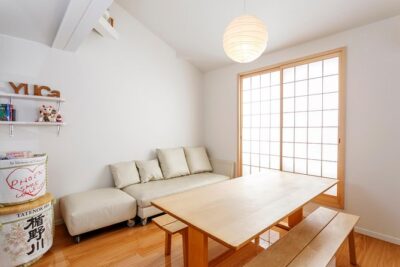
Ramen & Gyoza Cooking Class in Tokyo with Local Supermarket Visit
Read our review →
Easy Ramen Cooking Experience in Kabukicho, Shinjuku
Read our review →
Ramen and Sushi Cooking Class with Sake Pairing Set in Tokyo
Read our review →
Tokyo Washoku 4-hour Cooking Class: From Market to Table
Read our review →
TokyoSumoShow, ChickenHotPot, and Mochi-Pounding by Pro Wrestlers
Read our review →
Professional Ramen & Gyoza with Ramen Chef in a restaurant!
Read our review →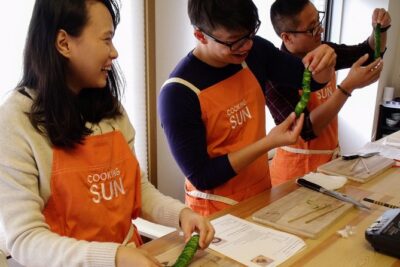
Small-Group Wagyu Beef and 7 Japanese Dishes Tokyo Cooking Class
Read our review →Browse the lists this tour appears in